Get Full Government Meeting Transcripts, Videos, & Alerts Forever!
Get email alerts on the Land Use topic
No spam. Unsubscribe anytime.
Council approves rezoning for Block 1 redevelopment after developer and neighbors negotiate buffer
Summary
The Murray City Council voted 4–1 to rezone a former office complex at 4800 South from general office to RM‑25 multifamily, clearing the way for a townhome‑style redevelopment after the developer agreed to preserve an adjacent R‑1A parcel as a vegetated buffer and to pursue deed‑restrictions to favor owner‑occupied units.
The Murray City Council voted 4–1 on Feb. 18 to amend the general plan and rezone roughly 3 acres of the Spring Pines office property at 4800 South (825–865 East) from general office (G‑O) to RM‑25 (multifamily, high density), clearing the path for a proposed owner‑occupied townhome redevelopment by a private developer, Lotus Companies.
The vote followed a public presentation by the developer and a lengthy Committee of the Whole discussion that centered on preserving an adjacent single‑family parcel and on neighborhood traffic and tree preservation. Council members cast the roll call vote as: Goodman (yes), Turner (yes), Hawk (yes), Pickett (yes) and Cotter (no). The zoning change affects the GEO‑zoned parcels owned by the developer; a neighboring R‑1A parcel to the west was explicitly excluded from the rezoning.
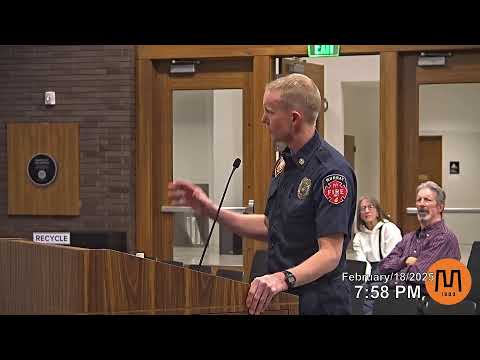
Developer Lotus said it purchased the aging office park in 2016 and showed consultants’ and engineering analyses the company said justify a residential reuse. Presenters told the council that the office product had seen rising vacancy after the 2020 pandemic and that the site lacks the Van Winkle frontage and pedestrian amenities typically needed for successful office or mixed‑use retail. Lotus said its proposed plan would concentrate residential density on the GEO parcel and preserve the neighboring R‑1A parcel as a landscaped buffer. The company also offered to record deed restrictions and homeowners‑association covenants that would restrict a portion — and potentially all — of the future units to owner occupancy rather than allowing unconstrained rental use.
Lotus supplied a traffic‑impact review and a tree survey to city staff and the public; consultants found no “major traffic issues” requiring off‑site improvements, and staff said infrastructure capacity (water, sewer) could be addressed through normal permitting and site design requirements. Neighbors raised concerns about sightlines on 4800 South, mature trees, and vehicle queuing at the Van Winkle/4800 South corridor during peak hours. A neighbor who could not attend submitted written comment urging “live‑work” options and caution about increased traffic.
City planning staff and the planning commission had recommended approval after public hearings. The council and the developer discussed options to ensure owner‑occupancy if council preferred that outcome: Lotus proposed recording CC&Rs and a restrictive covenant that would cap the number of rental units and require owner occupancy for a portion of units, enforced by the HOA and tied to project financing; staff said a formal development agreement could also be used to secure conditions but typically requires more detailed, project‑level commitments.
What happens next: with the zoning amendment approved, the developer and city will proceed to project design and permitting, including site‑plan review, engineering approvals and any short plat or subdivision steps. If the developer records occupancy restrictions, that deed restriction would be recorded on title and would be enforceable as a private covenant; council members noted the city may require any additional guarantees it deems appropriate during project permitting.