Get Full Government Meeting Transcripts, Videos, & Alerts Forever!
Get email alerts on the Water topic
No spam. Unsubscribe anytime.
City staff and consultants present water master plan, impact-fee update and draft rate options
Summary
City consultants presented Murray’s water system master plan, an updated impact-fee analysis and three rate/bond scenarios. Staff recommended a scenario that includes a one‑time bond and phased rate increases to keep cash-on-hand and debt-coverage ratios within policy targets; no formal vote followed at the Committee of the Whole.
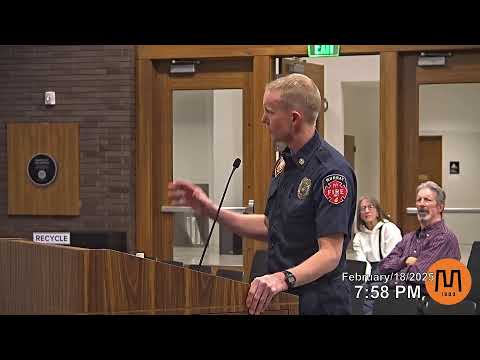
Consultants and Murray staff reviewed a draft water master plan, a paired impact-fee facility plan/impact-fee analysis and three possible rate-and-bond packages during the Murray City Committee of the Whole on Feb. 18.
The presenters outlined long-term system needs including pipe replacement, PRV and hydraulic work, a new well in the city’s southwest to improve pressure and a 100‑year replacement estimate. Staff said the city’s “100‑year scheduled replacement cost is $374,000,000,” and that replacing 1% of system assets annually would imply roughly $3,700,000 a year; the plan’s estimated replacement-target budget is about $3.5 million a year.
Consultants recommended keeping conservative planning baselines (they used 2020 as a planning baseline because that year represents a high‑use scenario) and said 2023 usage was lower than 2020 but had risen compared with the drought years. They described how indoor demand is projected to grow with population and redevelopment while outdoor irrigation demand is expected to be limited by infill and conservation.
On capital priorities, the presentation listed corrosion studies, meter replacement, emergency backup power for key wells, PRV work on State Street and a new well site at Winchester and 12 West. Presenters said a new Winchester well is targeted for design in 2027 and construction in 2028.
Separately, staff reviewed a draft impact-fee facility plan (ISFP) and impact-fee analysis (IFA) required under Utah Code 11-36a. The ISFP assigns shares of new well and pipeline projects to future growth; the IFA translates those shares to proposed fees for equivalent residential units (ERUs), apartments and nonresidential customers. Under the draft IFA, a single‑family ERU fee presented in materials was roughly $3,200 and an example nonresidential 1‑inch meter fee was roughly $3,000 (staff emphasized fees are shown as draft gross amounts before credits for existing funding and bonds).
Staff also presented three rate/bond scenarios intended to maintain capital programs and reserve levels. The consultants’ preferred plan (referred to during the meeting as “Option 3”) would: (a) issue a $6,000,000 water bond to smooth the capital‑spending spike, (b) combine increases to the monthly base charge and the tiered usage rates in early years (large step increases early, then smaller annual inflation adjustments), and (c) thereafter apply modest annual increases (the presenters modeled a 2–3% ongoing escalation after the initial phase). In the materials consultants showed that without rate increases the system’s cash-on-hand would decline sharply.
Presenters and staff discussed tradeoffs: larger bonding delays rate spikes but raises debt service and requires higher coverage ratios; smaller bonds and higher near‑term rate steps reduce borrowing but increase immediate bills. As examples discussed publicly, one draft scenario produced a roughly 20% first‑year increase to combined base-and-usage charges (presenters said a 20% first‑year increase equated to “about $4 a month” for an average single‑family account in materials shown during the meeting), followed by smaller annual escalators. Staff emphasized the plan assumes no reliance on unconfirmed grant revenues.
Separately, Murray staff and consultants discussed wastewater (Central Valley) fees. Staff said the Central Valley fee had been $11 per month and would drop to $8 in April under current structure; staff proposed restoring it to $12 and applying a 3% annual increase on the flow component pending a master‑plan update later in 2025, citing a recent $87,000,000 bond issued for Central Valley upgrades and state timing for plant requirements.
Staff presented several draft ordinance amendments tied to the water program: requiring construction customers to sign up for metered temporary service rather than receiving unmetered construction water; requiring developers to pay meter/AMI equipment costs rather than drawing from operating funds (examples showed a typical 1‑inch meter + AMI cost of about $433); and clarifying minimum service pipe sizes for residential versus commercial properties. Those draft code changes were shown for council direction; no final council action on these drafts occurred at the Committee of the Whole meeting.
What’s next: staff said the IFA/ISFP pair will be finalized and returned to the council with ordinance language and fee schedules for formal consideration. Staff also said design work for priority capital projects (including the Winchester well and PRV/pressure improvements) is underway and that the city is onboarding an asset‑management platform (WaterWorth) to better schedule replacements and refine budgets.