Get Full Government Meeting Transcripts, Videos, & Alerts Forever!
Get email alerts on the School Transportation topic
No spam. Unsubscribe anytime.
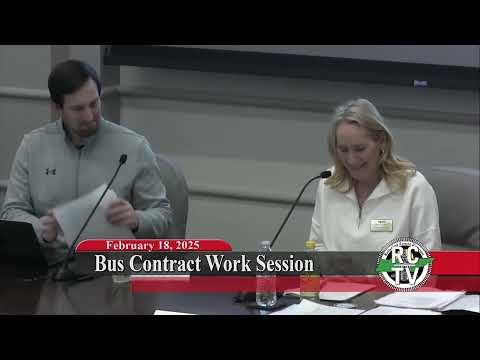
Rutherford County school leaders, contractors negotiate bus contract amid rising costs and safety procedure concerns
Summary
At a Rutherford County Schools work session, staff, bus contractors and an association attorney discussed proposed increases to mileage and seat rates, rising bus and maintenance costs, new insurance requirements, roster timing and emergency procedures after a driver-reported incident.
Rutherford County Schools staff, bus contractors and the contractors’ association attorney met at a work session to continue negotiations over a new multi-year transportation contract, addressing proposed mileage and seat-rate increases, rising bus purchase and maintenance costs, newly required insurance coverage, roster timing for the start of school and emergency-response procedures.
The discussion matters because changes to the contract will affect contractor revenue and operating costs, the county’s transportation budget and how drivers handle on-route emergencies that can affect student safety.
School staff and contractors remain in active talks and have exchanged draft contract text; the board did not take a final vote. Gabriel Ragsdale, the attorney appearing for an association of contractors, said the parties have “exchanged versions” of a draft and are trying to “develop… a uniform contract for all the contractors.” He told board members the association plans follow-up meetings this week to try to reconcile proposed changes and locate supporting invoices showing inflationary cost increases.
Contractors and contractor representatives described sharp increases in capital and operating costs since the last contract. One contractor (identified in the transcript only as a contractor) showed four bills of sale for identical special-education buses, saying a bus purchased in February 2022 cost about $76,180 while an otherwise identical bus purchased in August 2024 cost about $135,000 — a difference the speaker described as about $58,500 for the same model over roughly two-and-a-half years. Contractors also cited manufacturer price increases (Bluebird prices cited as a roughly 52.9% increase and Thomas buses about 48% in the examples shown) and higher labor and parts costs; multiple speakers said labor rates and parts have risen substantially in recent years.
Contractors urged the district to allow more flexibility on vehicle size for some routes. Several contractors asked that the contract permit purchase or use of smaller-capacity buses (for example 78- or 84-passenger models) on routes that do not require a 90-passenger vehicle, saying that would broaden the used-bus market and reduce acquisition costs. School staff noted that capacity calculations reflect three students per seat for larger students and that any change in seat-sizing should be discussed with transportation staff to avoid increasing route counts.
The draft contract includes operational changes contractors said would materially affect fleet needs and costs. Ragsdale and school staff noted a proposed contract requirement that each contractor maintain access to at least one spare bus and a spare driver for coverage; contractors warned that requirement would effectively increase the number of vehicles a contractor must own or lease.
Insurance and liability were discussed in detail. Contractor Christie Crossland (K N K and M Transportation) and insurance agent Ken Halliburton (Miller, Lowry & Beech Insurance) reported that updated insurance requirements in the draft increase premiums sharply. Crossland said a quoted package for three buses — including higher general-liability and umbrella coverage — would cost about $11,008.91 if paid in full (roughly $4,356.33 per bus). If paid in monthly installments Crossland said the quoted total rose to about $13,069. Halliburton said the quote assumed a $4 million combined limit option in his example and that switching to a $1 million limit would reduce the premium; he said workers’ compensation in the example accounted for roughly $2,554 per year of the total. Contractors said some carriers (Erie Insurance, specifically named) have declined to write policies once umbrella/general-liability terms change, forcing contractors to shop other carriers.
Contractors and lenders also raised financing concerns. A contractor noted that banks are tightening loan terms for buses and that some manufacturers or dealers offer in-house financing with higher interest rates, which increases operating costs when contractors must replace or add vehicles.
Operational procedures and safety also drew sustained attention after a driver-related incident described by a bus driver who identified himself as Tyler. Tyler said a student fight on his bus prompted the driver to ask transportation staff multiple times to call 911 because the driver could not safely stop and dial while handling the vehicle; his account said transportation staff told the driver to call 911 herself. Tyler said a school resource officer ultimately intervened and the injured student later received care, and he asked the board to reconsider a procedure that discourages staff from calling 911. “A driver… asked for help three times and did not receive it,” Tyler said, adding that the policy “needs to change.”
Board members and staff discussed whether the restriction on contractors or transportation staff calling 911 is written as an operational procedure rather than a board policy. At least one board member asked staff to review the procedure and whether the sheriff’s office or other first responders had requested the practice. Doctor Solon (identified in the transcript as asking about policy vs. procedure) said the restriction would be a procedure; Doctor Sullivan (transportation/school staff in the transcript) said the sheriff’s office’s response protocols factor into the practice and agreed to follow up and discuss with contractors. Board members also asked staff to review whether the new radio/GPS “red button” on some buses reliably connects to 911 and to clarify device capability across the fleet.
Contractors asked for earlier roster information before the first day of school so drivers are not making “blind pickups.” Christie Crossland asked that the roster delivery window be shortened from 14 days to seven days to better match when contractors secure drivers and prepare routes; school staff explained student-registration patterns make early rosters difficult but said they are willing to work on improved information-sharing.
Board members and staff said negotiations will continue. Ragsdale and school transportation staff said they expect to exchange further drafts and examples, and they plan to return a recommended contract to the board once terms have been finalized.
Votes at the work session were procedural and limited to agenda management: board members voted to approve the meeting agenda by voice and later moved to adjourn. No contract motion or final vote on the contract was taken during the session.
The board directed staff to (a) continue negotiating with the contractors and the association, (b) review the emergency-procedure language about calling 911 and clarify GPS/emergency-button capability with the contractor fleet, and (c) continue exploring options for insurance pass-through or county purchasing power. The board did not adopt contract language at the meeting.