Get Full Government Meeting Transcripts, Videos, & Alerts Forever!
Get email alerts on the County Budget topic
No spam. Unsubscribe anytime.
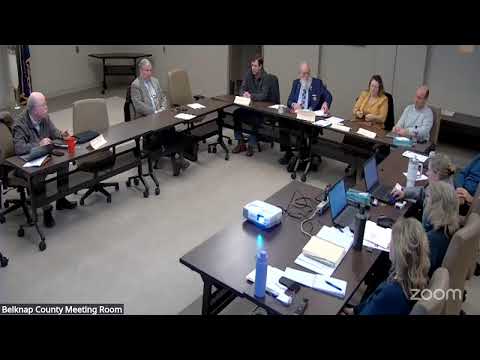
Belknap County panel finalizes budget recommendations, forwards cuts and level-funding to full delegation
Summary
County officials recommended a budget package to the full Belknap County delegation that trims several outside-agency line items, zeroes a maintenance request and keeps restorative justice at its 2024 actual spending level; the package would raise the county tax rate modestly and is scheduled for delegation review on March 12 at 6 p.m.
Belknap County officials agreed on a set of budget recommendations to send to the full county delegation, including cuts to several outside agencies, a temporary removal of a $30,000 maintenance garage line item and a decision to present the restorative-justice program at its 2024 actual-expenditure level rather than at the director’s requested increase.
The recommendation package, presented by the county’s review group after multi-hour discussion, will go to the full delegation for consideration at a noticed meeting set for March 12 at 6 p.m. The panel’s draft shows county spending up modestly and county property tax rates rising by a few cents per $1,000 of assessed value; commissioners described the increase to the tax rate in the discussion as roughly six cents per $1,000 compared with last year’s rate (from $0.99 to about $1.05 per $1,000, as stated in the meeting).
Why it matters: the review committee framed the package as an attempt to keep county operations — nursing home services, public safety staffing and facility maintenance — functional while trimming discretionary outside-agency support. Several commissioners said the choices were difficult and warned the recommendations might face pushback at the delegation level.
Key decisions and line items - Maintenance garage (line 14900): The committee recommended temporarily zeroing out a $30,000 line item for a new county maintenance garage. A commissioner who proposed the cut said he believed a lower-cost alternative (two metal containers and a metal roof) could be found for roughly $20,000 and that the purchase could be re-examined next year.
- Restorative justice program: After extended discussion, the committee decided to present the restorative-justice program at its actual 2024 expenditure level rather than funding the director’s requested increase. The program director detailed program outcomes to the committee, saying, “67 percent of the kids that go through our program have no chargeable offenses within 5 years of completion of the program,” and arguing that diversion saves jail and court costs relative to incarceration and unpaid guardian ad litem work.
- UNH Cooperative Extension (line +14610): The committee debated a requested increase but largely supported forwarding the review committee’s level — the figure discussed in the meeting as $165,000 — for the delegation to consider. Jana Lindblom, the UNH Extension office administrator, told commissioners that “70% of funds come from the UNH side of things… 30% is then from the county,” and stressed county funding is important this year because other UNH funding streams are uncertain.
- Lakes Region Mental Health (line 14660): The committee recommended reducing the agency’s county allocation from the agency’s request (discussed in the meeting as $32,000) to a smaller amount (discussed in the meeting as $16,000) and forwarded that recommendation to the delegation. The agency representative told the committee her organization provided “over $900,000 in charity care last year” and said county support remains important for Medicaid-eligible clients.
- CASA (Court Appointed Special Advocates) of New Hampshire: After hearing that the local CASA program had to refuse 16 children in a prior fiscal year for lack of capacity, the panel nonetheless recommended cutting the county allotment to zero in this recommendation packet. Tara, representing CASA, warned that refusing cases would shift the cost back to the state, because when a volunteer CASA is unavailable a paid guardian ad litem is assigned and the state covers that expense.
Other discussion points - Nursing home staffing and local LNA training: Commissioners discussed the county nursing home’s reliance on agency/travel nurses and a proposal to grow the local LNA (licensed nursing assistant) pipeline by working with a local college. Participants noted class sizes typically cap at eight students and that scheduling and instructor availability had disrupted a planned March cohort; commissioners said they would follow up with local training partners.
- Sheriff’s cell‑phone stipends: Commissioners asked whether deputies need both mobile radios and county-issued cell phones; the sheriff’s office explained the systems serve different operational purposes and that county-issued phones help manage court-related discovery and official communications.
What the committee did not decide: The review group did not make final, binding appropriations; it forwarded a package of recommendations and line-item adjustments to the full delegation for a noticed meeting on March 12 at 6 p.m. Several commissioners warned individual cuts could be challenged by delegation members.
Ending: County leaders said they would take the recommended package to the delegation and continue outreach to members who have expressed concerns. As one commissioner put it, the group tried to balance keeping core county services running and easing taxpayer burden.