Get Full Government Meeting Transcripts, Videos, & Alerts Forever!
Get email alerts on the Municipal Infrastructure And Local Governance topic
No spam. Unsubscribe anytime.
Battle Ground council renames community center, reviews 2025 street preservation and narrows speed‑limit change
Summary
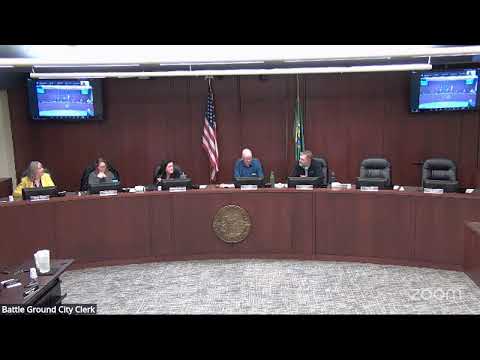
The Battle Ground City Council on Feb. 18 adopted Resolution 25‑01 renaming the Battleground Community Center as the Battle Ground Event Center and reviewed the city’s 2025 street preservation program and proposed citywide speed-limit changes.
Battle Ground’s City Council on Feb. 18 adopted a resolution renaming the Battleground Community Center as the Battle Ground Event Center, and heard staff presentations on the city’s 2025 street preservation program and proposed changes to city speed limits.
Council action The council voted 6–0 to adopt Resolution No. 25‑01 renaming the facility after the Parks, Arts, Culture and Events (PACE) board recommended the change; the council recorded the motion, a second, and unanimous approval following a brief presentation from staff. The resolution passed with Deputy Mayor Bowman excused from the meeting.
“Although the community center is in high demand, often hosting multiple events on a daily basis, it is something of a misrepresentation to call it a community center,” the city’s deputy city manager told the council while summarizing PACE’s recommendation and the municipal code process (Municipal Code Chapter 8.18.100) for renaming city facilities. Supporters noted the change aligns the facility name with its current operation and senior programming updates.
Street preservation: 2025 program and budget Public Works Director Mark Hercic presented the city’s pavement condition and the 2025 street-preservation plan. Citywide pavement condition index (PCI) is 72 on a 0–100 scale; the city maintains roughly 90 centerline miles of streets (about 7 miles of arterials, 17 miles of collectors and 63 miles of local streets). Hercic said unconstrained funding of about $4.5 million per year for five years would raise the network average to the low‑80s and eliminate deferred maintenance, while the city’s then‑current funding level of roughly $1.2 million per year would leave deferred maintenance rising to an estimated $16 million over five years.
For 2025 the proposed program focuses on the southwest portion of the city (neighborhoods south of Main Street around Winchester Ranch and Robinwood). The work package would include slurry- and cape-seal treatments across several subdivisions and replacement of roughly 50 Americans with Disabilities Act (ADA) corner ramps. Hercic said the 2025 package and remaining 2024 work and associated striping/marking contracts total an estimated $2.122 million.
Hercic described the city’s preservation strategy: “maintain the good roads first” to prevent higher future reconstruction costs, an approach the city uses to maximize PCI per dollar. He also told council that some 2024 work did not complete on schedule because a contractor started late and the city is resolving contract issues.
Speed limits: council directs staff toward study‑based option Staff presented three options for revising local speed limits, noting state law sets 20 and 25 mph statutory limits and other limits require engineering studies. Option 1 would set most arterial and collector streets at 35 mph (with some corridors at 40 mph), based on speed-study results; Options 2a and 2b proposed a citywide statutory baseline with more 20–25 mph neighborhood streets and higher signage costs.
Council discussion favored Option 1 — a study‑based system that places most major streets at 35 mph — and several council members asked staff to wait for WSDOT’s input on state highway speeds (502/503/Main Street) before making final changes. Staff estimated sign procurement and installation costs would vary by option (Option 1 roughly $3,500–$4,500 for about 23 signs; Option 2a and 2b higher due to more signs). The council asked staff to return with final materials and recommended implementation language, and to bring the item back for formal adoption in March after WSDOT discussion.
Other notes The council approved routine agenda items and a consent agenda in the meeting’s early business. Council members also heard reports from regional boards: C TRAN’s pending March discussion on language about transit O&M, RTC safety briefings, and an update on EMS procurement discussions at the county level.
What happens next Staff will proceed with procurement planning for the 2025 street preservation contracts (slurry/cape‑seal, crack sealing and markings), develop final cost estimates for speed-limit signage based on the council’s direction, and return with ordinance/resolution language to codify speed-limit changes after coordination with WSDOT on state highways. The newly named Battle Ground Event Center will be reflected in city materials and facility signage per the adopted resolution.