Get Full Government Meeting Transcripts, Videos, & Alerts Forever!
Get email alerts on the Interstate Bridge Replacement topic
No spam. Unsubscribe anytime.
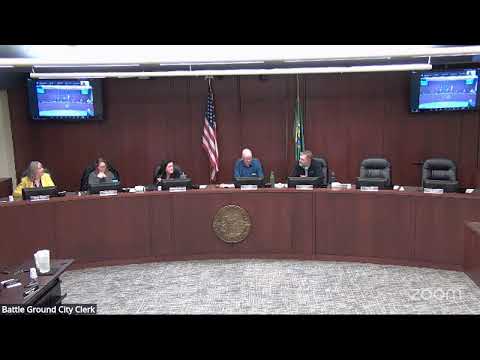
Interstate Bridge Replacement officials brief Battle Ground council on light-rail plan, funding and timelines
Summary
Interstate Bridge Replacement Program leaders told the Battle Ground City Council on Feb. 18 that the modified locally preferred alternative under study would replace the 108‑year‑old I‑5 bridge, modernize ramps and extend light rail from Portland’s Expo Center into Vancouver while the program continues federal environmental review and pursues major grants.
Interstate Bridge Replacement Program officials on Feb. 18 told the Battle Ground City Council that the program’s modified locally preferred alternative (MLPA) studies a five-mile corridor across the Columbia River that would replace the 108-year-old I‑5 bridge, add auxiliary lanes and extend light rail from the Expo Center in Portland to Evergreen Street in Vancouver.
“This project is too important to lay dormant,” Interstate Bridge Replacement Program Administrator Greg Johnson told the council, describing the program’s revival in 2019 after the earlier Columbia River Crossing effort stalled. He said the project is currently in a supplemental environmental impact statement phase and that staff received close to 9,800 public comments during the draft comment period.
Why it matters: program leaders said the corridor carries a high proportion of freight (about 11% of daily traffic) and $132 million worth of goods across the bridge each day, and they presented funding progress, schedule risks and trade-offs that would follow any major change to the studied alternative.
Environmental and design status Program staff said the project builds on work done during the Columbia River Crossing and that the current NEPA process is a supplement to an earlier record of decision. The MLPA under study includes a 5-mile corridor, seven interchanges, and a modern river crossing. Transit investments would include an approximately 1.9-mile light-rail extension with three new stations (Hayden Island plus two stops in Vancouver), integrated bus rapid transit (BRT) connections and express bus lanes using shoulder improvements.
Funding, grants and schedule Frank Green, assistant program administrator, outlined funding the program is seeking and assembling. He said the two states have each identified approximately $1 billion in legislative support in recent sessions, and the program has authority for tolling that staff described as roughly $1.25 billion. Program staff said the region has secured and executed multiple federal awards: a USDOT “mega” grant they identified as $600 million and a Bridge Investment Grant they stated as $1.5 billion; the program is also pursuing the Federal Transit Administration Capital Investment Grant (CIG), a multi-stage process for which the project is in early stages and could receive final CIG funding around 2028 if it advances through engineering.
Program cost estimates and risk Officials presented a 2023 cost range of $5 billion to $7.5 billion and said the program has targeted roughly $6 billion in funding needs. Separately, staff said roughly $5.5 billion in commitments exist at this stage. They warned that if partner communities change the MLPA — for example, replacing planned light rail with BRT or removing a transit component — the environmental work would have to reopen, setting back the schedule by an estimated 1½ to 2½ years and adding an estimated $300 million in inflation/escalation costs; that delay also could push the in‑water construction window beyond the program’s objectives for a 2027 start of key bridge work.
Operations and maintenance questions Green said the FTA CIG process requires a transit operations-and‑maintenance (O&M) plan and that O&M costs remain an open question for the region. He described preliminary service assumptions of trains running every six or seven minutes and said the O&M plan must account for vehicle operations, bridge inspection and maintenance, station operations and security and any park-and-ride or parking operations. Program staff and regional partners have not yet finalized how O&M will be funded.
C TRAN board language and local partner concerns Councillors asked about the role of C TRAN (Clark County’s transit agency) and whether the agency would take responsibility for light-rail O&M. Scott Patterson, deputy chief executive officer at C TRAN, said the C TRAN board removed restrictive language in November 2024 that would have categorically prevented C TRAN from paying light-rail O&M costs; since then, the board considered more permissive language but may revisit a more restrictive position at a March meeting. Patterson said if the board reverts to restrictive language, it would limit one of the region’s options for funding O&M even though other partners might contribute. He and other program staff said those policy choices affect the program’s ability to secure some federal grants that consider local funding commitments for O&M.
Ridership, mode choice and trade-offs Program staff described the MLPA decision to use light rail across the bridge — rather than a bus-only solution — as a regional compromise that links the two sides’ high‑capacity networks and leverages capacity advantages of rail. They cited regional modeling that produced a preliminary combined ridership forecast of about 30,000 daily trips between light rail and express bus in future-year projections. Staff said BRT is an effective mode in many corridors but raised constraints: light rail can carry more passengers per hour and operates on a separated guideway; achieving equivalent separated BRT facilities would require additional guideway that may not attract the same federal capital funding. Staff also described potential express bus improvements that would use bus-on‑shoulder operations through the upgraded corridor.
Traffic, safety and travel-time effects Program presenters said design changes — including auxiliary lanes and consistent 12‑foot lanes with wider shoulders — would improve safety and throughput. Staff estimated congestion hours across the corridor could fall from roughly 10.5 hours per day today to between 2½ and 3½ hours per day after the improvements. They offered a northbound travel-time example in which peak travel time through the corridor could drop from about 40 minutes to approximately 25–26 minutes, a roughly 40% reduction in the modeled scenario.
Public comment and local council concerns During public comment and the council Q&A, some residents and councilors pushed back on light rail and raised cost and voter‑preference concerns. A public commenter, Margaret Tweed of Camas, told the council she opposed light rail on the bridge and cited earlier 2012 countywide votes she said rejected rail. Several council members asked for underlying survey questions and ridership assumptions and stressed the need for clearer O&M funding commitments before the council takes a formal position.
What’s next Program staff said they will return with more refined numbers and invited further questions; they noted the MLPA and funding decisions are regional and require partner consensus. Key near-term milestones identified by presenters include the program’s final environmental work, continued grant development (including the FTA CIG multi-stage process), and pending local partner policy decisions such as the March C TRAN board meeting on O&M language.
Discussion items recorded during the study session are presented as discussion and requests for further information; no legislative action on the IBR program was taken by the Battle Ground City Council on Feb. 18.