Get Full Government Meeting Transcripts, Videos, & Alerts Forever!
Get email alerts on the Surveillance Cameras topic
No spam. Unsubscribe anytime.
Council advances community safety camera ordinance with oversight, audit and limits on live access to residential feeds
Summary
The committee advanced an amended ordinance to regulate the community safety camera network—commonly linked to contractor Fusus—adding reporting, audit language, limits on police live access to residential donor cameras and preservation rules for footage showing force; the bill passed committee after multiple amendment votes.
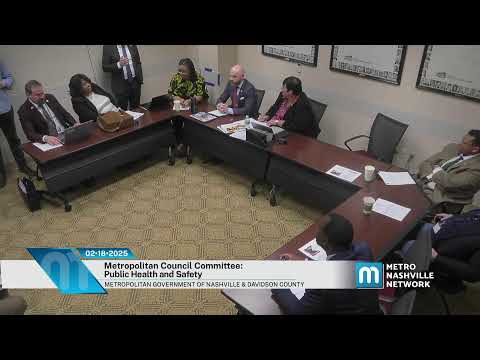
The Metro Nashville Public Health & Safety Committee on Feb. 18 recommended approval of an ordinance (BL2025-690) amending Metro Code section 13.080.08 to regulate a community safety camera network and set use, oversight and reporting requirements. The ordinance addresses public concerns about contractor access, police use of donor cameras and auditability.
Sponsor Councilmember Horton said the bill “establish[es] a legal framework, restrictions and public oversight on the use of any community safety camera network,” specifically naming Fusus and related programs and aiming to balance community privacy with MNPD operational use. The ordinance sets rules about where cameras can point, who may access footage, annual reporting to council and a termination clause allowing council to end the contract if it is misused.
Committee debate focused on residential privacy, homeowner-association participation, multifamily properties and audit independence. Amendment 1 (Councilmember Toomes) would prohibit MNPD access to live feeds from donor cameras installed at residential facilities; the committee recommended Amendment 1 (vote recorded 7 in favor, 3 against, 0 not voting). Amendment 2 (Councilmember Huffman) carved out an explicit exception allowing donor-camera access for non-residential common areas on multifamily parcels—parking lots, garages and outdoor common areas—while preserving privacy protections for private residential entrances; the committee recommended Amendment 2 (6 in favor, 3 against, 1 not voting).
Members also approved audit and reporting language. An amendment to create an independent audit mechanism and require an access log and narrative for each access (amendment 4, moved in the alternative to amendment 3) passed 8 in favor, 0 against, 2 not voting. Another change (amendment 5) requires footage to be captured and preserved when MNPD personnel observe possible excessive or unlawful force via donor-camera access; that amendment passed unanimously (10 in favor, 0 against).
Supporters framed these changes as guardrails that allow MNPD to use the system for public-safety investigations while creating transparency and a contractual termination pathway if the system is misused. Critics raised concerns about equitable treatment across housing types and the legal ambiguity of a “reasonable expectation of privacy.” Legal staff (Director Darby) and MNPD staff said the ordinance would preserve existing prohibitions on camera placement where privacy is expected and that audit records could be electronic rather than handwritten.
After votes on the amendments the committee voted to recommend approval of BL2025-690 as amended; the committee’s recorded recommendation was 7 in favor, 2 against, 0 not voting.
The ordinance amends Metro Code §13.080.08, adds reporting and audit requirements, establishes a notification process for violations, and requires contractual termination language obligating the contractor to permit Council to terminate for misuse. It also specifies limited public disclosure of operational details and requires coordination with Metro Legal on redactions.