Get Full Government Meeting Transcripts, Videos, & Alerts Forever!
Get email alerts on the Education topic
No spam. Unsubscribe anytime.
Senate committee approves bill giving DPI authority to review school compliance and impose sanctions
Summary
The Senate Education Committee on a 6-0 vote amended and passed Senate Bill 2,104 to create a Department of Public Instruction review process for school districts suspected of violating education-related state law, including corrective actions and possible sanctions (up to 2% of state payments) if districts fail to comply.
The Senate Education Committee voted 6-0 to pass Senate Bill 2,104 as amended, establishing a process under which the superintendent of public instruction may review school districts for compliance with education-related state law and issue corrective actions and sanctions if districts do not comply.
The amendment to the bill, discussed and drafted with the Attorney General’s Office and the Department of Public Instruction (DPI), replaces language about “guidance” with a formal corrective-action process, defines the scope of statutes subject to review, and clarifies timelines and enforcement options. "For the record, Lisonbee Hicks, with the Attorney General's Office, General Counsel Division," said during the committee discussion, explaining the drafters' reasoning. "If you fail to comply what gets issued to impose the sanction would be a corrective action."
The bill allows the superintendent to open a review based on (1) an allegation of noncompliance submitted by a resident or parent; (2) a majority vote of a school board alleging noncompliance; or (3) a written request from a county superintendent of schools. The amendment defines “education-related state law” as Title 15.1 except for chapters 15.1-15 and 15.1-16 (those chapters were excluded because they relate to teacher negotiations). The committee adopted clarified language that makes the superintendent's authority discretionary: the superintendent "may" conduct reviews and may tailor the scope of a review.
When a review is opened the superintendent must notify the school district superintendent and the district board and include (1) a description of the alleged noncompliance, (2) copies of documents submitted alleging noncompliance, and (3) the anticipated scope and estimated timeline of the review. DPI may request and review information from the district. The bill requires DPI to issue either a corrective action with a timeline and suggested remedial steps or a letter of compliance no later than 90 days after notifying the district.
If a district fails to comply with a corrective action, DPI may issue a written warning; if the district remains noncompliant 30 days after that warning, the superintendent may impose sanctions. The amendment clarified the chain of events so sanctions are tied to failure to comply after a warning rather than automatically applying after multiple corrective actions. Sanctions are not limited to withholding funds; the amendment states sanctions may include "deducting up to 2% of the total state payments to which a school district is entitled for that school year from the subsequent payment distribution under section 15.12701 for each corrective action issued except the first," and also may include probation or reporting requirements. The committee discussion repeatedly emphasized the superintendent's discretion in selecting appropriate remedies.
The bill also provides that a district may request a hearing before the superintendent if it files a written request within 10 days of receiving a corrective action or sanction; hearings would be conducted under chapter 28-32 (Administrative Agencies Practices Act) unless another law applies. If the department prevails in an adjudicative proceeding, the department may assess hearing costs, including reasonable attorney fees and expenses, against the district. The bill directs DPI to provide a form residents may use to submit allegations of noncompliance limited to residents who are qualified electors of the district or who have a child enrolled in the district. A district must cooperate with a DPI review to the full extent allowed by law; failure to cooperate may itself be considered noncompliance under the bill.
Committee members asked several clarifying questions during the debate. Some senators sought to ensure that minor technical violations would not trigger harsh fiscal penalties; drafters emphasized that the amendment uses the word "including" before the 2% withholding language to signal that withholding is one available sanction among others. The drafters also said the amendment is modeled on existing DPI compliance review practices in the administrative code and is intended to give the superintendent discretion to avoid "stacking" sanctions when districts cure violations.
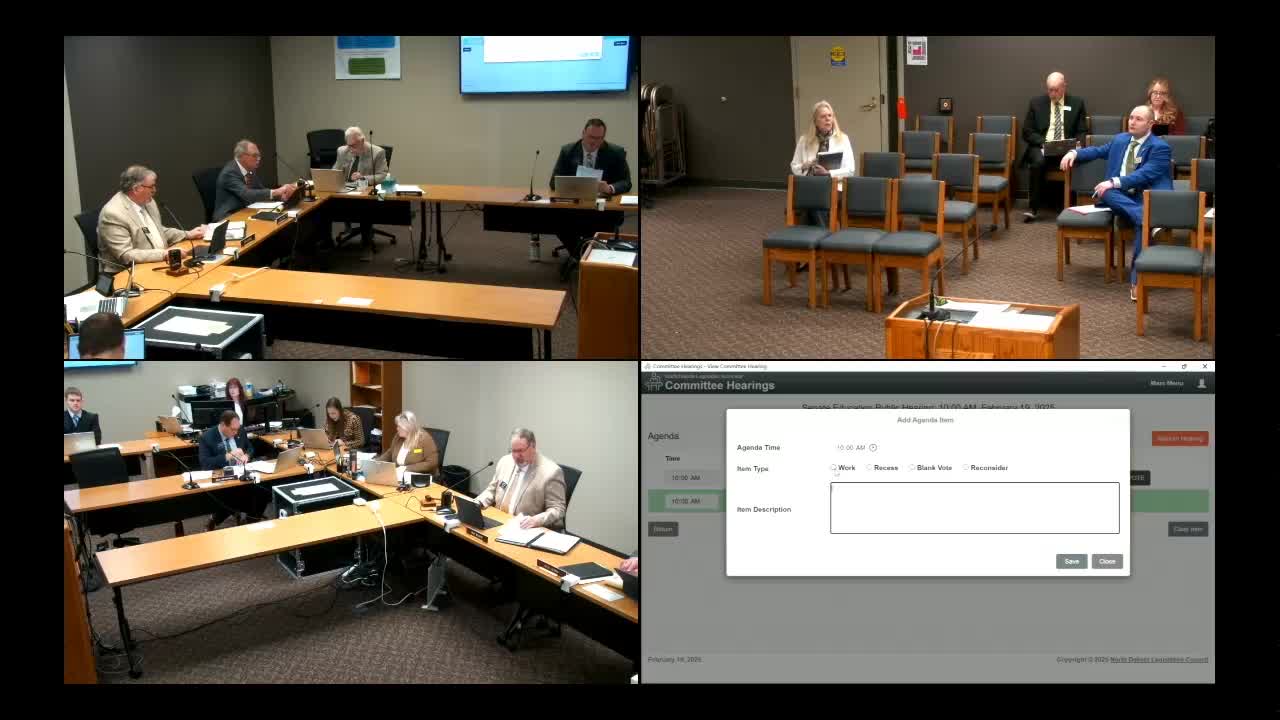
The committee adopted the amendment (identified in committee discussion with two amendment numbers during the meeting; the clerk recorded the motion and amendment on the record) and then approved the bill as amended. The amendment vote was 6 yeas, 0 nays; the final vote on Senate Bill 2,104 as amended was 6 ayes, 0 nays. The committee clerk said the committee will forward the measure with the committee’s actions recorded.
The bill makes changes to how DPI may enforce certain state education requirements; it does not apply to chapters 15.1-15 or 15.1-16, and the bill preserves existing statutory enforcement mechanisms that specifically provide alternative remedies. The measure also preserves procedural protections for districts by allowing hearings and, in some cases, fee-shifting for prevailing regulated parties under the Administrative Agencies Practices Act when applicable.