Get Full Government Meeting Transcripts, Videos, & Alerts Forever!
Get email alerts on the Education Attendance topic
No spam. Unsubscribe anytime.
Appropriations subcommittee hears HHS briefing on truancy, CHINS and a proposed $750,000 grant amendment
Summary
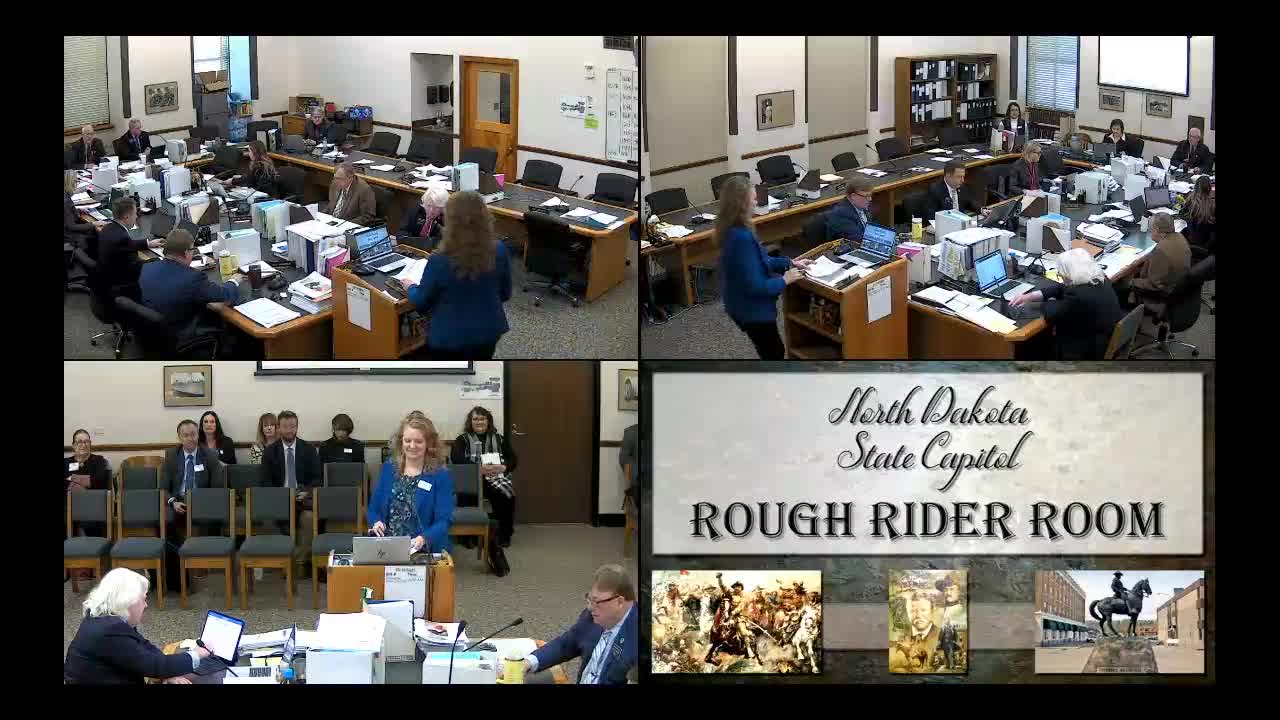
Chairman Nelson opened the HR section meeting and invited Jessica Thomason of the Department of Human Services (HHS) to brief members on how educational neglect, truancy and chronic absenteeism relate to CHINS (Children in Need of Services) and on gaps in local diversion services.
Chairman Nelson opened the HR section meeting and invited Jessica Thomason of the Department of Human Services (HHS) to brief members on how educational neglect, truancy and chronic absenteeism relate to CHINS (Children in Need of Services) and on gaps in local diversion services.
Thomason explained there are three distinct, though overlapping, categories used in practice: educational neglect (treated as part of the abuse-and-neglect spectrum at younger elementary ages), truancy (a willful absence once a child reaches the age at which they should be able to attend independently) and chronic absenteeism (commonly measured nationally as missing roughly 10% of school days). She also told the section that North Dakota’s compulsory attendance law covers ages 7 through 16 and described how referrals are routed: educational-neglect reports go to child protective services intake, while truancy often comes to CHINS for voluntary diversion and service connection.
Thomason summarized available data from CHINS casework: a large majority of CHINS referrals have had prior interaction with child-welfare or juvenile-court systems (Thomason cited a figure of 94 percent for referrals with prior system contact and broke that down roughly as 77 percent child welfare and 17 percent juvenile court). She said most CHINS truancy referrals are single incidents; about a quarter have multiple referrals and those repeat cases receive higher-intensity follow-up (Thomason said children with multiple referrals averaged about 2.8 referrals).
Representatives on the panel pressed for more and finer-grained data. Representative Murphy asked whether the committee could get CHINS referrals by human service zone; Thomason said the program captures zone-level data and that she could share it but did not have district-level lists in hand. Members also asked for state-by-state comparisons; Chairman Nelson asked staff to obtain Minnesota’s consequences and practices for comparison.
Marie Nessa, chief of staff to Lieutenant Governor Strinden and senior advisor to Governor Armstrong, described a governor’s-office amendment being offered to the HHS budget: $750,000 to be administered by HHS as grants to regional education associations (REAs) or local providers to restore juvenile-diversion services that had been funded previously through juvenile-court contracts. Nessa said the intent is to rebuild a provider network so schools and CHINS teams have paid community options to which they can refer families.
Committee members asked implementation and coordination questions. Thomason said CHINS referrals are voluntary; the team’s goal is to connect families with services to divert deeper system involvement, not to impose compulsory services. She described staffing distribution on CHINS central intake (two staff in Fargo, two in Bismarck, and four covering the remainder of the state) and identified Williston and Devils Lake as the two areas without a local physical CHINS presence. Thomason also highlighted that contracted diversion services were largely eliminated around 2017 and that a funding gap persists: prior juvenile-court contracts had supported providers in some communities, and the absence of those contracts means families often must pay privately or forgo services.
Members debated legislative vehicles. Several legislators said Representative Richter’s study bill (11/29) aims to analyze underlying causes and data, while 13/28 and other bills address referral authority or service language. Some committee members favored folding the governor’s amendment into the HHS budget so grants would be administered through HHS rather than as a separate silo; Marie Nessa indicated the governor’s office was open to the committee’s preferred vehicle but asked for coordination with sponsors of the other bills.
On possible next steps, members asked for: zone-level CHINS referral counts by recent years; a comparison of Minnesota practices and sanctions cited by stakeholders; a clearer inventory of community services that used to be funded (Thomason noted earlier court-contracted providers such as YouthWorks and Sunrise Youth Bureau were examples); and the governor’s-office grant language for review. No formal vote or amendment adoption occurred during the HR-section meeting.
The session closed with several members urging continued cross-agency coordination, and with suggestions from attendees — including a former legislator and representatives of community groups — that mentorship and local volunteer programs be considered as part of a comprehensive strategy.