Get Full Government Meeting Transcripts, Videos, & Alerts Forever!
Get email alerts on the Brownfields topic
No spam. Unsubscribe anytime.
Committee hears bill to extend property tax exemption for brownfield cleanups
Summary
A Senate Finance and Revenue public hearing reviewed Senate Bill 99, which would move the sunset on a local-option property tax exemption for brownfield redevelopment from Jan. 1, 2027, to Jan. 1, 2033. Supporters said the tool helps remove blight and leverage limited cleanup funds; opponents did not appear in person.
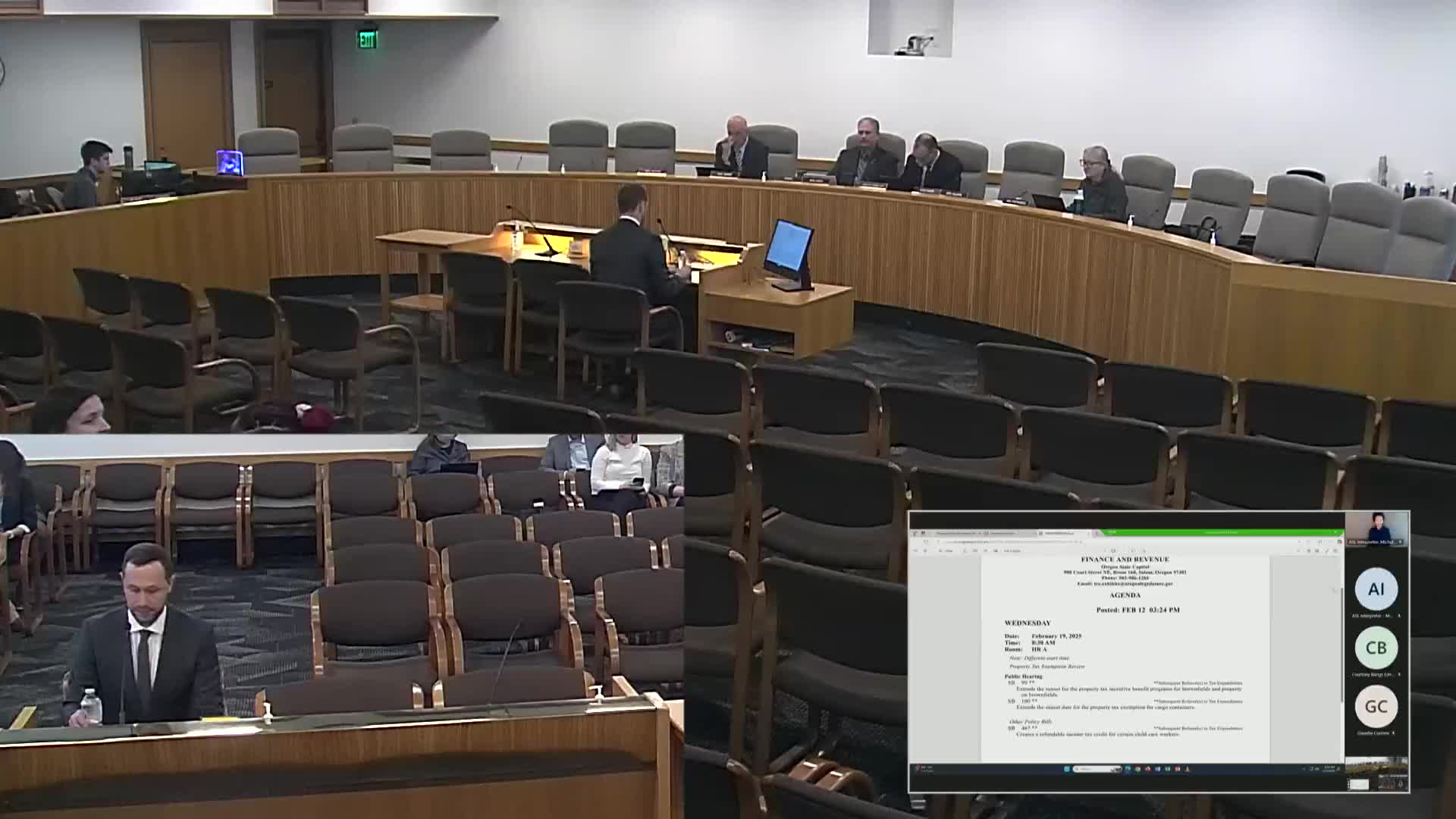
Chair Meek opened a public hearing Feb. 19 on Senate Bill 99, a proposal to extend a local-option property tax exemption intended to help redevelop brownfields in Oregon.
Senate Bill 99 would move the exemption’s sunset date six years, from Jan. 1, 2027, to Jan. 1, 2033. Legislative Revenue Office staff told the committee the exemption allows cities or counties to adopt an ordinance or resolution providing a land special assessment and a full or partial property-tax exemption for improvements and certain personal property on eligible brownfield parcels, subject to several limits and procedural requirements.
The bill matters because it is one of several tools — including the Oregon Brownfields Redevelopment Fund and the Oregon Brownfields Cleanup Fund — that local governments and private partners use to address environmental contamination that impedes redevelopment. Supporters said the exemption is a limited, targeted way to help pay remediation costs while protecting taxing districts from unlimited revenue loss.
Under the existing program LRO staff described, brownfields excluded from the exemption include U.S. Environmental Protection Agency Superfund sites and centrally assessed or large industrial properties assessed by the Department of Revenue. An incentive can apply to the taxes of all taxing districts only if districts representing 75% of the combined tax rate approve the exemption for the area. The typical benefit period is 10 years with an option for a five‑year extension; recipients stop receiving the benefit at the earlier of the benefit period’s end or when the dollar amount of benefits equals eligible cleanup costs net of other incentives. A remediation plan approved by the Department of Environmental Quality (DEQ) is required and the statute contains clawback and owner‑eligibility rules intended to prevent a polluter from benefiting from the incentive.
Rocky Dahl, testifying on behalf of the Oregon Economic Development Association and the Oregon Brownfields Coalition, said the policy grew from a multi‑stakeholder effort and is one of three “legs” — funding, land bank authority, and tax incentives — that together make brownfield redevelopment feasible. “Don’t let the limited use of the program be a symbol that it’s not valuable,” Dahl said, adding that cleanup is difficult but returns sites to productive use and back onto the tax rolls.
Jenna Jones of the League of Oregon Cities and Annalisa Curler of Metro also told the committee they support extending the exemption. Jones said Oregon’s two Business Oregon brownfields programs are oversubscribed; she said from 2019 to 2024 more than 50 cities applied and programs have awarded over $6 million for cleanup. Curler said Metro convened a Brownfields Coalition in 2014 that has grown into a public‑private partnership and emphasized the program’s “sideboards,” including that original polluters should not profit and that the total tax benefit cannot exceed cleanup costs.
LRO staff and members discussed program uptake and administrative cost. Staff said program usage has been limited: three accounts in recent years were cited in Klamath County and the City of Portland pursued the exemption earlier but the 75% combined‑tax‑rate threshold had been an impediment. A 2019 Portland estimate cited during testimony put brownfields at about one‑third of developable land within its urban growth boundary — roughly 900 acres — with estimated cleanup costs of about $240 million. Staff noted applications are due by March 15 under current rules and that cities and counties may amend or repeal the local incentive at any time.
Committee members asked whether the incentive is available to current owners as well as purchasers; staff said owners may qualify provided they are not responsible for the contamination. Senators also asked whether residential uses are allowed; staff said there are no statutory limits on the type of development that may occur on land granted the exemption.
The public‑hearing record for SB 99 includes written testimony from coalition partners; no formal motion or vote occurred during the Feb. 19 hearing. The committee closed the public hearing on SB 99 and moved to the next item on the agenda.