Get Full Government Meeting Transcripts, Videos, & Alerts Forever!
Minnesota senators hear new hunger data, consider funding for SNAP outreach, food banks, food shelves, seniors and prepared-meals program
Summary
The Minnesota Senate Health and Human Services Committee met Feb. 19 in St. Paul to hear new statewide hunger data and consider five bills to expand state funding for SNAP outreach, regional food‑bank grants, the Minnesota Food Shelf Program, a higher SNAP minimum for seniors and a prepared‑meals grant program.
The Minnesota Senate Health and Human Services Committee met Feb. 19 in St. Paul to hear presentations on a new statewide hunger survey and testimony on rising demand at food shelves and food banks, and to consider five bills proposing new or expanded state funding for hunger-relief programs.
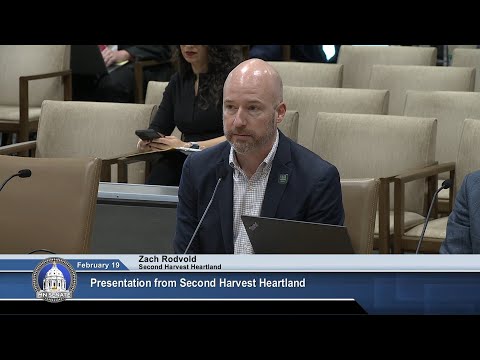
The hearing opened with a presentation from Second Harvest Heartland and Wilder Research about a household survey of about 20,000 randomly selected Minnesota households. “One in five Minnesota households are food insecure,” Zach Rodvold, director of public affairs for Second Harvest Heartland, told the committee, and he described a three-part continuum showing 2% of households said they experienced hunger and received no emergency food, 5% experienced hunger and received some services, and 13% had enough food only because of assistance from programs such as SNAP, WIC or food shelves.
Why it matters: Witnesses and lawmakers said the survey and food-bank visit data show a sustained, statewide increase in need that state funding can help address now, while also positioning Minnesota to draw down federal matches.
Committee testimony and numbers
Peter Whitock, government relations manager with The Food Group, told the committee that emergency food demand has climbed sharply: “Food shelves saw nearly 9,000,000 visits,” he said, up from about 7.5 million in 2023 and 5.5 million in 2022; before the pandemic, visits were roughly 3.5 million per year. Witnesses reported demand rising across age groups — children, adults and seniors — and emphasized that much of the increase reflects working households that are still food insecure.
Presenters described how the hunger-relief network is structured: food banks (wholesalers) source and purchase food and distribute it to local food shelves and partner programs; food shelves provide direct, immediate assistance to households and may serve people who do not qualify for or cannot access SNAP quickly.
Speakers stressed several operational points presented to the committee: - The Minnesota Food Shelf…
Already have an account? Log in
Subscribe to keep reading
Unlock the rest of this article — and every article on Citizen Portal.
- Unlimited articles
- AI-powered breakdowns of topics, speakers, decisions, and budgets
- Instant alerts when your location has a new meeting
- Follow topics and more locations
- 1,000 AI Insights / month, plus AI Chat