Get Full Government Meeting Transcripts, Videos, & Alerts Forever!
Get email alerts on the Food Insecurity topic
No spam. Unsubscribe anytime.
Minnesota senators hear new hunger data, consider funding for SNAP outreach, food banks, food shelves, seniors and prepared-meals program
Summary
The Minnesota Senate Health and Human Services Committee met Feb. 19 in St. Paul to hear new statewide hunger data and consider five bills to expand state funding for SNAP outreach, regional food‑bank grants, the Minnesota Food Shelf Program, a higher SNAP minimum for seniors and a prepared‑meals grant program.
The Minnesota Senate Health and Human Services Committee met Feb. 19 in St. Paul to hear presentations on a new statewide hunger survey and testimony on rising demand at food shelves and food banks, and to consider five bills proposing new or expanded state funding for hunger-relief programs.
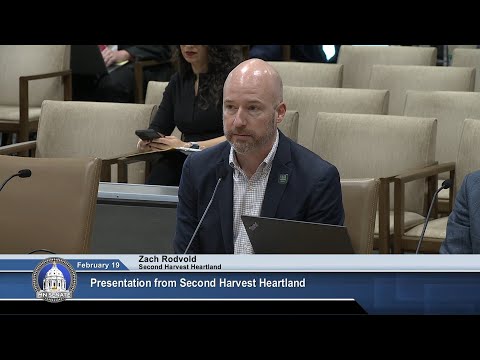
The hearing opened with a presentation from Second Harvest Heartland and Wilder Research about a household survey of about 20,000 randomly selected Minnesota households. “One in five Minnesota households are food insecure,” Zach Rodvold, director of public affairs for Second Harvest Heartland, told the committee, and he described a three-part continuum showing 2% of households said they experienced hunger and received no emergency food, 5% experienced hunger and received some services, and 13% had enough food only because of assistance from programs such as SNAP, WIC or food shelves.
Why it matters: Witnesses and lawmakers said the survey and food-bank visit data show a sustained, statewide increase in need that state funding can help address now, while also positioning Minnesota to draw down federal matches.
Committee testimony and numbers
Peter Whitock, government relations manager with The Food Group, told the committee that emergency food demand has climbed sharply: “Food shelves saw nearly 9,000,000 visits,” he said, up from about 7.5 million in 2023 and 5.5 million in 2022; before the pandemic, visits were roughly 3.5 million per year. Witnesses reported demand rising across age groups — children, adults and seniors — and emphasized that much of the increase reflects working households that are still food insecure.
Presenters described how the hunger-relief network is structured: food banks (wholesalers) source and purchase food and distribute it to local food shelves and partner programs; food shelves provide direct, immediate assistance to households and may serve people who do not qualify for or cannot access SNAP quickly.
Speakers stressed several operational points presented to the committee: - The Minnesota Food Shelf Program (MFSP), established by the legislature in 1992 and administered with the Department of Children, Youth and Families (DCYF), is a statewide, noncompetitive grant program that distributes funds once per year to food shelves. Grants are generally awarded in proportion to prior-year visits; individual MFSP awards range roughly from $7,500 to $150,000 (average cited at about $25,000). Testimony said 96% of MFSP funds must be used for purchase, transport, coordination and distribution of food, with up to 4% allowed for administrative costs. - SNAP outreach work in Minnesota is currently supported by a state grant program that leverages a 50% federal reimbursement from the USDA’s SNAP outreach program; outreach grantees assist applicants with the SNAP application and related barriers, including language and digital literacy. - Food banks reported falling corporate donations and rising purchasing costs; several food-bank leaders said state investments allow them to reliably purchase produce, milk, eggs and protein that rescued or donated food streams do not consistently provide.
Bills heard and committee actions
Five bills were presented, debated by committee members, and each was laid over for possible inclusion in the omnibus or later action. Committee members also adopted author amendments for several bills by voice votes; recorded roll-call tallies were not provided in the hearing record.
Votes at a glance — actions recorded in the hearing: - Senate File 849 (SNAP outreach): Author’s A‑1 amendment moved by Senator Mann and adopted by voice vote; bill as amended would appropriate $1,000,000 this biennium (split as $500,000 in FY26 and $500,000 in FY27) to continue the statewide SNAP outreach program; laid over for possible inclusion (voice vote; counts not specified). - Senate File 1348 (regional food bank grants): A‑1 amendment adopted by voice vote; bill would establish a regional food‑bank grant program at DCYF and requested $10,000,000 per year beginning FY26 to be divided among six regional food banks (and participating tribal nations); laid over for possible inclusion (voice vote; counts not specified). - Senate File 1112 (Minnesota Food Shelf Program appropriation): bill to increase MFSP funding (presented as a multi‑million dollar appropriation; committee discussion referenced a proposal of $4,000,000 per year on top of the base MFSP appropriation); laid over for possible inclusion (voice vote; counts not specified). - Senate File 1110 (increase SNAP minimum for seniors): author’s amendment changed the qualifying age threshold to align with federal definitions; A‑1 adopted by voice vote; bill would raise the monthly SNAP minimum benefit for qualifying seniors (current minimum cited in testimony as $23) and the bill’s proposed new minimum discussed was $50 per month for eligible seniors; laid over for possible inclusion (voice vote; counts not specified). - Senate File 1412 (prepared meals grant program): A‑1 amendment adopted; an additional A‑2 amendment (prohibiting a listed entity from receiving funds) was offered by Senator Curran and adopted; bill would reestablish or continue funding for a prepared‑meals grant program that pays nonprofits, tribes or health systems to deliver culturally and medically tailored, commercially prepared meals to individuals who cannot prepare food themselves; laid over for possible inclusion (voice votes; counts not specified).
Substantive concerns and clarifications
Committee members pressed presenters on federal fiscal risks and program design. Witnesses said federal budget reconciliation debates in Washington could reduce SNAP and other nutrition-program funding, and any federal cuts would increase demand on the state’s emergency food network. Rodvold warned cuts to SNAP would “drive more people to food shelves.”
Members also asked for operational detail, and presenters gave specifics: the MFSP grant is noncompetitive and applied for once per year; SNAP outreach grantees are local nonprofits or community organizations that help people complete the combined SNAP application and reduce barriers; and regional food banks distribute to hundreds of food‑shelf partner agencies. One witness described MFSP distribution rules and the use of data reported by food shelves to calculate grant amounts.
Prepared meals and health care links
Several health‑system and medically oriented witnesses urged funding for prepared‑meals services, noting the program reaches people who cannot shop or cook because of illness, disability or limited housing/kitchen access. Lisa Lane of Open Arms, Fairview Health Services staff, and other program directors reported measurable health‑related benefits from medically tailored meals for patients undergoing cancer treatment, living with diabetes, or recovering from critical illness.
Community testimony
More than a dozen food‑bank and food‑shelf leaders from across Greater Minnesota and the Twin Cities described local surges in demand: increases in unique households served, more first‑time shoppers, and higher pounds of food distributed. Several leaders said they had run deficit budgets or tapped reserves to cover food purchases; others said without a steady state appropriation they would be forced to cut planned purchases of protein, dairy and produce.
What the committee did not decide
Committee members did not adopt final appropriations or a fiscal note for any bill in this hearing. Each bill (and related adopted amendments) was laid over for possible inclusion; no roll‑call tally for final passage was recorded in the hearing transcript. Several lawmakers asked state staff to supply follow‑up fiscal detail.
Ending note
Witnesses uniformly urged sustained, predictable funding and emphasized that state dollars often leverage federal matching funds and local economic activity when spent at grocery retailers. Lawmakers and presenters described the package of bills as complementary options for shoring up Minnesota’s emergency food system and reaching seniors and medically vulnerable people who cannot access or prepare food on their own. The committee closed after laying the bills over for further consideration.