Get Full Government Meeting Transcripts, Videos, & Alerts Forever!
Get email alerts on the Wildfire Budget State Fire Marshal topic
No spam. Unsubscribe anytime.
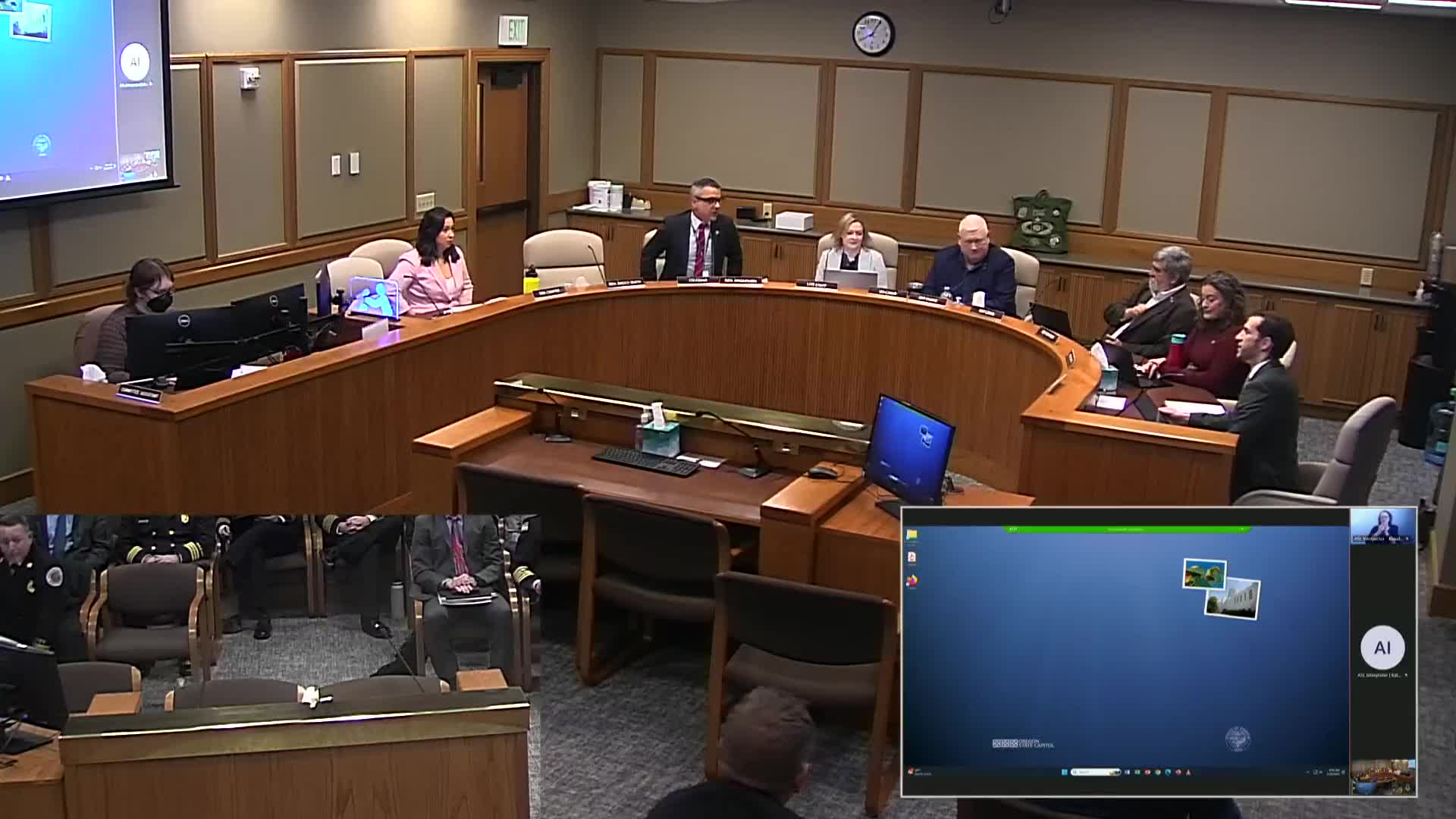
State fire marshal outlines budget, wildfire response investments in informational hearing on Senate Bill 5538
Summary
Mariana Ruiz-Temple, Oregon State Fire Marshal, and agency deputies told the Public Safety Subcommittee on Feb. 19 that the governor's recommended budget for the Department of State Fire Marshal (Senate Bill 5538) focuses on sustaining operations and targeted investments to prepare for future wildfire seasons.
Mariana Ruiz-Temple, Oregon State Fire Marshal, and agency deputies told the Public Safety Subcommittee on Feb. 19 that the governor's recommended budget for the Department of State Fire Marshal (Senate Bill 5538) focuses on sustaining operations and targeted investments to prepare for future wildfire seasons.
"Our mission is to protect people, property, and the environment from fire and hazardous materials," Ruiz-Temple said as she opened the agency's presentation to the committee.
The briefing by Jonathan Bennett of the Department of Administrative Services's Chief Financial Office said the 2025-27 current service level (CSL) budget for the agency reflects a roughly 55% reduction from the 2023-25 legislatively approved budget because a large share of the earlier biennium's funding was one-time wildfire response and start-up costs. Bennett described the governor's recommended package as maintaining operational funding while prioritizing wildfire preparation and response and several operational investments.
Why it matters: Lawmakers and the fire service say the state must address growing wildfire frequency and the cash-flow strains of responding to large conflagrations while preserving prevention, inspections and hazardous-materials work that protect communities year-round.
Key budget items and programs
- Wildfire response and readiness: The governor's recommendation includes a general-fund deposit to the State Fire Marshal Mobilization Fund intended to ease cash-flow constraints during large incidents and allocations for pre-positioning and mobilization. The administration proposes roughly $15 million for wildfire season costs in the governor's recommended budget (the agency noted a five-year rolling average of about $22 million in wildfire season costs).
- Engine program: The agency reported it purchased 76 apparatus (three types: Type 3, Type 6 and tenders) that will be loaned to local departments; all are scheduled to be placed in local stations by the end of the first quarter of 2025.
- Staffing grants: A $6 million staffing grant program provided $35,000 to 192 agencies to add surge capacity during peak periods, mutual-aid responses and conflagrations.
- Mutual-aid tracking and mutual-aid reimbursement modernization: The governor's package funds a mutual-aid tracking system and agency staff described plans to replace a largely spreadsheet-based reimbursement process with an electronic system aimed at increasing efficiency, transparency and speed of reimbursements.
- Regulatory and prevention work: The recommended budget includes positions for implementing and enforcing changes to self-service gasoline rules, expansion of the community wildfire risk reduction and defensible-space work, and ongoing funding for the Community Right to Know/Hazardous Materials reporting program. The agency emphasized its Fire and Life Safety divisions and analytics teams that underpin prevention, inspections and code work.
Wildfire trends, capacity and outcomes
Agency leaders and deputies described a historically severe 2024 wildfire season: about 1.9 million acres burned in Oregon, 44 response mobilizations, 17 conflagrations and roughly $34.5 million in associated costs. The State Fire Marshal and deputies emphasized new operational tools introduced after earlier legislative action: immediate response authorities to send resources early in an incident, pre-positioning of assets before expected extreme weather, and the engine and staffing grant programs designed to increase local capacity.
Chief Deputy Travis Madema described Oregon's concentric-circle mutual-aid system, from local response out to interstate aid, and said the state's incident management teams and 12 regional HAZMAT teams are central to large mobilizations. The agency reported 88 Oregon task forces and more than 450 pieces of apparatus responded within the state during the 2024 season, and that 21 task forces and more than 100 apparatus were deployed to a late-season California mobilization.
Prevention, data and community programs
Claire McGrew, chief deputy for Fire and Life Safety, described a growing analytics unit that receives incident data from more than 300 agencies and supports dashboards on fatalities, open burning and other risks. She said roughly 17,000 fires were reported in 2023, about 28% of those were structure fires, and roughly half of reported incidents are "outside fires" such as debris burning or discarded smoking materials.
The agency highlighted the Fire Adapted Oregon program and community wildfire risk reduction grants (about $18 million initially, plus a subsequent $3 million), seven regional risk-reduction specialists and a defensible-space assessment tool with nearly 3,000 assessments completed to date and about 430 certified assessors.
Tribal and interagency coordination
Ruiz-Temple said the agency has consulted with Oregon's tribal nations over the past two years and provided $500,000 grants to each tribe to support mitigation and suppression efforts; three tribal nations have emergency response agencies that participate in the Oregon Mutual Aid system. Agency staff also described regular coordination with the Oregon Department of Forestry, Office of Emergency Management and federal partners.
Outstanding issues and implementation risks
The agency listed several unresolved issues, including reliance on FEMA and FMAG reimbursements that can take multiple years to arrive and are not guaranteed. Officials warned that a lag between legislative action and the start of new programs could create short-term funding gaps for 2025 operations.
Information-technology projects and workforce
Agency leadership described two cross-agency modernization projects: a mutual-aid reimbursement system and a shared learning-management system (LMS) involving OSFM, DPSST, ODF and other partners. They also described workforce challenges: declining volunteer ranks in some places, the operational strain of EMS calls on fire departments, and the need for training models that match volunteer schedules. Ruiz-Temple and deputies highlighted a health-and-safety collaborative focused on cancer prevention, physical fitness, behavioral health and incident safety for firefighters.
Next steps
The informational hearing produced questions and requests for follow-up on interoperability of the mutual-aid tracking system and details on analytics and detection systems. The agency said the Oregon Wildfire Funding Workgroup will report to the committee on March 5, and staff noted a public hearing on the bill was scheduled for Feb. 20.
No formal votes were taken at the Feb. 19 informational hearing; the committee scheduled a public hearing for the next day to receive testimony.
Ending: The agency asked the committee to consider durable funding options for wildfire response and prevention to sustain the statewide fire service and avoid recurring cash-flow problems during major fire seasons.