Get Full Government Meeting Transcripts, Videos, & Alerts Forever!
Get email alerts on the Court Fees topic
No spam. Unsubscribe anytime.
Judiciary hears proposal to raise multiple court fees, including civil filing charge
Summary
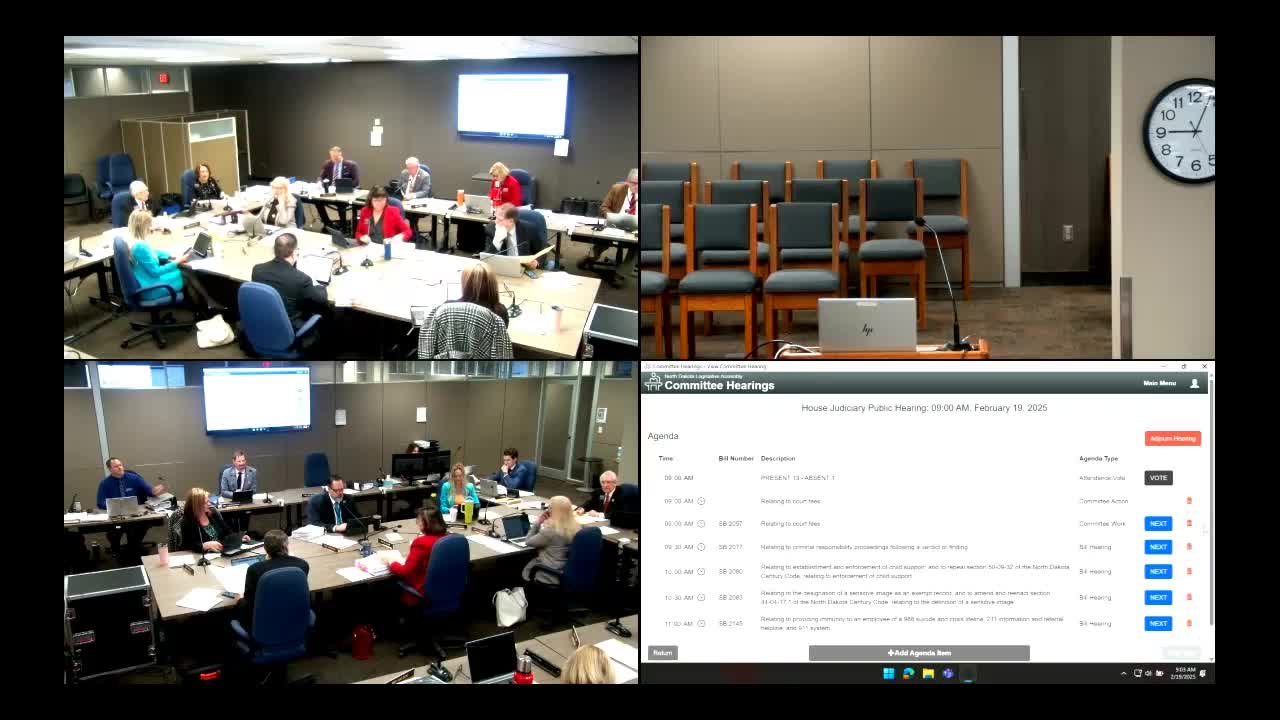
The House Judiciary Committee on Monday heard testimony on Senate Bill 2057, a measure introduced at the request of the Supreme Court that would raise multiple court fees, from civil filing fees to criminal assessment charges, and change how some fees are split between state and local funds.
The House Judiciary Committee on Monday heard testimony on Senate Bill 2057, a measure introduced at the request of the Supreme Court that would raise multiple court fees, from civil filing fees to criminal assessment charges, and change how some fees are split between state and local funds.
State Court Administrator Sally Haleva testified for the bill, telling the committee the proposal responds to long-neglected fees that “haven't been increased for the most part since 1995” and that even after the proposed increases North Dakota’s filing fees would remain among the lowest nationwide. "Everything that we do has a cost. It's either a cost to the public, a cost to the user, or it's a shared cost," Haleva said, arguing the current distribution places too much burden on the public.
Haleva walked the committee through specific changes the bill would make. Key civil-fee proposals in her testimony included doubling the general civil filing fee from $80 to $160 and the family case filing fee from $80 to $160, increasing the civil answer fee from $50 to $100, and raising the small-claims filing fee from $10 to $20. The bill would also increase the Supreme Court filing fee from $125 to $250 and raise or create several other clerk-of-court fees and administrative charges.
Haleva said the bill would raise the portion of each civil filing fee directed to the civil legal services fund from $15 to $30 and increase that fund's biennial cap from $750,000 to $900,000. She identified Legal Services of North Dakota and Dakota Plains Legal Services as the two legal-service providers that would receive funds. The family case filing fee split also includes a rise in the share directed to the displaced homemaker fund from $50 to $100; Haleva said that fund is used by the Department of Public Instruction to pass through adult learning center funding.
On the criminal side, Haleva described proposals to double several conviction-based assessments, including raising a renamed indigent-defense-and-court-facilities fee from $100 to $200 (the fee's current distribution provides initial dollars to indigent defense and court facility grants, with a split after fixed thresholds). A community-service supervision fee would rise from $25 to $50, and a restitution collection assistance fee would increase from $10 to $20. Haleva emphasized most of these fees can be waived if a court finds a person indigent.
Outside testimony questioned the value of raising criminal fees. Gus Patel Tupper, supervising attorney at the Policy Advocacy Clinic at Berkeley, testified remotely that criminal justice fees are difficult to collect and can be counterproductive. "You're trying to squeeze blood from a stone," Patel Tupper said, summarizing national research that criminal-fee collection rates are low, collection costs can exceed revenue, and fees can increase recidivism and family strain. He urged more data collection and study before enacting broad increases.
Committee members asked about who pays various fees, collection rates, and indigency standards. Haleva said civil filing fees are typically paid at the request-for-service stage and therefore largely collected, while many post-conviction criminal assessments have collection rates she estimated at roughly 20–25 percent and decline after two years. On indigency standards for indigent defense waivers, Haleva said she did not have statistics available at the hearing but described the qualifying threshold as tied to a fraction of the poverty level and said judges are often lenient when public safety and access to counsel are at stake.
No committee vote was taken on Senate Bill 2057 during the hearing; the committee recorded written testimony and closed the bill's hearing. The Judiciary Committee did not adopt or reject the bill at this meeting.
Details from the hearing and the bill text were presented by the state court administrator and by outside witnesses; members requested additional information on collection rates and the likely fiscal impact of the proposed increases.
The committee did not set a date for further action on the bill at the conclusion of the hearing.