Get Full Government Meeting Transcripts, Videos, & Alerts Forever!
Get email alerts on the Criminal Justice Reentry topic
No spam. Unsubscribe anytime.
Appropriations committee hears three‑bill reentry package aimed at reducing recidivism and improving transitions
Summary
A three‑bill reentry package presented to Appropriations would fund pilot prosecution‑led diversion and deflection, create tiered sanctions for supervision violations while eliminating some supervision and indigent defense fees, and appropriate money for jail reentry grants, IDs, Medicaid coordination and a Native American reentry liaison.
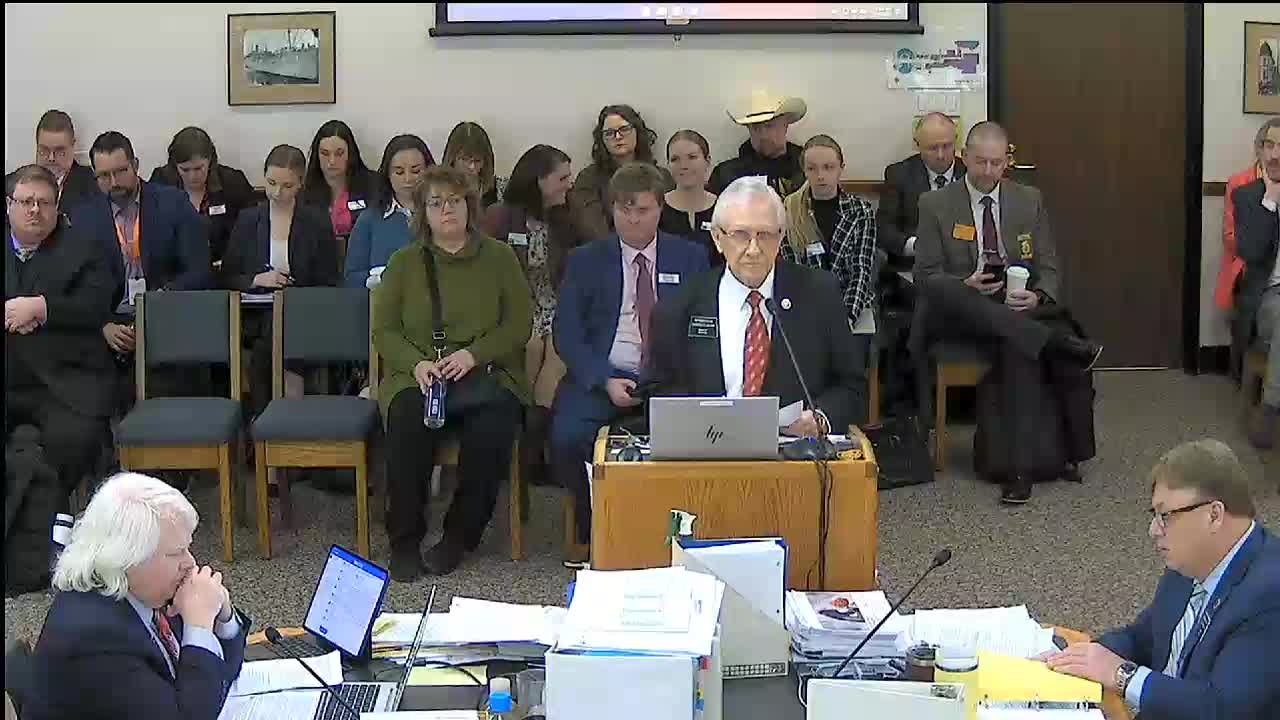
Representative Lawrence Clameen, presenting a package of three bills to the Appropriations Committee, said the measures target front‑end diversion, supervision consistency and reentry supports to reduce recidivism and relieve pressure on overcrowded prison and jail beds.
House Bill 14 25 (prosecution‑led diversion, deflection and pretrial services): Clameen said the bill would authorize prosecution‑led diversion programs (court rule 32.2 codified) and establish a three‑county pilot in which the Department of Corrections and Rehabilitation (DOCR) would provide supervision. The bill requests an appropriation to DOCR for supervision administration and requests $750,000 to the Department of Health and Human Services (DHHS) for treatment and related services for participants. Clameen and DOCR described deflection as a community‑level process that connects people with behavioral health needs to services "rather than putting them in jail." The bill additionally asks for a $55,000 study to evaluate cost savings from pretrial services.
House Bill 14 17 (parole/probation violations, fees, indigent defense): Clameen said HB 14 17 proposes a more consistent, tiered response to technical supervision violations — for example, short custodial sanctions for initial technical violations (15 days for a first revocation, up to 30 days for a second, up to 90 for a third, before imposing the remaining sentence on a fourth violation) — and would eliminate a $55/month supervision fee and a $35 public‑defender application fee. The fiscal impacts were described: eliminating the $55/month supervision fee would reduce DOCR collections by about $1.5 million over two years (collection rate ~25%); eliminating indigent defense application and recoupment fees would reduce revenue by roughly $310,000–$343,000 over the biennium; HB 14 17 includes a $310,000 appropriation to the Commission on Legal Counsel for Indigence to offset lost application fee revenue.
House Bill 15 49 (reentry grants, IDs, Medicaid coordination, Native American reentry): Clameen said HB 15 49 would create a grant program to fund evidence‑based jail reentry programming ($1.5 million appropriation to DOCR) and direct DOCR to work with the Department of Transportation to improve access to state identification and to coordinate with DHHS to enroll eligible people in Medicaid before release. The bill also directs DOCR to partner with tribes on culturally appropriate reentry initiatives and appropriates $25,000 for a Native American reentry program liaison. Section 7 requests a study on criminal record sealing and possible automation or expansion of sealing eligibility.
Colby Braun, DOCR director, told the committee that the department does not currently have the requested supervision FTE in its budget and would need appropriations for new positions and contract oversight. Pam Segnus of DHHS explained that the proposed diversion funding would target pre‑prosecution populations and supplement (but not replace) existing programs such as Free Through Recovery, which serves people under DOCR custody.
Committee members asked about expected savings from reduced admissions and whether the proposals would meaningfully bend the upward trend in admissions. DOCR said outcomes data exists on improved short‑term outcomes (court appearance, service connection) but a study is needed to quantify long‑term impacts and cost savings. Members discussed candidate counties for the pilot, operational details for third‑party contracts, and coordination with existing county and tribal programs. No final committee votes on the reentry bills were recorded in the provided transcript.