Get Full Government Meeting Transcripts, Videos, & Alerts Forever!
Get email alerts on the Securitization topic
No spam. Unsubscribe anytime.
Minnesota committee hears bill to let regulated natural-gas utilities use securitization after extraordinary events
Summary
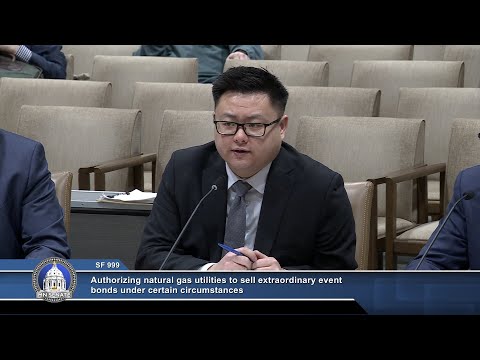
The Senate Energy, Utilities, Environment, and Climate Committee heard testimony Feb. 19 on Senate File 999, which would allow regulated natural-gas utilities to seek PUC approval to recover extraordinary, one-time costs through low-interest securitized bonds; committee laid the bill over for further consideration.
The Minnesota Senate Energy, Utilities, Environment, and Climate Committee on Feb. 19, 2025, heard testimony on Senate File 999, which would allow regulated natural-gas utilities to seek approval from the Minnesota Public Utilities Commission (PUC) to recover extraordinary, one-time costs through long-term, low-interest securitized bonds. The committee adopted a largely technical A2 amendment and laid the bill over for further consideration.
Senator Jeong, the bill's chief author, told the committee that securitization is an affordability tool used in more than 30 states and would be available only to regulated natural-gas utilities. "This legislation creates the regulatory and legal framework needed to enable regulated natural gas utilities to seek securitization and allows a utility the option to petition the PUC to issue long term bonds," Senator Jeong said. He emphasized that the bill is optional and that PUC oversight, stakeholder input and customer protections are built into the process.
Jason Luce, associate general counsel at CenterPoint Energy in Minnesota, said CenterPoint — which he said serves more than 900,000 Minnesota customers — supports the bill as an optional tool. "This bill provides us with an optional tool. If the PUC finds it's in the best interest of consumers, not with the company, they can use this tool," Luce said, adding that CenterPoint has used securitization in other states. He cited Texas storm recovery as an example and said securitization there is estimated to save customers about $50,000,000 in interest-rate costs.
Eric Swanson of Winthrop & Weinstine, who assisted with drafting the bill, told the committee securitization would be limited to costs that the PUC finds to be reasonable and prudent. "If the utility does seek approval of a securitization, other parties, the Department of Commerce, the Attorney General's office, ratepayer advocates, can review, scrutinize, and weigh in," Swanson said. He described the mechanism as a tool that "may never be used, but it's a whole lot better to have the tool and not use it than need the tool, but not have it." He noted the bill specifies the PUC findings required before a financing order could issue.
Committee members asked questions but took no final vote to advance the bill. Several members pressed for assurances that the PUC review would examine whether a utility had taken reasonable actions before seeking securitization — for example, equipment hardening, hedging strategies, storage management and other risk-mitigation steps. Senator Dibble repeatedly raised the concern that allowing securitization without careful scrutiny could create an incentive for utilities to "offload risk" rather than invest in resilience. "I'm just worried about the ability to offload risk that easily that might incent CenterPoint to not undertake some activities like making sure its equipment is sufficiently strong," Dibble said, and asked that the PUC explicitly consider such measures when deciding whether costs are prudent.
Committee members also noted a fiscal note had been requested but was not available at the hearing. The chair said the committee did not intend to pass the bill that day and formally laid Senate File 999 over for possible inclusion in an energy omnibus bill.
The A2 amendment, described in committee as largely technical with two substantive exceptions, was adopted by voice vote before the bill presentation. No formal roll-call vote on the amendment or on laying the bill over was recorded in committee minutes.
Next steps identified during the hearing included additional discussions between the bill author and committee members on the specific scope of costs eligible for securitization and on strengthening transparency and PUC scrutiny. The bill remains under consideration.