Get Full Government Meeting Transcripts, Videos, & Alerts Forever!
Get email alerts on the Local Enforcement Nuisance topic
No spam. Unsubscribe anytime.
Committee passes bill giving property owners a civil path when local governments decline enforcement; advocates warn it will criminalize homelessness
Summary
House Bill 295 would allow property owners or renters to seek damages or reimbursement when local governments repeatedly fail to enforce certain ordinances; the committee approved the bill 8–5 after extensive public testimony opposing the measure as likely to increase arrests of unhoused people and shift costs to litigation rather than housing.
The House Public Safety and Homeland Security Committee voted Wednesday to advance House Bill 295, a measure that would let owners or renters seek reimbursement or other remedies when a city or county declines to enforce certain local laws or ordinances—such as those addressing illegal camping, loitering, obstructing public ways and related offenses.
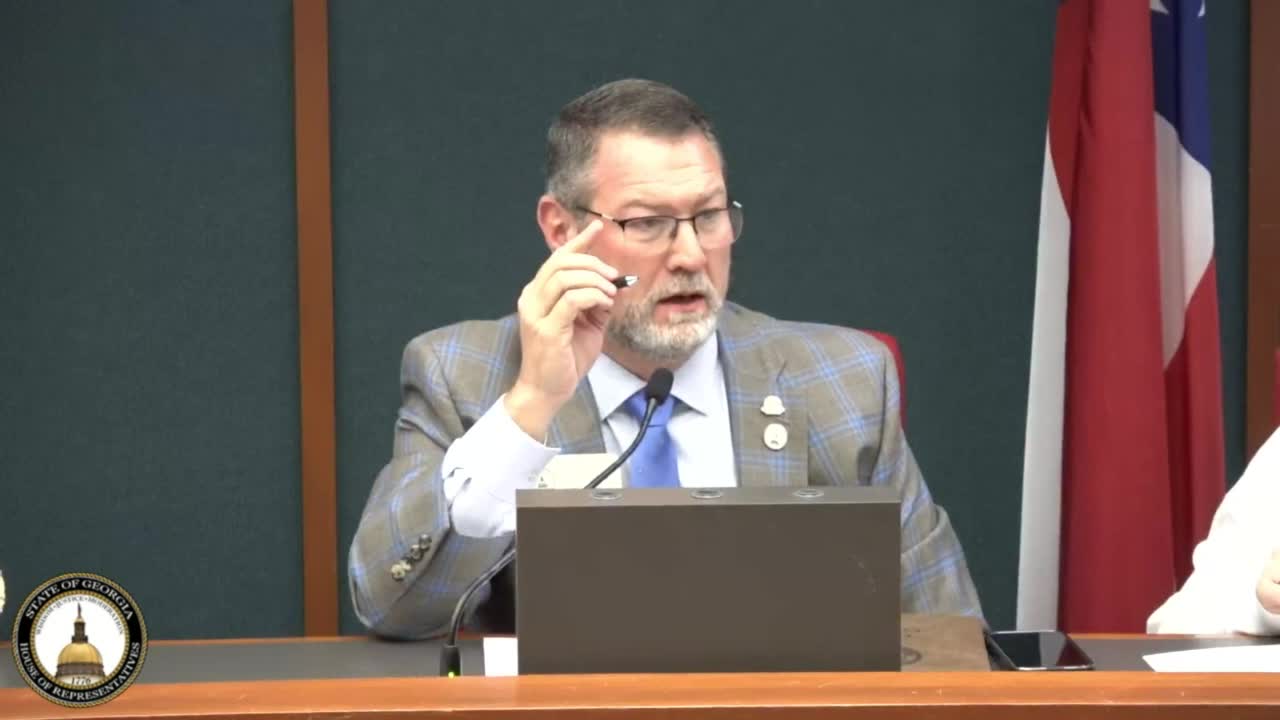
Vice Chairman Gaines, the bill sponsor, told the committee the intent is “to make sure that local governments are enforcing the laws on the books” and that financial consequences would “hit them in the pocketbook” to prompt enforcement. Gaines said the bill includes changes made after meetings with the Georgia Municipal Association (GMA) and Association County Commissioners of Georgia (ACCG), including clearer language on “policy, practice or pattern” and a provision limiting repeated unsuccessful claims.
Opponents—including legal, housing and homelessness service providers, faith groups and advocacy organizations—told the committee HB 295 would effectively increase criminal enforcement against people experiencing homelessness and make it harder for them to get housing. Testimony included lawyers and service providers describing how arrest records and missed court appearances make it more difficult for people to retain or obtain housing, and how criminalization can lead to higher public costs and worse health outcomes.
"This bill will kill people," Amanda Leppard, a former street outreach worker who testified for a homelessness advocacy organization, said, citing research that forced encampment policies and relocations increase life-threatening infections and deaths over time. Several witnesses described instances in Atlanta and Fulton County in which homelessness, court involvement and fatal outcomes intersected.
Service providers and housing advocates urged the committee to direct resources to proven solutions—expanded housing vouchers, the Georgia Housing Voucher Program, the state housing trust fund and supportive services—instead of imposing litigation-based penalties on local governments. Multiple witnesses said arrests and incarceration are more costly than housing and that enforcement-focused approaches displace people from outreach and care.
Committee members debated narrow technical questions during the hearing, including the bill’s exemptions for district attorneys and solicitors and the meaning of “declining” enforcement in contexts of limited officer availability. Sponsor Gaines said the bill is aimed at systematic failures to enforce—"not a single call where some one decision is made"—and that provisions were included to avoid penalizing jurisdictions facing short-term capacity issues.
After several hours of testimony, the committee voted by a hand-counted roll-style signal. The motion to pass HB 295 carried 8–5.
Supporters of the bill argued it is designed to protect property owners and encourage local governments to act, not to criminalize poverty. Opponents said available evidence shows criminalization increases barriers to housing and health care and urged state investment in affordable housing and supportive services instead of litigation remedies.
The bill includes detailed provisions that (as discussed in committee) would remove repeated unsuccessful claimants’ procedural advantages and exempt certain elected county officials; the text also contemplates a process to avoid cases where one property owner repeatedly files unsuccessful claims. Stakeholders asked for additional clarifications and clean-up language, and several committee members suggested forming a subcommittee or further edits before the bill moves further in the House.