Get Full Government Meeting Transcripts, Videos, & Alerts Forever!
Get email alerts on the Nextgen 911 topic
No spam. Unsubscribe anytime.
House committee advances bill to fund statewide NextGen 911 upgrade
Summary
Lawmakers heard testimony on House Bill 423 to expand the Georgia Emergency Communications Authority's duties to deploy Next Generation 911, including initial state funding estimates of $5 million–$8.03 million and added cybersecurity and GIS representation on GECA's board.
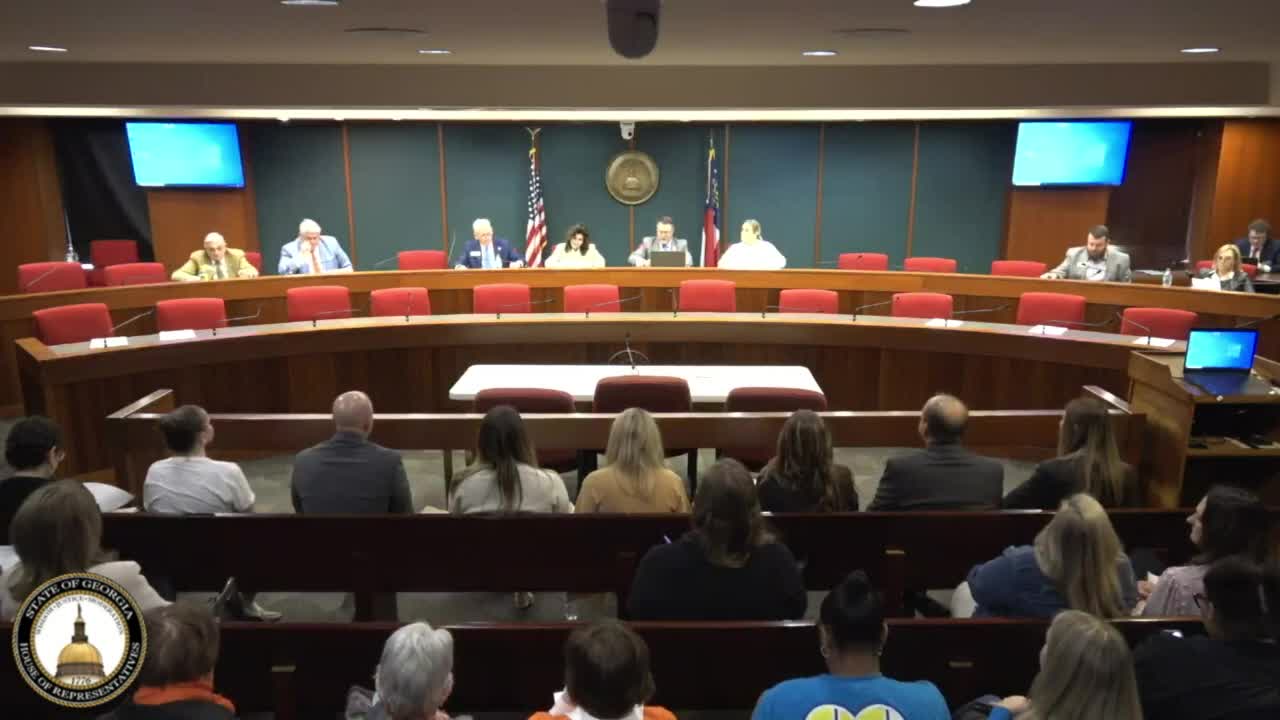
House members on the Public Safety and Homeland Security Committee advanced legislation Wednesday to direct the Georgia Emergency Communications Authority to lead procurement, implementation and oversight of a statewide Next Generation 911 (NG911) system.
The bill, House Bill 423, would amend GECA’s duties and expand the authority’s board to include representatives from information technology, cybersecurity and geographic information systems so that “these agencies are having crossover communication,” Representative [Wade] said while presenting the measure.
Supporters told the committee that Georgia’s current 911 infrastructure is aging and, if not updated, could leave centers isolated as telecom companies decommission copper lines. “NextGen 911 will increase caller location accuracy reported to the 911 center,” Alicia Rucker Wright, deputy executive director of the Georgia Emergency Communications Authority, told the committee. She said NG911 routes calls, messages and data based on a caller’s GIS location and would allow text, voice-memo and other modern communication types to reach the appropriate center.
The bill would also add an enforcement mechanism for centers that connect to the statewide network so they must comply with industry standards required for interoperability, Rucker Wright said. Committee members repeatedly asked whether enforcement would strip local authority; Rucker Wright said enforcement would apply only to entities that “wish to connect to the statewide network” and must meet “the requirements of that network.”
Representative Wade said the initial first-year state appropriation under discussion in the Legislature is between $5,000,000 and $8,030,000. He and GECA staff said a fee study or other future legislation could be used to help cover ongoing costs as more local centers opt in. GECA told the committee 16 communities already use a NG911 solution and that roughly 80% of another set of 40 counties have signaled commitment or are analyzing adoption.
Committee members asked practical questions about improved routing near jurisdictional borders, vendor choice and whether “NextGen” denotes a single vendor. Rucker Wright and the bill’s sponsor clarified that “Next Generation 911” describes a class of technology rather than a single vendor and that the state would not mandate a single supplier; the state could pursue economies of scale through a competitive procurement.
After questions, a motion to pass the bill was made and seconded; the committee approved the measure by voice vote.
If enacted, HB 423 would expand GECA’s statutory role, require standards-based connectivity for the statewide network, and authorize initial state funding to begin a phased rollout and local opt-in. Supporters included the Association County Commissioners of Georgia (ACCG), Georgia 9-1-1 directors, the Georgia Sheriffs Association, the Georgia Association of Chiefs of Police and the Georgia Department of Behavioral Health and Developmental Disabilities, according to testimony and sponsor remarks.
The bill will proceed to the next step in the House process.