Get Full Government Meeting Transcripts, Videos, & Alerts Forever!
Get email alerts on the Annexation Growth Boundary topic
No spam. Unsubscribe anytime.
Panel hears concept to add growth-boundary agreements to service-delivery strategy to reduce annexation disputes
Summary
Representative Thomas presented a hearing-only idea to allow local growth-boundary agreements to be incorporated into the service-delivery strategy process as a pilot, citing Cherokee County's experience. Local government groups said the concept merits further study but warned it would require careful drafting and education.
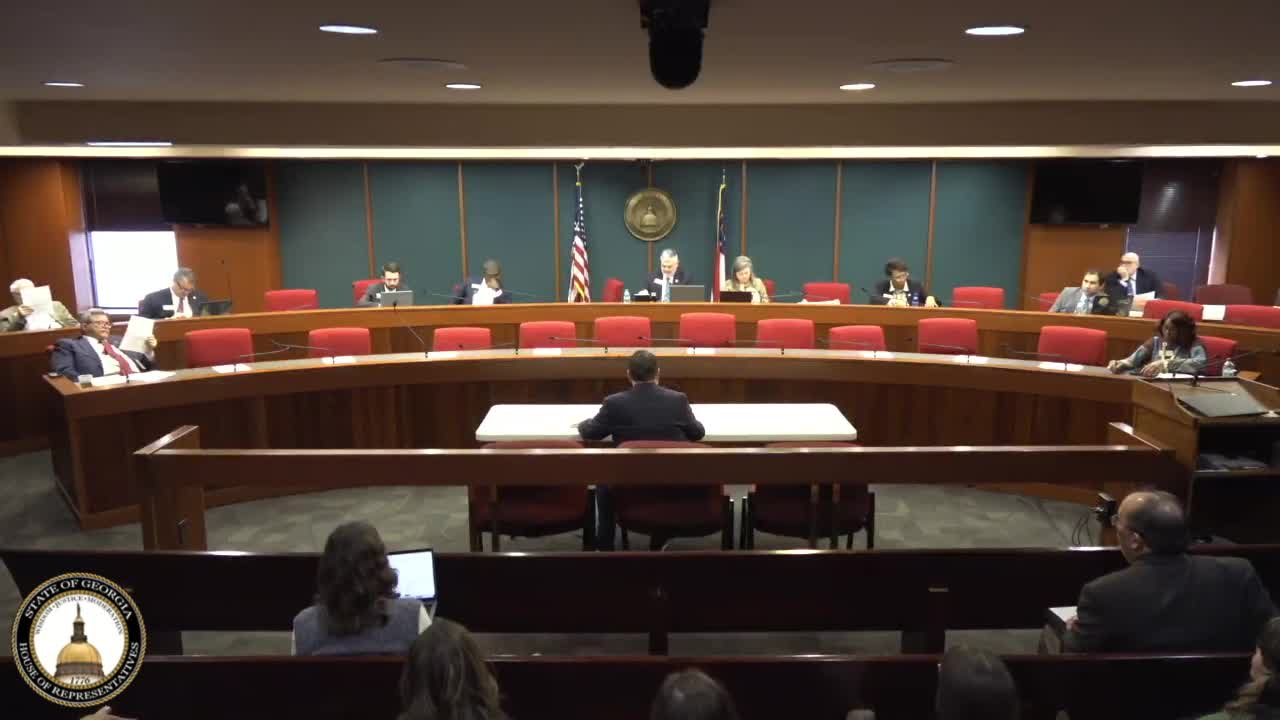
Representative (Chairman) Thomas brought LC473356A (introduced in committee as a concept bill, hearing only) to the House Governmental Affairs full committee to propose adding growth-boundary agreements to the service-delivery strategy (SDS) framework as a pilot option for some counties.
Thomas said the idea grew from a multi-year study and from Cherokee County’s experience, where the county and cities negotiated a growth-boundary agreement that the sponsor said has ended annexation disputes there for four years. "We decided that instead of spending all this time fighting each other in court, they would create what they call a growth boundary agreement," Thomas said, describing the agreement as a negotiated boundary and density plan that allowed both governments to plan services and avoid litigation.
The concept would make that kind of growth-boundary agreement part of the SDS process in places where it fits and would include an opt-out provision Thomas described as a "double opt out" (both the city and county would have to agree to opt out). Thomas framed the change as a planning tool to coordinate infrastructure and affordable-housing planning and to give residents outside city limits more input when annexation is possible.
Jim Thornton of the Georgia Municipal Association told the committee the Cherokee County example has been successful and that GMA is willing to work with the author and the Association County Commissioners of Georgia (ACCG) to assess how the idea could or should apply elsewhere. "This has obviously worked very well in Cherokee County," Thornton said, while advising the committee that SDS is complex and the approach would need careful vetting before becoming widely applicable.
Todd Edwards of ACCG also praised the idea as a potential way to reduce litigation and plan growth, while cautioning it would not be suitable in every county. Both associations said more education and a detailed decision tree would be needed so the concept does not become another source of conflict.
Committee members asked about applicability in fully municipal counties (Fulton County was cited as a different context) and whether growth-boundary agreements are binding. Thomas and others said many existing agreements are nonbinding but that the sponsor would like to explore making them binding where appropriate; participants noted most agreements typically last about 10 years and can be revisited.
Because this was a first hearing and a concept bill, the committee took no final action. GMA and ACCG pledged to work with the sponsor on drafting and on outreach to local governments.