Get Full Government Meeting Transcripts, Videos, & Alerts Forever!
Get email alerts on the Elections Ethics Jurisdiction topic
No spam. Unsubscribe anytime.
House committee advances bill to let Ethics Commission seek out-of-state election evidence
Summary
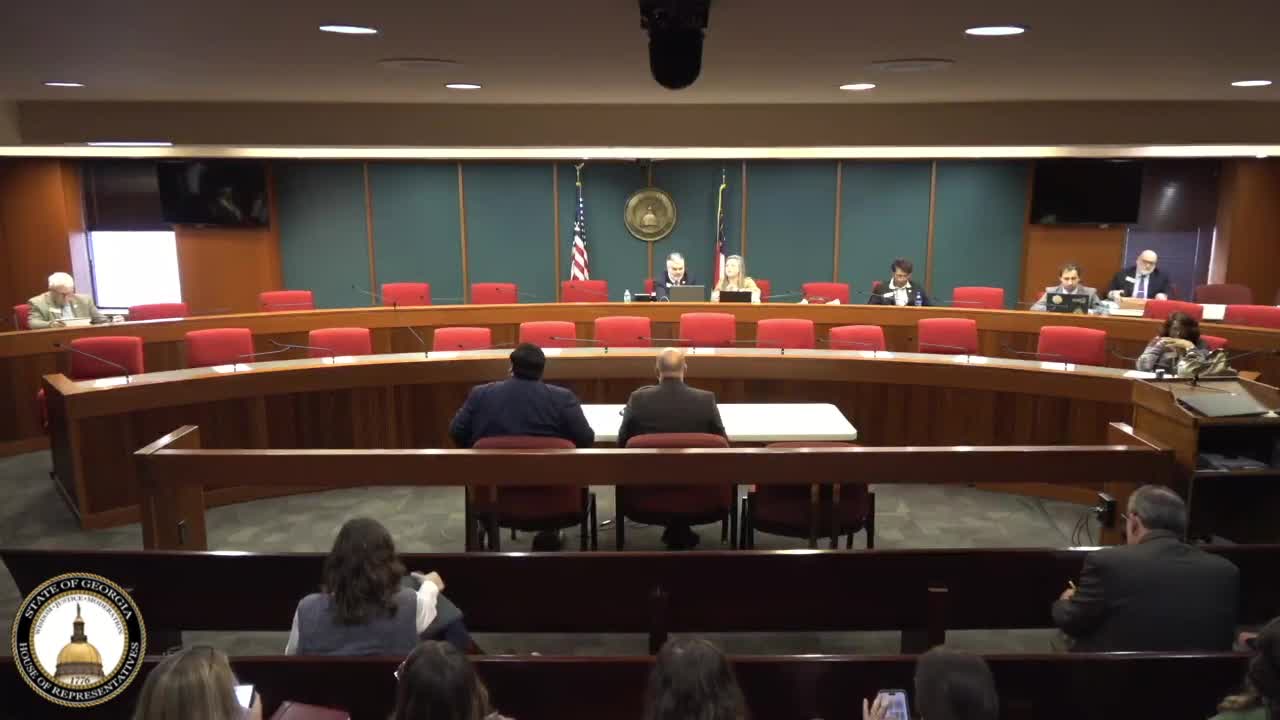
The Georgia House Governmental Affairs committee approved a substitute to allow the Georgia Ethics Commission to perfect subpoenas for out-of-state individuals or vendors with a nexus to Georgia elections, routing enforcement requests through Fulton County superior court when needed.
Representative Todd Jones, chairman of the House Governmental Affairs full committee, introduced LC473421S (referred to in committee as House Bill 414) to give the Georgia Ethics Commission a mechanism to obtain evidence from nonresident vendors who work on Georgia elections.
The measure, presented as a substitute, would define “nonresident” in line with the state’s long-arm framework, enable the commission to seek Superior Court assistance when a nonresident will not comply with an investigatory request, and designate Fulton County as the venue for such actions. The committee approved the substitute by voice vote.
The bill responds to what Jones described as a gap in enforcement: "Individuals outside of our state are not, I'll say, at reach by the Georgia Ethics Commission," he told the committee, saying the commission’s subpoenas effectively stop at the state line. Jones said the substitute lays out a process in which the commission first seeks cooperation and, if necessary, may ask a judge to find requested evidence "necessary and pertinent" to an investigation.
David Amati, executive director of the Georgia Ethics Commission, said the bill does not expand the substance of the commission’s authority but gives the agency a practical means to obtain evidence located outside Georgia. "This just changes our ability to obtain the evidence ... It gives us a mechanism to obtain that evidence if it's out of state from that vendor," Amati said, describing instances in which consultants, mail houses or social media vendors outside Georgia hold records needed to investigate possible undisclosed spending.
Committee members asked about timing and the court process. Representative Bernal asked whether backlog in the courts would delay evidence gathering; Jones and Amati replied that the timing would depend on the case and that judges could order expedited hearings during an election if warranted. Representative Adesanya asked whether the bill would apply to consultants who may not know they violated Georgia law; Amati responded that the bill concerns the commission’s ability to obtain evidence rather than creating a new scienter standard.
The substitute defines the nonresident nexus in language tied to Georgia’s long-arm principles and directs that, when necessary, the Ethics Commission may petition the Superior Court to compel out-of-state compliance; Jones said the venue for those proceedings would be Fulton County. The committee moved the bill forward by voice vote and instructed staff to send a copy to the rules committee for processing.
Votes at a glance: The committee approved the substitute for LC473421S/HB 414 by voice vote; no roll-call tally was recorded in the transcript.