Get Full Government Meeting Transcripts, Videos, & Alerts Forever!
Get email alerts on the State Investment Crypto topic
No spam. Unsubscribe anytime.
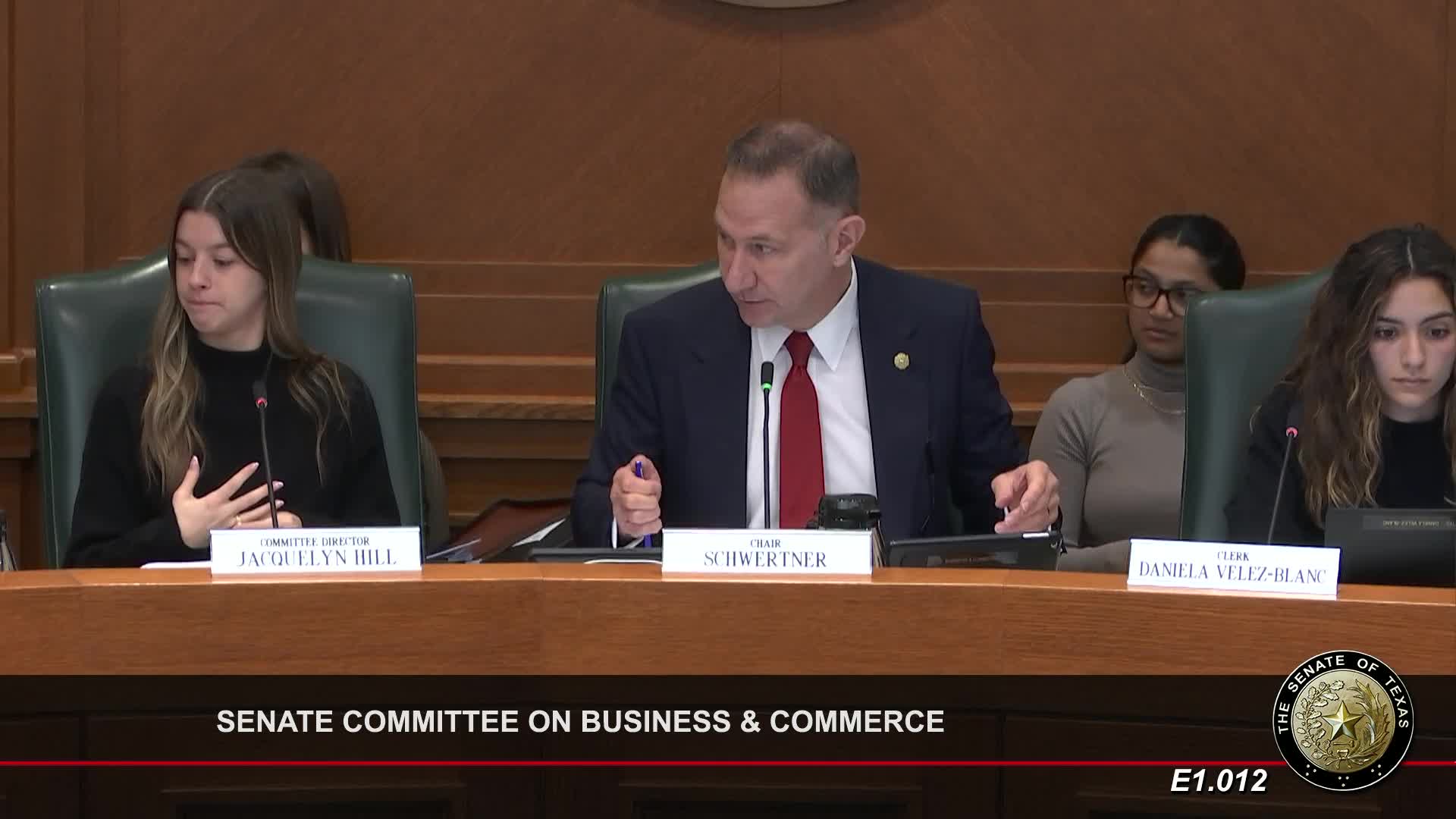
Senate committee debates bill to create Texas strategic Bitcoin reserve managed by comptroller
Summary
The Senate Committee on Business & Commerce spent extensive time Oct. 12 on Senate Bill 21, a proposal to create a Texas Strategic Bitcoin Reserve and authorize the comptroller to acquire, hold and manage Bitcoin and other large‑market‑cap cryptocurrencies.
The Senate Committee on Business & Commerce spent extensive time Oct. 12 on Senate Bill 21, a proposal to create a Texas Strategic Bitcoin Reserve and authorize the comptroller to acquire, hold, sell and manage Bitcoin and other cryptocurrencies that meet a market‑capitalization threshold.
Senator Charles Schwertner, the bill’s author, told the committee SB21 would "create the Texas strategic Bitcoin reserve, sending a clear message regarding the decades long spendthrift stewardship of our country by the federal government." He said the bill would let Texas diversify its investment approach and allow public donations into the reserve.
Under the bill as explained in committee, the comptroller could acquire, exchange, sell, manage and retain investments in Bitcoin and other cryptocurrencies with a total market capitalization of at least $500,000,000,000. The bill would allow donations of cryptocurrency, require the reserve to be managed under the same "prudent investor" standard that governs other state portfolios, authorize the comptroller to contract with qualified custodians and service providers, establish an advisory committee to provide expertise, and require a biennial report to the Legislature and online publication of holdings and activity. Legislative approval would be required before the comptroller could transfer money out of the reserve.
Glenn Hegar, Texas comptroller of public accounts, testified in support and described the trust company he oversees: "The trust company currently invests and manages more than $105,000,000,000 in state assets across multiple portfolios with different return and liquidity objectives." Hegar said cryptocurrency — and Bitcoin in particular after SEC approval of spot Bitcoin ETFs in 2024 — is being evaluated as a potential hedging and diversification tool for institutional portfolios.
Senators pressed several concerns during the hearing. Senator Juan Hinojosa Menendez and others asked why the bill’s advisory committee was not established under the state advisory committee chapter that requires reporting to the Legislative Budget Board; Hegar said the committee would report to the comptroller and that the bill was drafted per counsel’s advice. Senator Nichols warned that accepting donations could enable market manipulation if an investor used a large donation to "create the market for themselves," and advocated limiting donations so the state would not be used to artificially elevate an asset price. Committee members also raised custody and security questions after a senator described a constituent who lost Bitcoin in a hacked account. Hegar said custodial safeguards and contracting with qualified providers would be part of implementation planning.
A few senators discussed potential funding scales in hypotheticals; the bill contains no specific appropriation and any funding to seed the reserve would require legislative action in the budget process. One senator referenced a possible $21,000,000 seed figure as an example; Hegar and his staff said the comptroller’s office had not provided a recommended dollar amount during the hearing.
The committee received invited testimony from the comptroller and from representatives of the Texas Blockchain Council. No committee vote was taken; Chairman Schwertner recessed the committee and left the bill pending for further work and potential follow‑up with the finance and appropriations committees.
Why it matters: SB21 would create a novel state‑level vehicle to hold cryptocurrency on behalf of Texas taxpayers and could set precedents for how public funds are used to participate in digital‑asset markets. It raises policy questions about fiscal policy signaling, donor rules, custody and operational safeguards, and legislative control over appropriations.
Next steps: The bill remains pending in the Business & Commerce Committee pending further drafting and discussion; any appropriation would be considered in separate budget processes.