Get Full Government Meeting Transcripts, Videos, & Alerts Forever!
Get email alerts on the Artificial Intelligence In Education topic
No spam. Unsubscribe anytime.
Emory researcher urges Georgia to expand AI training in higher education and the workforce
Summary
Dr. Joseph Sutherland of Emory University told the Georgia House Higher Education Committee that artificial intelligence is reshaping education, health care and jobs, and urged the state to adopt a clear strategy, invest in broadband and integrate AI into vocational and higher-education programs.
Dr. Joseph Sutherland, director of Emory University's Center for AI Learning, told the Georgia House Higher Education Committee on Feb. 19 that artificial intelligence is “changing everything” and urged the state to adopt a coordinated strategy to give students and workers early access to AI tools.
Sutherland, who described Emory's Center for AI Learning as an effort that has recruited 46 tenure-track faculty and focuses on applying AI across fields such as health care and law, told legislators that hands-on training and statewide outreach are critical to avoid leaving rural Georgians behind.
Why it matters: Sutherland said AI has the potential both to accelerate work—he compared it to the calculator—and to widen disparities if access and training are unequal. He cited health-care use cases, workforce upskilling, and improved educational outcomes when AI tools are deployed as tutoring or personalized instruction.
Sutherland warned against relying on commercial detection tools that claim to identify AI-written student work unless they are based on verifiable watermarks. He also urged lawmakers to ensure broadband access, saying roughly 200,000 Georgians still lack broadband service and may be cut off from new opportunities.
Examples and evidence - Workforce and outreach: Sutherland said his group held hands-on AI demonstrations in more than 22 communities and reached “in excess of 2,500 people” with training supported by the Rowan Foundation and the Georgia Chamber of Commerce. - Education outcomes: He described a randomized classroom trial in which students assigned an AI tutoring tool trained on course material outperformed peers; he summarized the result as a 63% increase in final scores for students who used the chat-based tutor versus a passive-learning control group. Sutherland attributed gains to greater engagement and interactivity. - Health care: Sutherland described national radiology shortfalls and said up to 25% of imaging scans may be unread or delayed, citing an aggregate estimate of about 120,000,000 scans per year nationwide. He argued that AI tools to triage and read scans could reduce delays and expand access across the state.
On the nature of the tools, Sutherland explained that large language models such as ChatGPT work by predicting likely next words from training text (an advanced form of autocomplete), not by human-like reasoning. He said universities should not attempt to ban student use, but instead develop new pedagogies—examples he gave include assigning students to compare multiple AI-generated drafts and synthesize a superior argument by hand.
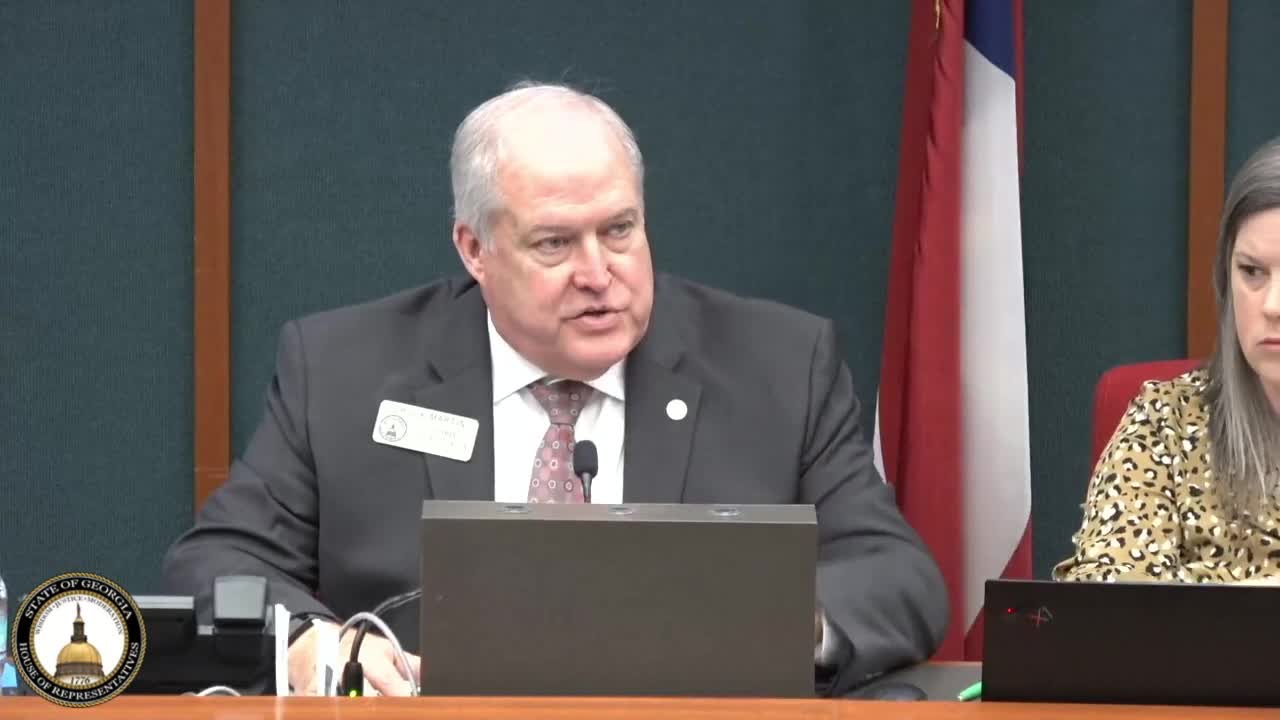
Chairman Martin of the committee said the presentation showed how the technology might be used to “educate our educators” by capturing effective teaching practices and making them available to other instructors.
Questions from committee members touched on classroom integrity, whether students are learning when AI helps produce homework, and how to integrate AI for first-year students. Sutherland urged clear statewide strategy, single-sign-on access to approved tools for faculty and students, and vocational programs that pair AI training with industry needs.
The presentation concluded with Sutherland offering to provide additional materials and to return for questions; the committee moved on to legislative business.
Ending: Committee members asked staff to consider Sutherland’s recommendations as they review related bills and workforce proposals this session.