Get Full Government Meeting Transcripts, Videos, & Alerts Forever!
Get email alerts on the Digital Assets Bitcoin topic
No spam. Unsubscribe anytime.
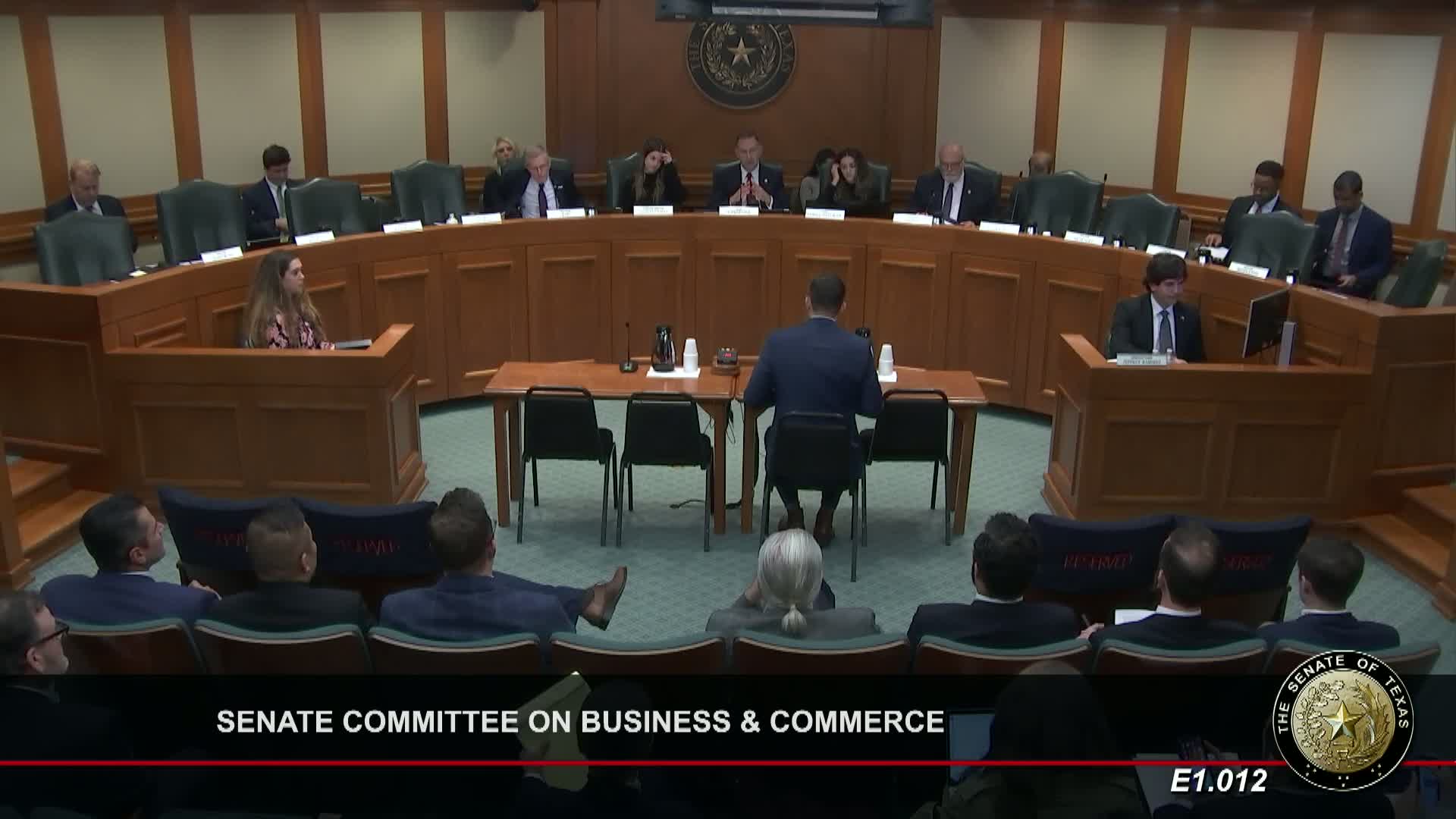
Senate committee hears hours of testimony on Texas 'Bitcoin Strategic Reserve' bill
Summary
Supporters told the Senate Committee on Business & Commerce that Senate Bill 21 would give Texas a hedging asset and advance innovation; opponents raised cybersecurity, energy and fiduciary concerns. Public testimony closed and the bill was left pending.
The Senate Committee on Business & Commerce heard hours of public testimony on Senate Bill 21, the Bitcoin Strategic Reserve bill, with proponents urging the state to adopt Bitcoin as a long-term reserve asset and opponents warning of security, energy and fiduciary risks.
Lee Bratcher, representing the Texas Blockchain Council, told the committee that the bill would extend Texas’ leadership in “industry, energy and innovation,” and that “Bitcoin is backed by the insights from Austrian economics around monetary scarcity.” He said private companies and individual Texans have signaled willingness to donate varying amounts of Bitcoin and that the bill empowers the comptroller’s office to issue an RFP for “institutional grade qualified custodians.”
The bill’s supporters told senators it would serve as a hedge against future monetary uncertainty and could increase demand for U.S. Treasury securities through related industries. “Stablecoins are the fifteenth largest buyer of U.S. debt,” a witness said, describing stablecoin purchases of treasuries in the hundreds of billions of dollars.
Opponents and skeptical witnesses urged caution. Blake Burns of Entrana Corporation said he stood “firmly against this bill” and argued the sector still lacks sufficient consumer protections and that Bitcoin’s early use by criminal actors remains a concern. Cyrus Reid of the Sierra Club’s Lonsar chapter argued that Bitcoin’s proof-of-work model is “very energy and water intensive,” and warned about effects on local energy and water infrastructure.
Committee members questioned witnesses on cybersecurity, custody and historical loss of coins. Robert DeMarco, chief executive officer of Novara BBX, said that “Bitcoin has never been hacked,” clarifying that attacks in the industry have targeted wallets, exchanges and custodial services rather than the protocol itself. Witnesses described improved custody options since Bitcoin’s early years — including hardware wallets, multisignature arrangements and insured custodians — and explained how lost private keys can permanently remove coins from circulation, reducing supply.
Witnesses also debated technical risks. Cort Welty, founder of Introna Corporation and leader of a tokenization work group, testified that Bitcoin’s cryptography is “legacy” and urged post-quantum encryption and additional controls for sovereignty and national-security uses; others disputed that characterization or said newer distributed ledger technologies are more appropriate for some government uses.
After multiple panels of public comment and questioning by senators, Chairman Schwartner closed public testimony. The committee left Senate Bill 21 pending for further consideration and rulemaking input, including the comptroller’s role in custody and acceptance of donations.
Lawmakers and witnesses signaled more information will be collected on donor identities, custody arrangements and technical safeguards before any appropriation or final decision by the legislature or the comptroller’s office.