Get Full Government Meeting Transcripts, Videos, & Alerts Forever!
Get email alerts on the Earned Wage Access topic
No spam. Unsubscribe anytime.
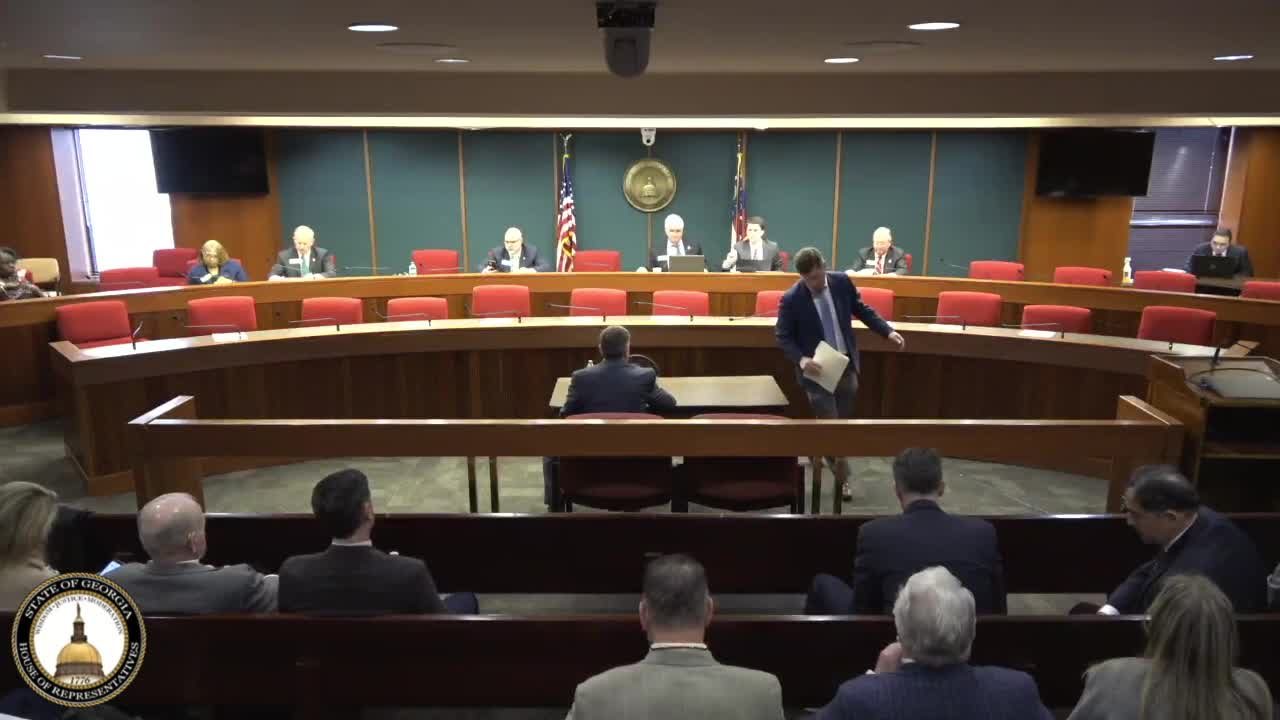
Committee approves bill to regulate earned-wage access providers as lenders
Summary
The House Banks and Banking Committee voted to pass House Bill 241, which clarifies that earned-wage access (EWA) products offered as loans fall under existing Georgia lending laws and permits a convenience fee up to $5 for instant transfers by licensed lenders.
The Georgia House Banks and Banking Committee voted to pass House Bill 241, a proposal to treat certain earned-wage access (EWA) products as loans regulated under Georgia lending statutes and to permit a convenience fee of up to $5 for instant transfers by licensed lenders.
The measure aims to provide regulatory clarity for EWA services—products that let workers access wages as they earn them rather than waiting for payday—by explicitly allowing providers that classify their advances as loans to operate under the state’s existing lending framework.
Chairman Trey Rhodes said the bill “provides regular regulatory clarity for certain types of earned wage access in Georgia and enhances consumer protections for our consumers.” Rhodes described EWA as a tool many workers find helpful to cover rent, utilities and other expenses that arise between paychecks.
Nick Stowell, who identified himself as representing Chime Financial, described his company’s MyPay product and how it would operate under the bill. “One of our newest products, which is called MyPay, is an earn wage access service that allows our customers to access their wages as they earn them ... for free, or for $2, if they want to access that money instantly,” Stowell said. He added that Chime treats MyPay as a loan so the company can fit within current lending statutes and, under the bill, a convenience fee up to $5 would be permissible for EWA advances structured as loans.
Consumer advocates urged further limits. Liz Coyle, executive director of Georgia Watch, said the organization appreciates the bill’s approach but recommended two changes: lowering the convenience-fee cap from $5 to $3 and inserting explicit 24-hour language to confirm the free option. “We think that would be the one area where we’d really like to see maybe a slightly lower from 5 to 3 for the expedite fee,” Coyle said, and urged specifying that consumers who decline instant access receive funds within 24 hours.
Committee members asked practical questions during the review. Stowell said Chime offers access within 24 hours for customers who do not pay the expedite fee, and that Chime allows customers to access up to 50% of earned wages up to $500 per pay period. When asked whether the industry broadly supports the approach, Stowell said he could not speak for the whole industry but that some providers are classifying their products as loans to come under lending statutes.
A motion to pass the bill was made and seconded; the committee adopted the measure by voice vote. The record in the transcript indicates approval by voice but does not list a roll-call tally or named votes.
The bill as passed by committee keeps the existing lending framework in place and adds an explicit convenience-fee allowance for licensed Georgia installment lenders that offer EWA advances as loans.