Get Full Government Meeting Transcripts, Videos, & Alerts Forever!
Get email alerts on the Legislation topic
No spam. Unsubscribe anytime.
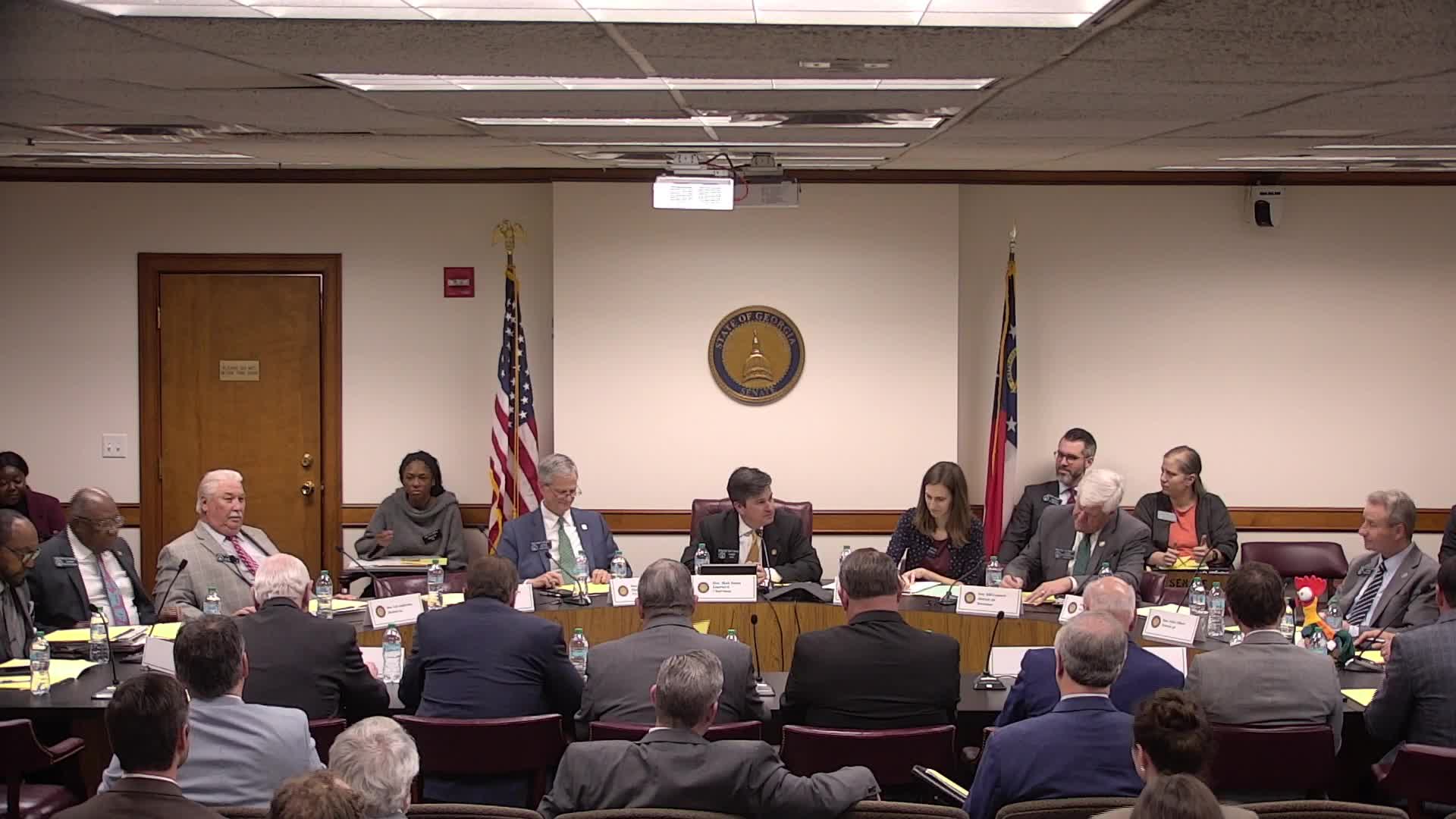
Senate committee advances package of bills including housing-board changes, guardianship, drones and school attendance reforms
Summary
A Georgia State Senate committee on Tuesday recommended that six measures be reported favorably to the full Senate, voting unanimously by voice to recommend “do pass.”
A Georgia State Senate committee on Tuesday recommended that six measures be reported favorably to the full Senate, voting unanimously by voice to recommend “do pass.” The bills and resolutions covered a mix of statewide policy and local matters, including a governor’s cleanup bill that alters multiple advisory bodies, a bill to allow county guardians to serve as conservators, a prohibition on purchasing drones manufactured by companies primarily owned in China, steps to restore local attendance-review teams in chronically absent districts, and two resolutions.
The committee chair convened the session and called the bills in sequence; after brief presentations and limited questions from senators, the committee took a single voice vote to move the listed measures forward. “All in favor, say aye.” “Aye.” “All opposed, say nay.” “Motion passes unanimous,” the chair said.
Why it matters: the measures reach a range of day-to-day and structural issues that affect state agencies, local governments and vulnerable populations. Several are intended as procedural fixes (a governor’s cleanup bill) while others would change how courts, local governments and state agencies operate or purchase equipment.
Senate Bill 96
Senator Echols described Senate Bill 96 as a governor’s bill that eliminates a number of advisory boards and, in at least one case, creates a new entity, the State Housing Trust Fund Board. “It’s a cleanup bill. It’s a good, good government bill to streamline this bureaucracy,” Echols said. The bill lists several boards affected, including the Environmental Advisory Council; the Jekyll Island Citizens Resource Council; the Governor’s Office for Children and Families Advisory Board; the Georgia Volunteer Fire Service Council; the Palliative Care and Quality of Life Advisory Council; and the Georgia Council on Lupus Education and Awareness.
Senate Bill 98
Senator Kauser presented Senate Bill 98 as a department bill to allow county guardians to also act as county conservators, which would give them authority to manage the finances of disabled or elderly individuals who cannot care for their own affairs. Kauser summarized the bill as expanding the powers available to county guardians.
Senate Bill 64
Senator Dixon said Senate Bill 64 would prohibit state and local governments from purchasing drones that are manufactured by companies “primarily owned by the Chinese.”
Senate Bill 100 ("Andy’s Law")
Senator Robertson described Senate Bill 100, known in discussion as Andy’s Law, saying it would allow people adopted in Georgia to obtain a copy of their original birth certificate at age 18 directly from the health department, without hiring an attorney. “This bill allows babies that are adopted here in Georgia to get a copy of their original birth certificate the same way the rest of us do when they turn 18,” Robertson said.
Senate Bill 112 (attendance-review teams)
Senator Ginn outlined a bill to reinvigorate an attendance-review-team program first established in 2005 for school districts with chronic absenteeism, defined in the presentation as students missing 10% or more of school days. Ginn said, “We have 380,000 kids in Georgia that were chronically absent from school last year,” and described the proposal as returning decision-making to local teams to identify causes and solutions for chronic absenteeism.
Local bills and resolutions
Senator Dixon and others presented local bills related to Mulberry in Gwinnett County, including a bill addressing service-delivery agreements and an annexation request from the city. Separate resolutions included SR 23 (term limits, details not specified in committee) and SR 96 (designating May 1 as Purebred Dog Day, selected by the committee for a future floor calendar).
Committee action
A single procedural motion to recommend “do pass” was made and seconded; the committee advanced the package to the Senate by unanimous voice vote. The transcript records the action as a voice vote and does not provide a numerical roll call.
What was not decided
The committee did not enact final laws; the measures were only recommended for floor consideration. Several presentations referenced background facts or external rulings but the committee did not adopt implementing language or appropriate funding on the floor. For example, a senator discussing public-records concerns referenced a recent U.S. Supreme Court ruling affecting open-records requests for work by a private contractor for Georgia Tech but did not detail statutory changes in committee. Similarly, the judgeship bill presenter said a circuit “has not added a judge since 1979,” but no appropriation or formal establishment was approved in the committee action.
Votes at a glance
- Motion: Recommend “do pass” on listed measures (SB 96; SB 98; SB 102; SB 138; SR 23; SR 96). Mover: senator (not specified in the transcript). Second: Senator Walker. Outcome: approved by unanimous voice vote; numerical tallies not recorded in transcript.
Next steps
The recommended bills and resolutions will be placed on the Senate calendar for floor consideration. Any senator may offer amendments on the floor; final passage will require a separate floor vote in the full Senate.