Get Full Government Meeting Transcripts, Videos, & Alerts Forever!
Get email alerts on the Automated Enforcement School Zones topic
No spam. Unsubscribe anytime.
Committee revises school-zone camera and bus-camera rules, leaves key choices to subcommittees
Summary
Lawmakers discussed a merged substitute tying automated school-zone speed cameras and school-bus camera rules into existing school-zone enforcement law; sponsors asked members to form subcommittees to refine permit, timing, revenue and penalty provisions before a Monday vote.
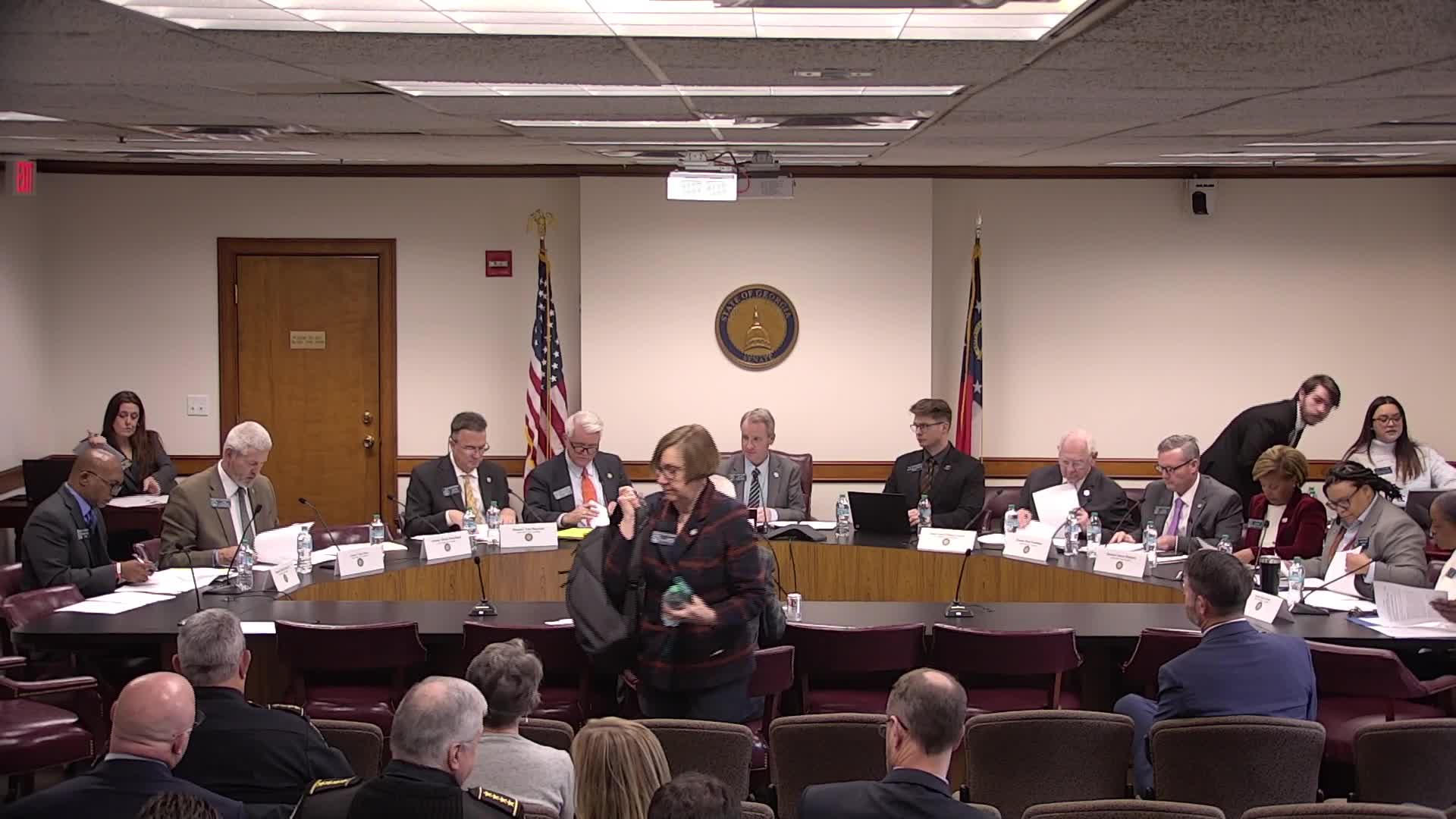
Senator Burns presented a committee substitute that ties elements of Senate Bill 75 to language previously considered in the session’s House substitute to House Bill 348. The substitute would define school zones by existing master state orders or local ordinances, require advance warning signs and driver-speed displays ahead of school zones, and set rules for automated enforcement and school-bus cameras.
Burns told the Senate Public Safety Committee the substitute includes a section requiring warning signs about a half-mile before a school zone and an additional sign within a quarter-mile displaying the motorist’s speed and the posted limit. He said the bill also preserves law enforcement authority to ticket drivers when an officer is actively using a speed-detection device.
Key operational details in the substitute include a permitted operating window for automated devices: 90 minutes before to 30 minutes after the official start of the school day, and 30 minutes before to 90 minutes after the official end. The bill would move the permitting authority from the Department of Transportation to the Department of Public Safety and would limit authorized uses of automated traffic enforcement devices to safety purposes only.
On fines and remittances, Burns said the substitute sets a flat civil penalty of $50 per automated-speed citation (down from $75 with prior escalation) and includes a $5 late fee. The substitute would require municipal remittances to the Peace Officers’ Annuity and Benefit (POAB) fund in Chapter 17 of Title 47; Burns asked the committee to consider striking some downstream language that would allow remaining revenues to be used for local public-safety initiatives after POAB obligations are met.
The substitute includes a provision that could subject a jurisdiction to state withholding of funds if an investigation finds improper use; Burns and committee members discussed that the language stating a jurisdiction “shall be subject to” withholding leaves enforcement discretion with the Department of Public Safety and is imprecise.
On school-bus cameras, Burns noted the substitute mirrors the citation-process language from speed-zone cameras and highlighted that state law already provides a $1,000 fine for illegally passing a school bus with its lights on. Committee members raised concerns about a mandatory $1,000 fine with no judicial discretion and the disproportionately small $5 late fee paired with that penalty.
Committee chair Senator Chuck Payne appointed two subcommittees — a first-responder subcommittee chaired by Senator Robertson and a general-welfare subcommittee chaired by Senator Tim Bearden — and asked Senator Burns to work with Senator Robertson to produce a final committee substitute for a planned Monday vote.