Get Full Government Meeting Transcripts, Videos, & Alerts Forever!
Get email alerts on the Appointments Agencies Leadership topic
No spam. Unsubscribe anytime.
Senate committee questions nominees for FSEC chair, Ecology director and state CIO on permitting, wildfire and digital modernization
Summary
The Senate Environment, Energy & Technology Committee heard three gubernatorial nominees on Oct. 12 — Kurt Beckett to chair FSEC, Casey Sixkiller for Department of Ecology director, and Bill Kehoe to lead Washington Technology Solutions and serve as state CIO — pressing each on engagement, permitting culture, wildfire coordination and technology governance.
The Senate Environment, Energy & Technology Committee held confirmation hearings for three gubernatorial nominations on Oct. 12, hearing extended discussion about energy siting, permitting culture, wildfire coordination, contaminated‑site redevelopment, and state information technology modernization.
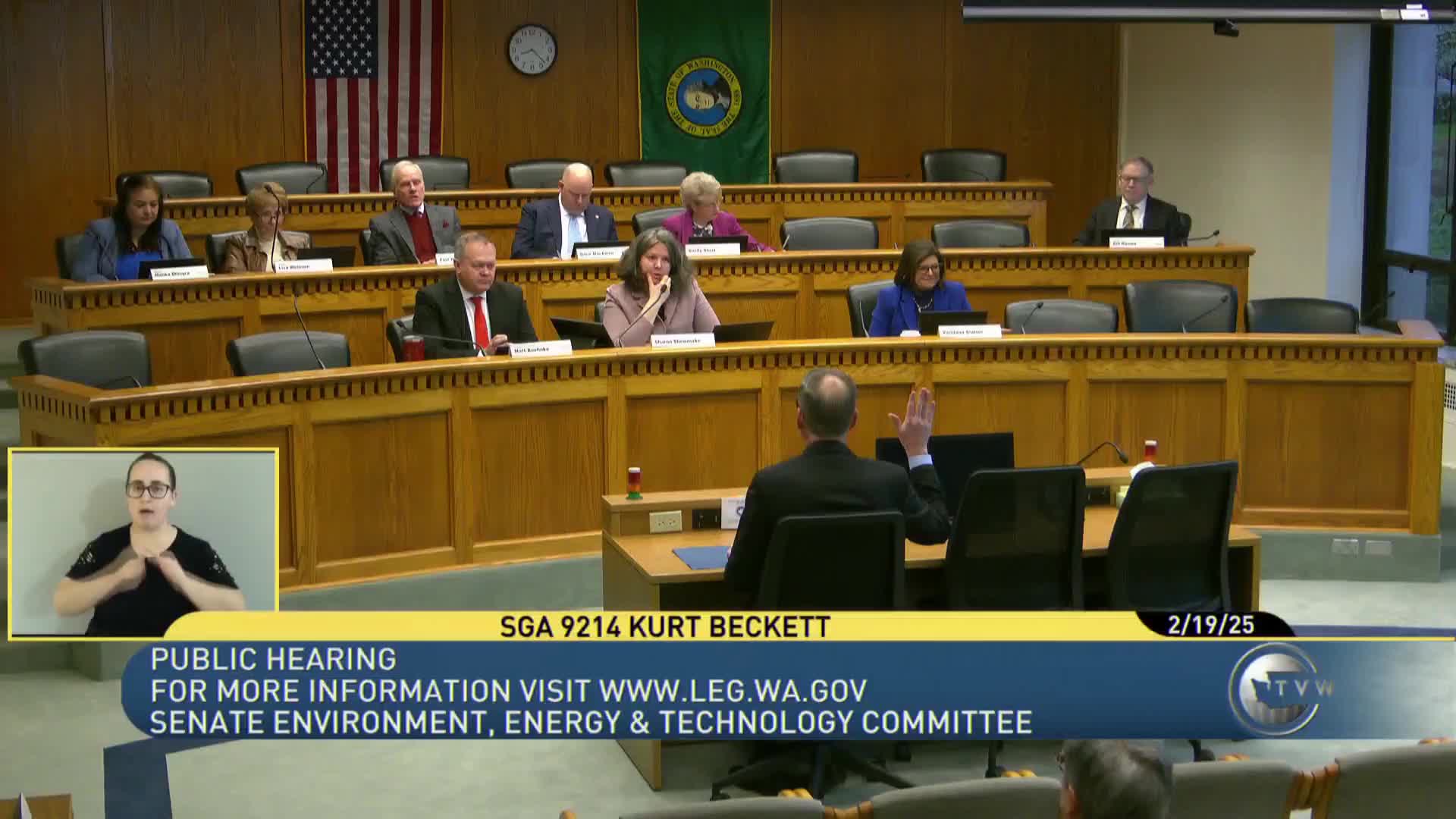
Kurt Beckett, governor’s nominee to be chair of the Energy Facility Site Evaluation Council (FSEC), described his background in port operations and federal‑state relationships and said he seeks to improve FSEC’s engagement with local governments, tribes and partner agencies. Beckett told senators that once a project is formally before FSEC "no one gets to talk to the council under adjudicative law," and he said the agency should expand pre‑application conversations and programmatic environmental reviews to avoid surprises and to build trust. "I think pre application conversations are key," Beckett said, adding he supports more transparent and time‑certain reviews and continuing FSEC’s statewide programmatic EIS work for transmission projects.
Senators asked Beckett how FSEC can address cumulative impacts and distribute siting equitably; he suggested multi‑agency dashboards and early engagement with counties and tribes and said FSEC could help keep projects in local permitting pathways where feasible.
Casey Sixkiller, nominated as director of the Department of Ecology, emphasized collaboration with tribes and local communities and said he plans statewide listening tours. Sixkiller, who recently served as an EPA regional administrator, said Ecology should "show up in a problem‑solving mode" and strike a balance between environmental protection and predictable permitting. On contaminated‑site redevelopment, he said faster, clearer consultation and technical assistance can reduce time and cost without skipping required steps.
Sixkiller also discussed federal funding uncertainty and the agency’s role if federal partners shift responsibilities. He said Ecology is analyzing potential consequences of federal changes and emphasized partnerships with EPA and NOAA on science and grants. On wildfire and prescribed burns, Sixkiller said he and the Department of Natural Resources are discussing ways to coordinate more closely and to prepare communities for smoke and emergency response.
William S. Kehoe, nominee to lead Washington Technology Solutions (WATEC) and serve as state chief information officer, presented his experience as a long‑time public sector CIO and described priorities for cybersecurity, enterprise services and technology governance. Kehoe highlighted a State and Local Cybersecurity Grant Program distributing roughly $18 million to local governments, tribes and higher education, and he said WATEC provides more than 60 enterprise services including network and telephony. He pledged to advance data management, resident‑facing portals, identity and access management, and a cautious, risk‑aware approach to artificial intelligence that emphasizes privacy and security.
Committee members pressed Kehoe on the troubled 1Washington modernization project and on transparency in evaluating IT investments. Kehoe said WATEC participates in the project's steering committee, has increased oversight and strategic advisory services, and believes the program can be brought to a successful go‑live after reassessment.
All three nominees said they would prioritize earlier engagement with stakeholders, clearer public communication, and process improvements to reduce delays. No confirmation votes were recorded during the committee session.