Get Full Government Meeting Transcripts, Videos, & Alerts Forever!
Get email alerts on the Housing topic
No spam. Unsubscribe anytime.
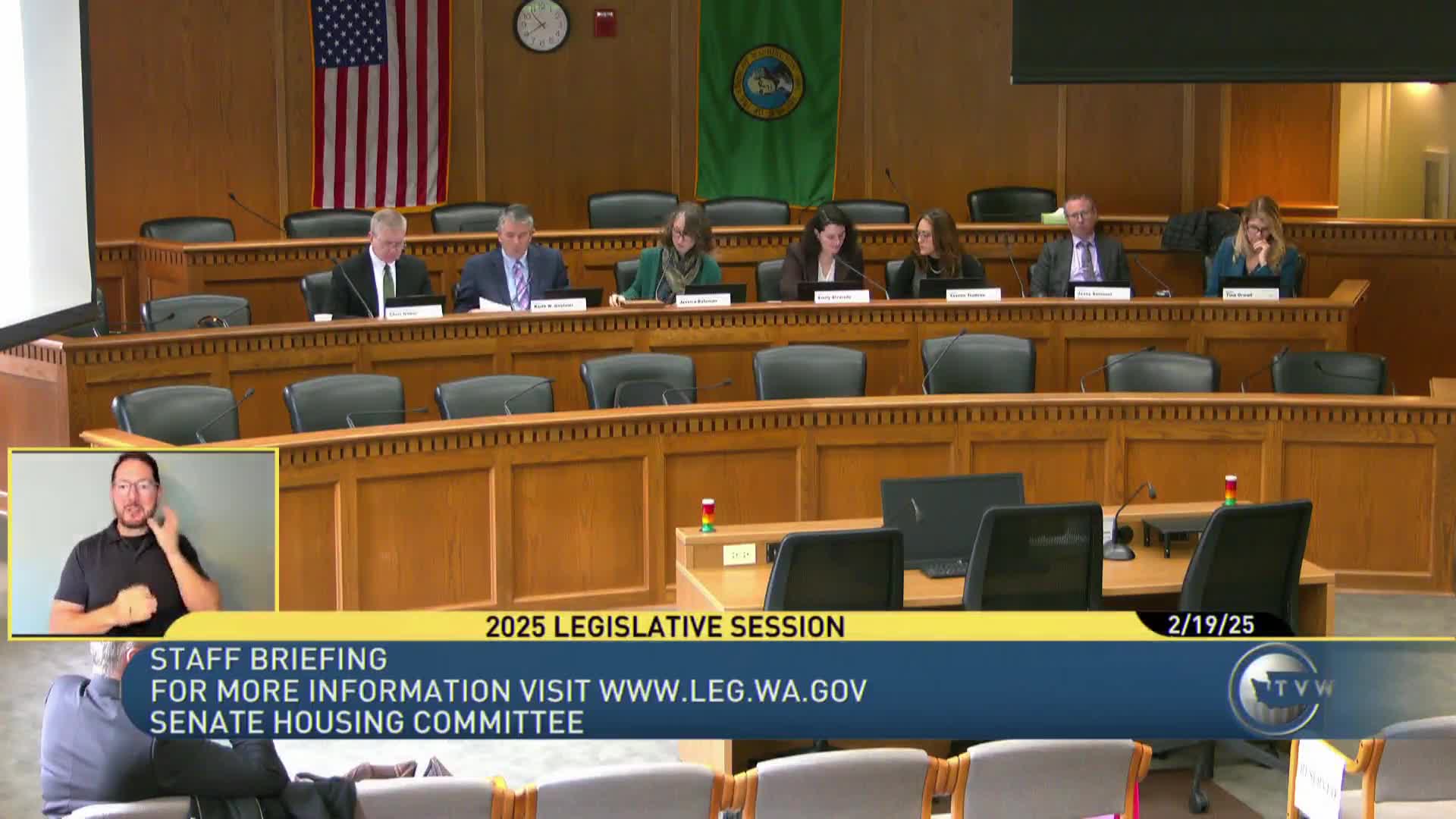
Senate committee considers bill allowing community and technical college land to support affordable housing (SB 5725)
Summary
Senate Bill 5,725 would let the State Board for Community and Technical Colleges transfer, lease or pledge underutilized college land for affordable housing, including long‑term leases and tax exemptions tied to affordability commitments.
The Senate Housing Committee on Feb. 19 heard testimony on Senate Bill 5,725, which would explicitly authorize the State Board for Community and Technical Colleges (CTC Board) to lease, transfer, assign, pledge or otherwise dispose of underutilized college property for affordable housing purposes and to use long‑term instruments — including up to 99‑year leases — to facilitate development.
Melissa Van Gorkholm, committee staff, summarized the bill and the central changes: the CTC Board would be permitted to use fee transfers or long‑term leases to support affordable housing development on surplus land; leasehold interests used for affordable housing would be exempt from the leasehold excise tax when a lessee commits to renting or selling 100% of units at affordable levels for 99 years; and the bill includes a right‑of‑first‑refusal provision for CDCs (community college districts) and a repurchase‑agreement mechanism allowing a CDC to reclaim land if a project fails to commence construction or secure financing within four years.
Sponsor Sen. Vandana Slatter framed the bill as a tool to expand supply of workforce and employee housing near colleges — citing examples such as a planned 192‑unit partnership at North Seattle College — and said the proposal is intended to make it easier for colleges to repurpose surplus land without returning to the Legislature for each transaction.
Developers and affordable‑housing organizations testified in support, describing financing complexities and asking the Legislature to allow fee transfers or discounted conveyances in addition to leases. Susan Boyd, CEO of Bellwether Housing, said Sound Transit’s surplus‑property program had “allowed us to increase production from 50 homes a year to over 200 homes a year” and urged the committee to permit below‑market fee transfers because “some financing structures do not accommodate long‑term ground leases.” Lincoln Farris, senior consultant to the chancellor and presidents of the Seattle Colleges, said the bill would clarify financing and pledge authorizations that were critical to making projects viable.
College system staff expressed conditional support and flagged concerns. Daryl Jennings, capital budget director for the State Board for Community and Technical Colleges, said the board already has broad authority to transfer property and that recent transactions (for example, a North Seattle College conveyance) taught the system operational lessons. Jennings said the current draft could “tie our hands in some situations” and the board requested revised language to preserve needed operational flexibility. Rosie Raimondo Charruzza, chancellor for the Seattle Colleges, described a ten‑year process that culminated in a fee sale (rather than a lease) only after encountering financing and IRS restrictions; she said student‑only housing financed by certain tax credits or bond mechanisms may not qualify for those financing sources, which complicates projects intended primarily for students.
Staff provided a preliminary fiscal estimate items tied to required JLARC review and Department of Revenue changes: a JLARC review cost roughly $15,000 initially and about $10,000 ongoing; Department of Revenue system updates estimated at $6,000; costs to community and technical colleges were listed as indeterminate.
Testimony emphasized two recurring themes: (1) permitting fee transfers or discounted conveyances is sometimes necessary to unlock low‑income housing finance and tax‑credit structures, and (2) legislative text should avoid restricting the CTC Board’s existing authorities or imposing procedural hurdles that would slow transactions. The bill’s advocates asked for explicit permissive language allowing below‑market fee transfers and clarity that colleges can use land as pledged collateral when needed for financing.
The committee did not take final action on SB 5,725 that day; committee staff said sponsors and agency representatives were continuing to negotiate technical fixes.