Get Full Government Meeting Transcripts, Videos, & Alerts Forever!
Get email alerts on the Energy Siting Local Control topic
No spam. Unsubscribe anytime.
Bill would bar state energy siting council from preempting local bans on battery storage in critical areas; sponsor cites safety and local rights
Summary
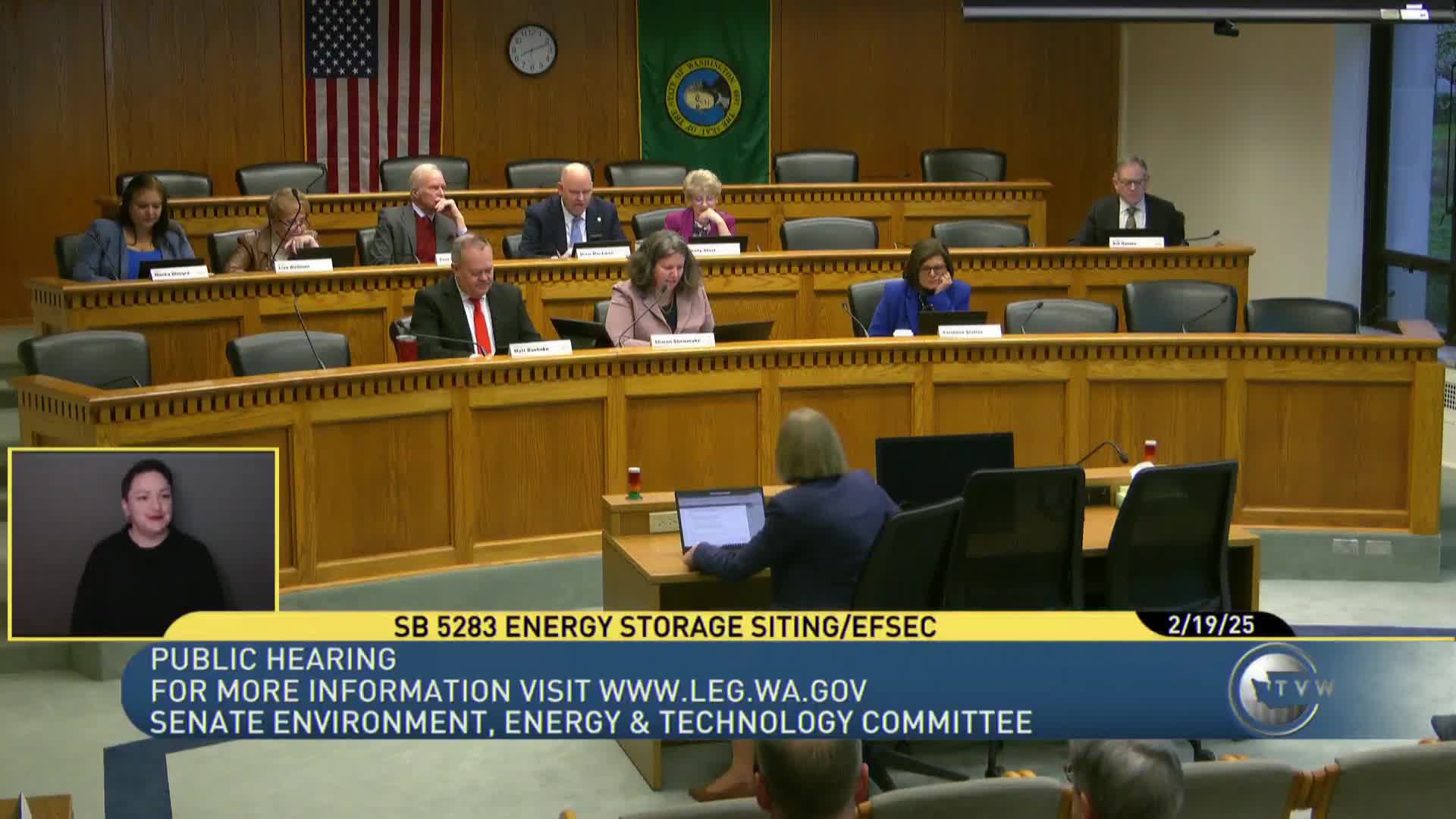
Senate Bill 5283 would stop the Energy Facility Site Evaluation Council from preempting local zoning that forbids siting certain electrical battery storage facilities in Growth Management Act critical areas, sponsor testimony and committee staff said at an Oct. 12 hearing.
Senate Bill 5283, introduced to the Senate Environment, Energy & Technology Committee, would prohibit the Energy Facility Site Evaluation Council (FSEC) from preempting local land‑use or zoning ordinances that bar siting certain electrical battery storage facilities in critical areas mapped under the Growth Management Act.
Kim Cushing, committee staff, briefed the panel that the bill targets FSEC preemption where battery storage projects have opted into FSEC’s permitting and certification process. "The bill before you prohibits FSEC from preempting land use or zoning ordinances for siting electrical battery storage facilities in these critical areas," Cushing said.
Senator Keith Wagner, sponsor and state senator who identified Sedro‑Woolley as the jurisdiction of concern, urged the committee to protect local zoning and environmental resources. Wagner described a proposed lithium‑ion storage site he said was "less than a mile outside a city of 12,000 people, within a mile and a half of 3 schools," and located near a salmon‑bearing stream. "Picture an idyllic farmer's field next to a clear salmon bearing stream," Wagner said. He told the committee recent large fires at battery storage sites underscore safety concerns and argued siting should favor hardened industrial areas rather than small agricultural communities.
Committee members pressed staff and the sponsor on definitions and scope. Senator Wellman asked whether "wetlands" and other critical‑area terms are specifically defined; staff replied that the bill pulls in the Growth Management Act definition of critical areas and that more precise definitions can be provided from that chapter. Senator Harris and others asked about motives for specific site selection; Wagner said proximity to existing transmission infrastructure and a nearby PSE corridor likely informed developers' decisions.
Wagner and others, including Kurt Beckett (appearing later as FSEC acting chair nominee in the same hearing), acknowledged the technology's role in the power system but said siting rules should avoid routing projects into areas that are environmentally sensitive, near schools, or lack local emergency resources. Wagner proposed that industrial land and other less‑sensitive locations would be more appropriate for battery storage or emerging alternatives.
Public testimony included Matt Steinman, an organic farmer from Skagit County, who said a proposed site near Hansen Creek threatened farmland and local water supplies. "This particular location has the potential to be flooded and just it it threatens the food source for many many Washingtonians," Steinman told senators.
The committee temporarily suspended the public hearing to consider gubernatorial appointments and later resumed; no vote on the bill was recorded during the session. Staff said a fiscal note was not yet available and that additional definition and mapping material could be provided to clarify how the Growth Management Act’s critical‑area categories would apply.