Get Full Government Meeting Transcripts, Videos, & Alerts Forever!
Get email alerts on the Public Finance Public Bank topic
No spam. Unsubscribe anytime.
Lawmakers hear creation of Washington public bank; proponents point to Bank of North Dakota model, bankers voice concerns
Summary
Senate committee heard pro‑ and con testimony on SB 5,754 to create a Washington State Public Bank. Supporters said a state‑owned bank could leverage public deposits to fund infrastructure and housing at lower net cost; bankers and community banks raised risk, oversight and deposit liquidity concerns.
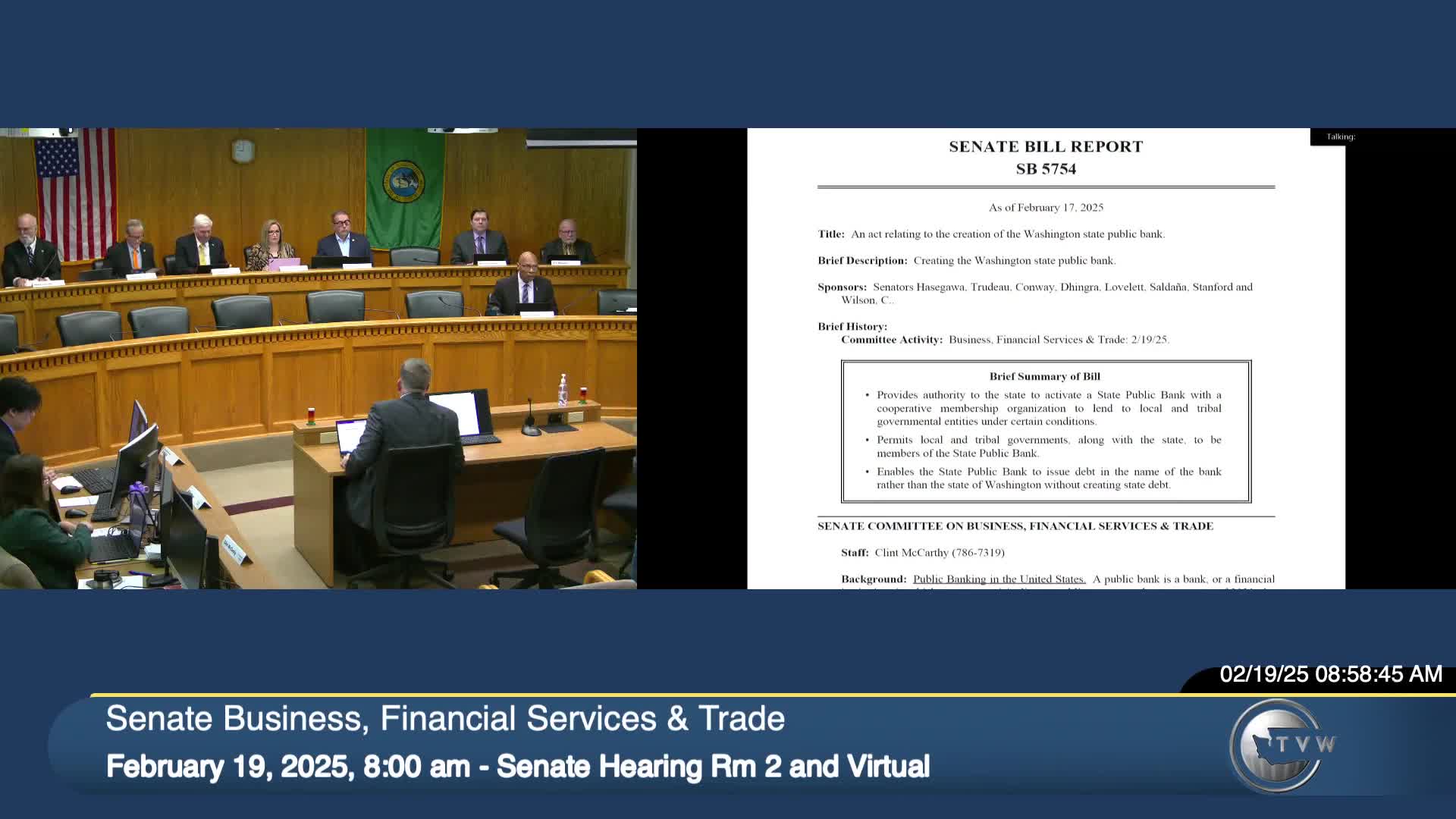
OLYMPIA — The Senate Financial Services and Trade Committee held a public hearing on SB 5,754, a proposal to create a Washington State Public Bank that would be owned by public members and able to lend to local and tribal governments and support infrastructure and economic development.
Committee staff described the bill’s structure: the bank would be established by appropriation, governed by a nine‑member board (including five directors appointed by bank members, three gubernatorial appointees, and the state treasurer as an ex officio member) and housed administratively within the office of the state treasurer. The bill would permit local and tribal governments to join as members and to borrow from the bank; bonds issued by the bank would be obligations of the bank, not the state, staff said. A fiscal note had been requested; staff noted a 2023 study of an earlier proposal estimated multi‑year start‑up costs in one variant.
Senator Bob Hasegawa, the bill’s sponsor, said the bill is intended to expand the state’s financing capacity for infrastructure, housing and economic development without raising taxes. Hasegawa and supporters pointed to the Bank of North Dakota as a working U.S. example in which state ownership has been used to support local lending and economic development.
Proponents included Marco Rossi of Washingtonians for Public Banking, who said Washington has lost local banking capacity since the 2008 recession and that a public bank could provide affordable credit for community‑scale projects. Kim Conavan, a city council member and attorney, and Catherine Lundowski, a retired nurse, also testified in support, citing North Dakota’s long track record.
Opponents included the Washington Bankers Association and Community Bankers of Washington. Glenn Simichek, president of the Washington Bankers Association, cited an earlier compilation of studies that concluded a state bank would be unlikely to achieve proponents’ objectives and could face political interference; he flagged a provision directing the treasurer to transfer state general‑fund and concentration account deposits into the public bank as “troubling.” Brad Tower of the Community Bankers of Washington warned that state deposits are a "river, not a lake" and criticized using demand deposits for long‑term lending, saying such a mismatch could create interest‑rate and liquidity risk.
Other opponents also raised concerns about exemption from certain standard safety nets and the potential for the bank to operate outside traditional federal oversight; proponents countered that the Bank of North Dakota model demonstrates resilience and local benefits, including higher community bank participation in loans and local economic returns.
The public hearing concluded with committee members requesting additional data. Staff said they will research the state’s current banking‑services costs and return with fiscal figures at a later time.