Get Full Government Meeting Transcripts, Videos, & Alerts Forever!
Get email alerts on the Housing topic
No spam. Unsubscribe anytime.
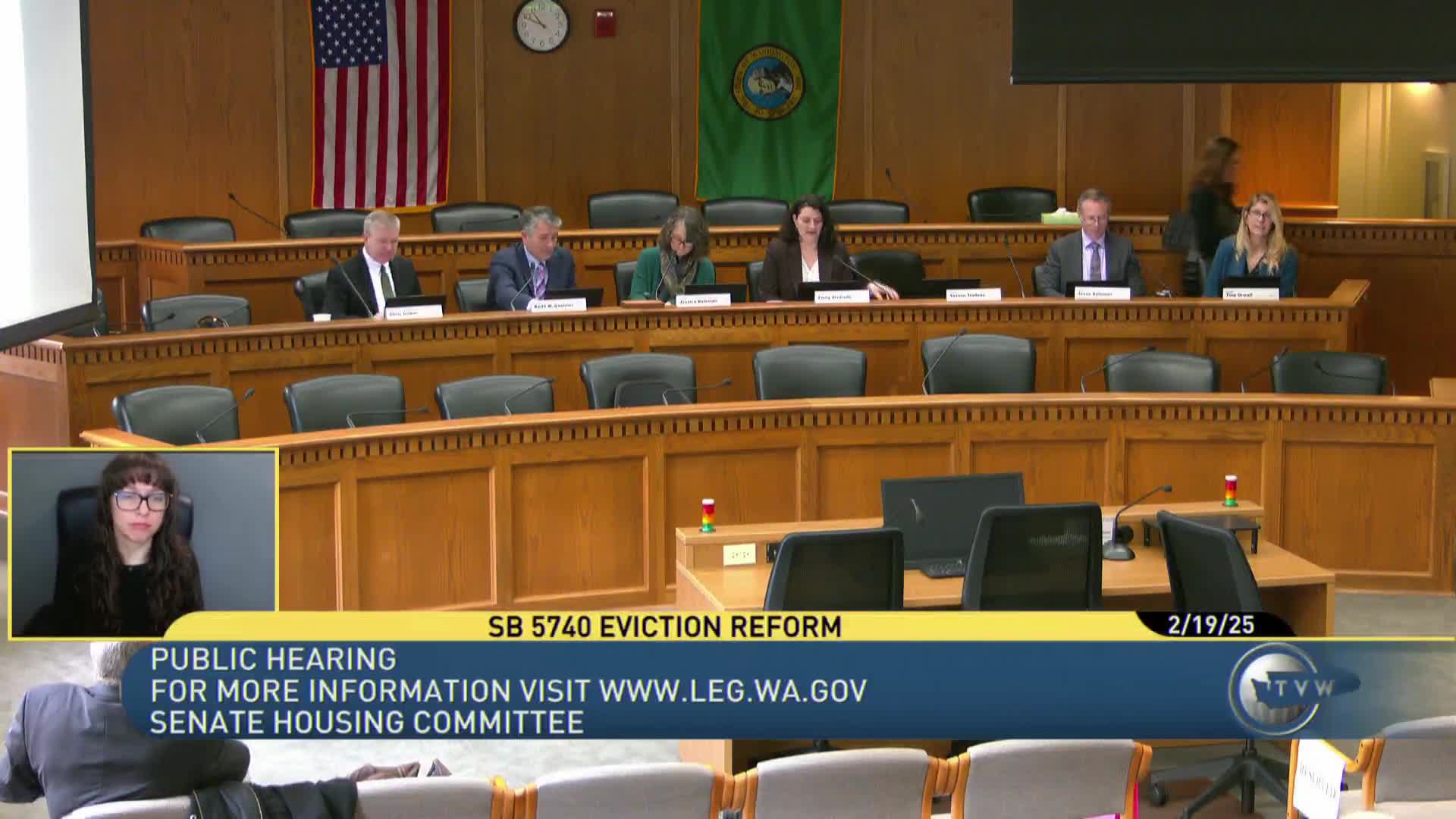
Committee hears hours of testimony on eviction reform and tenant-safety bill (SB 5740)
Summary
The Washington State Senate Housing Committee on Feb. 19 heard extensive testimony on SB 5,740, a bill that would allow courts to appoint attorneys as commissioners in unlawful detainer cases and would change several procedures and protections in eviction law.
The Washington State Senate Housing Committee on Feb. 19 heard extensive public testimony and staffing briefings on Senate Bill 5,740, a package of changes labeled “eviction reform and tenant safety” that would allow superior courts to appoint attorneys as commissioners for unlawful detainer actions and alter several procedural and substantive protections in the Residential Landlord Tenant Act (RLTA).
Bill Fosbury, staff to the committee, told members the bill would authorize superior courts to appoint one or more attorneys to act as commissioners in unlawful detainer actions; revise the unlawful detainer summons and the timing and scope of show-cause hearings; impose written-answer requirements on tenants; and change aspects of the RLTA’s just-cause eviction provisions, among other items. Fosbury summarized the bill’s three main components as court-commissioner appointments, changes to unlawful detainer procedure, and modifications to just-cause eviction rules.
The bill’s prime sponsor, Sen. John Braun, said the measure responds to court backlogs and delays that “provide a better way to help provide the resources necessary to manage the backlog.” Braun said the committee had seen “a large backlog and, therefore, a long wait times” in unlawful detainer cases and characterized the bill as a tool to address those capacity issues.
Supporters at the hearing — including multifamily operators and small landlords — emphasized courtroom delays and safety concerns. Audra Riddle, housing director at Goodman Real Estate, said delays can allow balances to grow beyond the point where community aid can help, and that “timelines are the same for both nonpayment of rent as well as life-safety cases.” Corey Brewer, representing small, private landlords, said some eviction cases he has seen took more than 14 months to resolve and left landlords unable to continue operating. Bruce Becker, a Seattle landlord, framed part of his support as a tenant-safety issue and urged the committee to act so “a dangerous person” can be removed faster.
Opponents — including tenant-advocacy organizations, legal-aid representatives and low-income housing advocates — urged rejection or substantial revision. Michelle Thomas of the Washington Low Income Housing Alliance said the bill would “roll back core protections for vulnerable renters” at a moment the state is seeing record eviction filings. Carrie Burnside of the Bellingham Tenants Union recounted receiving a retaliatory eviction after reporting code violations and said the bill would enable more misuse of eviction proceedings.
Office of Civil Legal Aid testimony highlighted procedural concerns. Philippe Knabb, eviction defense and reentry program director for OCLA, said several provisions risk increasing defaults or creating administrative impossibilities for the tenant-appointed‑counsel system: requiring full written answers during the appearance period (where oral answers have long been permitted), imposing near‑same‑day counsel-appointment timelines tied to show‑cause hearing notices, and placing onerous eligibility‑verification steps on counsel appointments. Knabb said those changes would increase default judgments and strain counsel capacity.
Legal services advocates also warned of ethical and practical conflicts. Christopher Brunetti of Northwest Justice Project argued that a proposed requirement for attorneys to share client eligibility information with OCLA before appointment could “require them to violate ethical duties, notably the duty to maintain client confidentiality” and could impair the right‑to‑counsel program.
Other concerns raised by opponents included disparate impacts on BIPOC renters, the link between rental instability and homelessness, and a prediction that rolling back tenant protections would increase displacement rather than stabilize housing.
The hearing drew large public interest: committee staff recorded hundreds of sign‑ins (288 pro, 814 con, 3 other). No final committee action on SB 5,740 occurred during the Feb. 19 meeting; the bill remains under consideration and drew a high volume of competing testimony.
Supporters and opponents asked the committee to address court capacity while preserving due‑process protections for tenants. Several witnesses urged complementary policy steps — for example, measures to limit excessive rent increases or to expand rental-assistance funding — rather than procedural rollbacks alone.
The committee suspended and resumed multiple times during the meeting for other agenda items; SB 5,740 remains subject to further amendment and debate in the Housing Committee and its subsequent referral path.