Get Full Government Meeting Transcripts, Videos, & Alerts Forever!
Get email alerts on the Public Health Supplements topic
No spam. Unsubscribe anytime.
Senate committee hears testimony on bill to bar sale of weight‑loss and muscle‑building supplements to minors
Summary
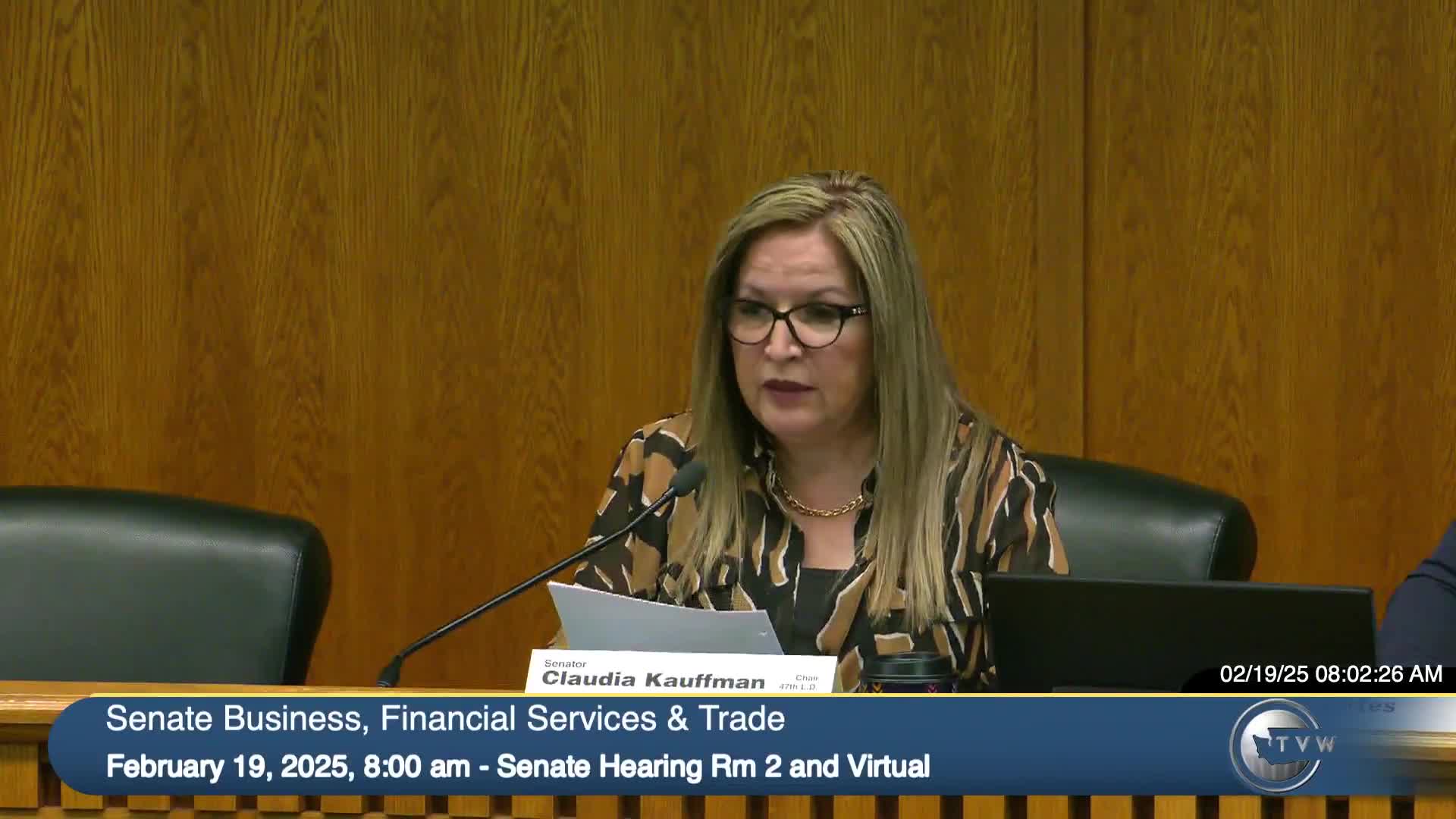
The Senate Financial Services and Trade Committee on Wednesday took public testimony on SB 5,622, legislation that would ban over‑the‑counter diet pills and dietary supplements marketed for weight loss or muscle building to anyone under 18.
MADISON, Wash. — The Senate Financial Services and Trade Committee on Wednesday took public testimony on SB 5,622, legislation that would ban in‑store and online sales of over‑the‑counter diet pills and dietary supplements marketed for weight loss or muscle building to people under 18.
John Kim, staff to the committee, told senators the proposal is patterned on a 2023 New York law and would prohibit a retail offer, sale or promotional giveaway of such products within the state to someone under 18. The bill sets out proof‑of‑age requirements for retailers, allows retailers to use transaction‑scan devices under limits, and authorizes the state attorney general to enforce the law and seek injunctions and penalties; a fiscal note was requested, Kim said.
The bill’s prime sponsor, Senator John Lubbock, 40th District, told the committee the measure is intended to prevent “negative outcomes for our youth,” saying adolescents are being targeted by companies that market untested or dangerous products. "The American Academy of Pediatrics has strongly cautioned against teens using these products," Lubbock said during his sponsor remarks.
During a nearly three‑hour public hearing, more than a dozen witnesses spoke. Several high‑school students testified in support, citing peer‑reviewed studies and public‑health warnings. Aden George, a Washington state high‑school student, said a Harvard study found one in 10 adolescents worldwide have used unregulated weight‑loss pills and cited a New England Journal of Medicine figure that dietary‑supplement exposures lead to about 23,000 U.S. emergency‑room visits annually. "These pills can result in organ failure, heart attacks, strokes, and even death," George said.
Other student supporters echoed concerns about hidden stimulants and contaminants in supplements and that the U.S. Food and Drug Administration lacks premarket authority over many dietary supplements because of the Dietary Supplement Health and Education Act of 1994. Corley Zhuang, a high‑school junior testifying in favor of the bill, said, "There is not enough federal, state, and state regulation for supplements," and urged senators to "prioritize youth lives and listen to the science." Several students said they were open to amendments so long as age protections for minors remained.
Industry representatives and grocery and retail groups testified in opposition or expressed concern about the bill’s breadth and practical effects on retailers. Tyler Cannon, representing the Natural Products Association, said federal regulators already impose “rigorous quality standards” and argued the bill rests on an unproven link between supplements and eating disorders. Peter Galbowski of the Association of Washington Business and Katie Beeson of the Washington Food Industry Association said the bill’s definitions could sweep in common wellness products, creating storage, staffing and liability challenges for small retailers. Carlos Gutierrez of the Consumer Healthcare Products Association said his trade group would be neutral if the law were limited only to products specifically marketed for weight loss, but said the current draft’s ingredient‑based lists and vague metabolization language were too broad.
Some testifiers cautioned the panel about constitutional and federal preemption risks. Committee staff noted that legal challenges to the New York law have already been filed in federal court; John Kim said those cases remain pending and that plaintiffs there alleged First Amendment and Fourteenth Amendment claims and argued federal law (the Federal Food, Drug, and Cosmetic Act) preempts state law.
Committee members asked about the bill’s exemptions and enforcement. Staff said the text excludes standard protein powders and foods marketed as containing protein unless those products contain other ingredients that fall within the bill’s definitions; the bill would list factors a court could consider when deciding whether a product is marketed for weight loss or muscle building.
The public hearing closed after roughly three hours of testimony. No final committee action or vote on SB 5,622 was taken during the hearing.
Looking ahead: committee staff said a fiscal note had been requested and that sponsors and industry representatives indicated a willingness to negotiate narrower definitions and other draft changes.
Sources: committee briefing by John Kim; public testimony by Senator John Lubbock and multiple student and industry witnesses.