Get Full Government Meeting Transcripts, Videos, & Alerts Forever!
Get email alerts on the Local Legislation Process topic
No spam. Unsubscribe anytime.
Subcommittee receives detailed briefing on Florida local-bill process and delegation meetings
Summary
Members heard a step-by-step presentation on how local bills are developed, noticed, certified and amended, including notice requirements, delegation meetings, economic impact statements, and special Senate calendar rules.
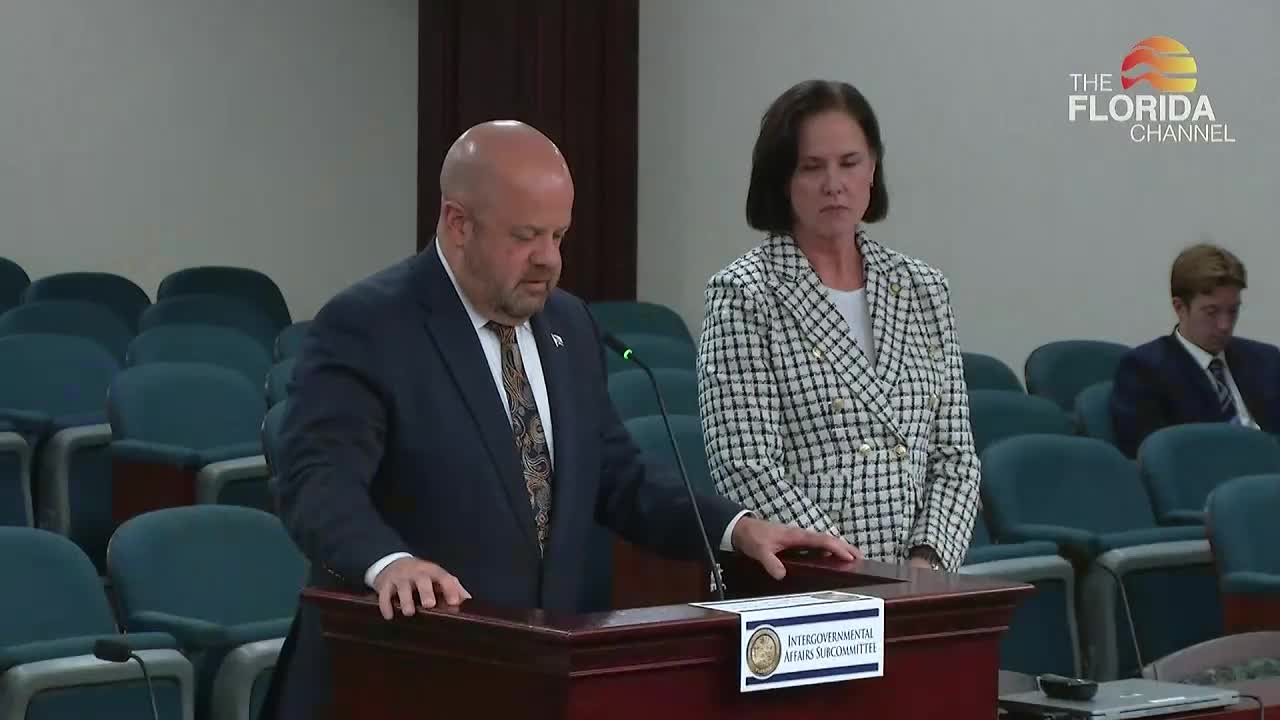
Representatives Robert Holcomb and Kendall briefed the Intergovernmental Affairs Subcommittee on the local-bill process, explaining when a local bill is appropriate, required public-notice procedures, delegation meeting rules, and filing requirements such as the Local Bill Certification Form and the economic impact statement.
Holcomb opened with a definition: “what is a local bill? The Florida Constitution recognizes 2 types of laws, general laws and special laws,” and explained that local bills are a form of special law limited to particular persons, places, or classes when a general law is not a proper vehicle. He noted that certain topics are constitutionally prohibited from local bills, such as the assessment or collection of taxes for state and county purposes and the disposition of public property for private purposes.
Kendall described the role and timing of local delegation meetings, which are public and must be properly noticed. He summarized notice requirements including publishing a legal advertisement at least 30 days before introduction (or posting in at least three public places if no newspaper circulation is available) and said the notice must summarize the substance of the proposed local bill. Kendall said each local delegation may adopt its own internal rules and that a local bill impacting multiple counties must be presented in each affected county’s delegation.
The presenters reviewed the administrative requirements that must accompany a filed local bill: a Local Bill Certification Form that certifies compliance with House rules and constitutional requirements (including House Rule 5.5A), and an economic impact statement projecting revenues and costs for the first two fiscal years after the bill’s effective date. Kendall explained that local bills do not require a Senate companion and that the Senate handles local bills on a special calendar generally during the last week of session; a senator may object and remove a bill from that calendar.
The briefing also covered amendment rules: an amendment to a local bill must be consistent with the published notice or else a revised notice must be published; substantive amendments require a Local Bill Amendment Form and approval of the local delegation. Holcomb and Kendall noted that, historically, the number of local bills per session has declined since the 1968 Florida Constitution but averages roughly 35 per session.
Members asked logistical questions: Representative Gerwig asked whether members whose districts overlap multiple counties serve on multiple delegations; presenters confirmed a member typically participates in each relevant delegation. Representative Daley and others asked about delegation thresholds and voting; presenters said a local delegation must approve a proposed local bill by a majority unless its internal rules require a higher threshold, and that the delegation’s chair signs the certification form for bills affecting more than one county.
The subcommittee heard the presentation as informational; no votes were taken. Committee leadership said the overview was intended to help members and the public better understand the procedural prerequisites the subcommittee enforces when it is the first committee to consider local bills.