Get Full Government Meeting Transcripts, Videos, & Alerts Forever!
Get email alerts on the Nursing Education topic
No spam. Unsubscribe anytime.
Lawmakers, educators press fixes as Florida remains near bottom on NCLEX pass rates
Summary
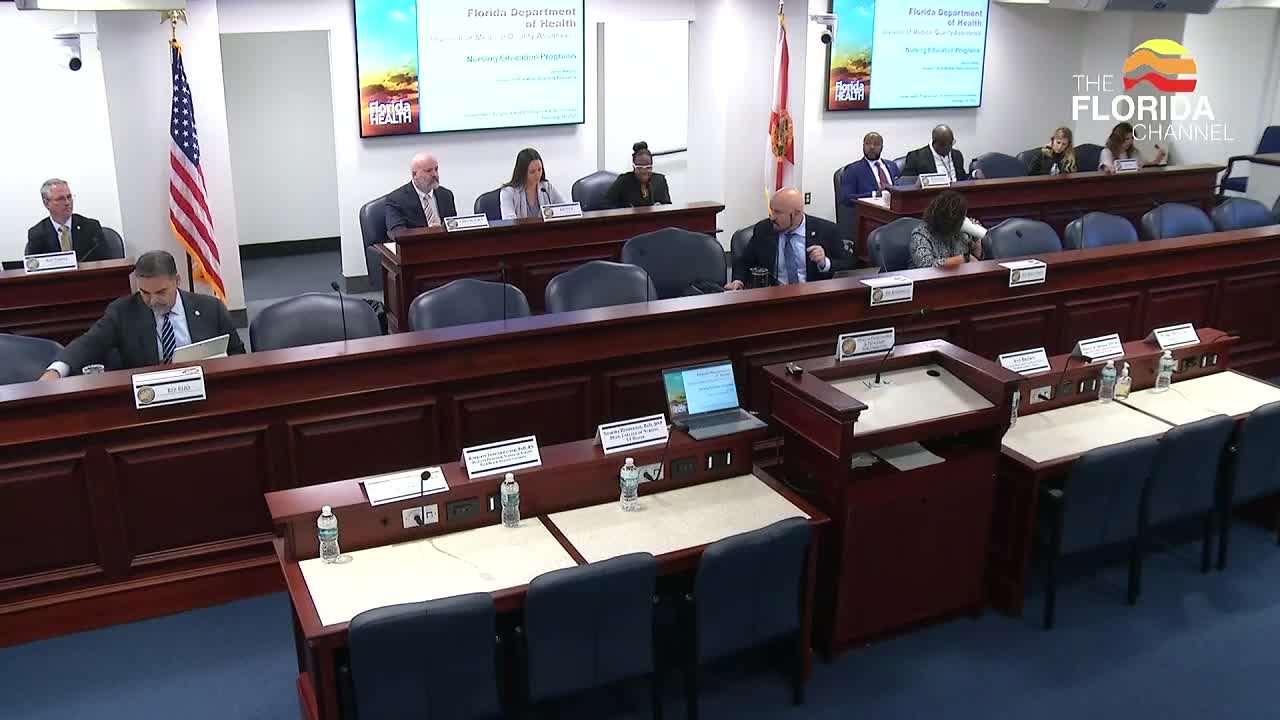
Chair Tuck opened the Health Professions & Grama Subcommittee hearing by saying, “Florida is predicted to have a shortfall of 59,000 nurses by 2035,” and asked state regulators and nursing educators to explain why Florida’s first‑time NCLEX pass rates remain low despite recent improvements.
Chair Tuck opened the Health Professions & Grama Subcommittee hearing by saying, “Florida is predicted to have a shortfall of 59,000 nurses by 2035,” and asked state regulators and nursing educators to explain why Florida’s first‑time NCLEX pass rates remain low despite recent improvements.
The Department of Health and the Florida Center for Nursing told the committee that Florida’s first‑time NCLEX pass rates have lagged the national average for more than a decade but that the gap has narrowed in the last three years. Jessica Najam, director, Bureau of Medical Quality Assurance at the Florida Department of Health, described the Board of Nursing’s program approval and probation rules and said the Board places programs on probation if their NCLEX passage rates are more than 10 percentage points below the national average for two consecutive years.
“The program is placed on probation, and they have two years to demonstrate they meet the passage‑rate benchmark; a program may request a one‑year extension,” Najam said. She added that termination follows if a program still fails to meet the benchmark after the extension. Najam also summarized the documentation required to obtain and retain Board approval: application and fee, institutional licensure from the Department of Education, faculty qualifications, curriculum evidence of statutory compliance, and verified clinical training sites.
Dr. Reina Letourneau, executive director of the Florida Center for Nursing and an associate professor at the University of South Florida, presented the Center’s statewide analysis. She said the Center’s 2023–24 annual evaluation counted roughly 510 pre‑licensure nursing programs (about 317 RN programs and 193 PN programs) and that Florida produces a large share of the nation’s test takers. “Florida produced the greatest number of NCLEX‑RN test takers in the nation,” Letourneau said, noting Florida accounted for about 8.73% of the nation’s RN test takers and about 6.5% of PN test takers in the most recent comparison.
Letourneau and Department of Health staff gave several data points that committee members used during questioning: Florida’s gap behind national pass rates reached its low point in 2020–2021 but has closed in recent years; many programs placed on probation over the past five years were private for‑profit institutions; and reasons for program termination included failure to submit required reports, repeated failure to meet passage rates and failure to obtain required accreditation.
Committee members and panelists identified multiple, often overlapping causes for lower first‑time pass rates. Panelists — administrators and deans from public, private nonprofit and private for‑profit programs — repeatedly cited a shortage of qualified nursing faculty, competition for clinical training sites, student academic preparation (especially in college‑level science and math and reading comprehension), and the resource intensity of high‑fidelity simulation labs and remediation programs.
Pedro de Guzman, president and CEO of HCI College, said that many students are returning adults with family and job responsibilities and that differences in household language or life circumstances affect test processing speed and study time. “If English is your second language or another language is dominant in your household, that may affect your processing speed on testing,” he said.
Speakers described program‑level strategies that have improved outcomes at several institutions: stricter admission/readmission policies paired with expanded remediation; routine use of NCLEX‑style computerized, adaptive practice exams throughout the curriculum; a mandatory capstone review and predictor tests before graduation; an on‑campus testing and remediation coordinator; and financial support or fee reimbursement to encourage students to test promptly after graduation. Florida Gateway College, which reported raising its RN pass rate from a low point during probation to the mid‑90s in recent years, credited mapping curriculum to NCLEX test plans, increasing internal benchmarks and creating a required 12‑week NCLEX remediation course.
Panelists and committee members also discussed accreditation. Letourneau noted that RN programs must obtain nursing‑specialty accreditation within five years of enrolling their first cohort; some private for‑profit programs are newer and still within that window. The Florida Center for Nursing’s analysis showed accredited programs generally outperform approved‑only or probationary programs on NCLEX first‑time pass rates.
On recommendations, panelists urged continued and targeted state funding rather than one‑off measures. Suggested priorities included sustained line‑item funding for (1) graduate nurse education to expand the pipeline for nursing faculty; (2) simulation labs and simulation operating funds; (3) remediation and test‑prep resources for students; and (4) structured mentorship, training or peer‑review programs for program administrators at newer or struggling schools. One panelist proposed a six‑month target for students to sit for the NCLEX after graduation to preserve knowledge and increase the chance of first‑time success.
Committee members asked for additional followups on several items that were not available during the hearing, including the precise number of programs opened or reorganized in recent years, whether terminated programs later reappeared under new names or addresses, and the post‑termination disposition of affected students. Najam and Letourneau said they would consult agency records and the Board of Nursing and provide those specifics on request.
No formal motions or votes were recorded during the hearing. The committee adjourned after the panel discussion and member questions.
Why this matters: lawmaker and provider testimony showed Florida still ranks near the bottom of states and jurisdictions on first‑time NCLEX pass rates despite recent improvements, while the state faces a projected nursing shortage. Committee members indicated they will use the testimony and data to consider policy and budget proposals focusing on faculty development, simulation capacity and remediation support.
The hearing transcript records numerous data tables and slide references provided by the Department of Health and the Florida Center for Nursing; committee staff and agency presenters said they will follow up with more detailed program‑level information that was not available at the hearing.