Get Full Government Meeting Transcripts, Videos, & Alerts Forever!
Get email alerts on the Workforce Education Funding topic
No spam. Unsubscribe anytime.
Florida education panel reviews district workforce funding model as state readies budget
Summary
The Higher Education Appropriations Subcommittee heard a detailed briefing Wednesday on how Florida calculates state funding for district workforce education programs as lawmakers prepare budget decisions for the upcoming year.
The Higher Education Appropriations Subcommittee heard a detailed briefing Wednesday on how Florida calculates state funding for district workforce education programs as lawmakers prepare budget decisions for the upcoming year.
The briefing matters because the funding model determines how state dollars are allocated to career and technical programs in school districts across Florida and figures centrally in requests to increase or reallocate appropriations.
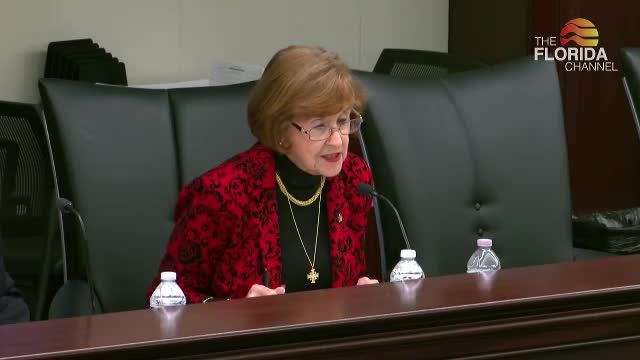
Tara Goodman, vice chancellor of career and adult education at the Florida Department of Education, told the committee that district workforce programs include non–college-credit career certificates and applied technology diplomas, registered apprenticeship partnerships and adult general education designed to prepare individuals for career technical programs. "A large array of technical career and technical education programs and a variety of literacy programs that are intended to prepare individuals in Florida to enter into those career and technical education programs," Goodman said.
Goodman said 56 of Florida's 67 school districts currently offer one or more workforce program types; some rural districts provide only adult general education while neighboring districts or Florida College System institutions deliver technical programs. She provided counts from the department's data showing about 39 districts offer career certificates, 15 offer applied technology diplomas, 19 offer registered apprenticeship partnerships and 55 offer some form of adult general education.
The department explained the model uses historical enrollment rather than current-year estimates. "There is no estimate of FTE in the current year for district workforce education," Goodman said, adding the model presented to the committee is based on a two‑year average of 2022–23 and 2023–24 enrollment and is being used to fund 2025–26. The use of lagged data, she said, is a reason local districts receive a lump-sum appropriation and retain flexibility to reallocate funds to reflect changing local needs.
The model incorporates differential cost weights (low, medium and high) for program types to reflect varying instructional costs and required equipment. Goodman said higher‑cost programs (for example, welding or aviation mechanics) receive larger weights; some health‑care programs and those with intense consumables or low student‑to‑teacher ratios are placed in higher cost categories. "We're required to assign low, medium, and high funding weights to all of the programs, and that's what this model does," she said.
Goodman also described adjustments the model makes for locally collected tuition and fees (which are backed out to calculate the state's funding need), a minimum‑funding floor to support very small rural programs, and a small set of supplemental factors including documented disability costs and GED testing operations. She estimated federal funds available to districts at approximately $34,000,000 from WIOA and about $6,000,000 for postsecondary Perkins (totaling about $40,000,000).
The model sums program costs, applies supplemental factors and subtracts tuition revenue to arrive at a state funding need for each district; comparing that need to the current appropriation produces an "unmet funding need" number the department said has historically guided where additional state resources should be placed. Goodman said the workload model is reviewed annually with district technical college directors and that the model's primary driver is the prior year recurring appropriation.
On questions, committee chair Sen. Harrell asked whether very expensive programs such as nursing have additional categories or weights. Goodman said many health care programs are in a higher weight category and some receive a 2.5 weight to reflect greater cost; she offered to share the department's full program list showing each program's assigned weight. "We're happy to share a list of all the programs and where they might fall," Goodman said.
The presentation concluded with the department inviting committee members to ask further questions and confirming that the model is a tool for legislators to determine how to apportion increases, level funding, or reductions based on demonstrated enrollment and costs.
No formal committee votes were recorded on the funding model during the meeting.