Get Full Government Meeting Transcripts, Videos, & Alerts Forever!
Get email alerts on the Fish Wildlife Commission Reform topic
No spam. Unsubscribe anytime.
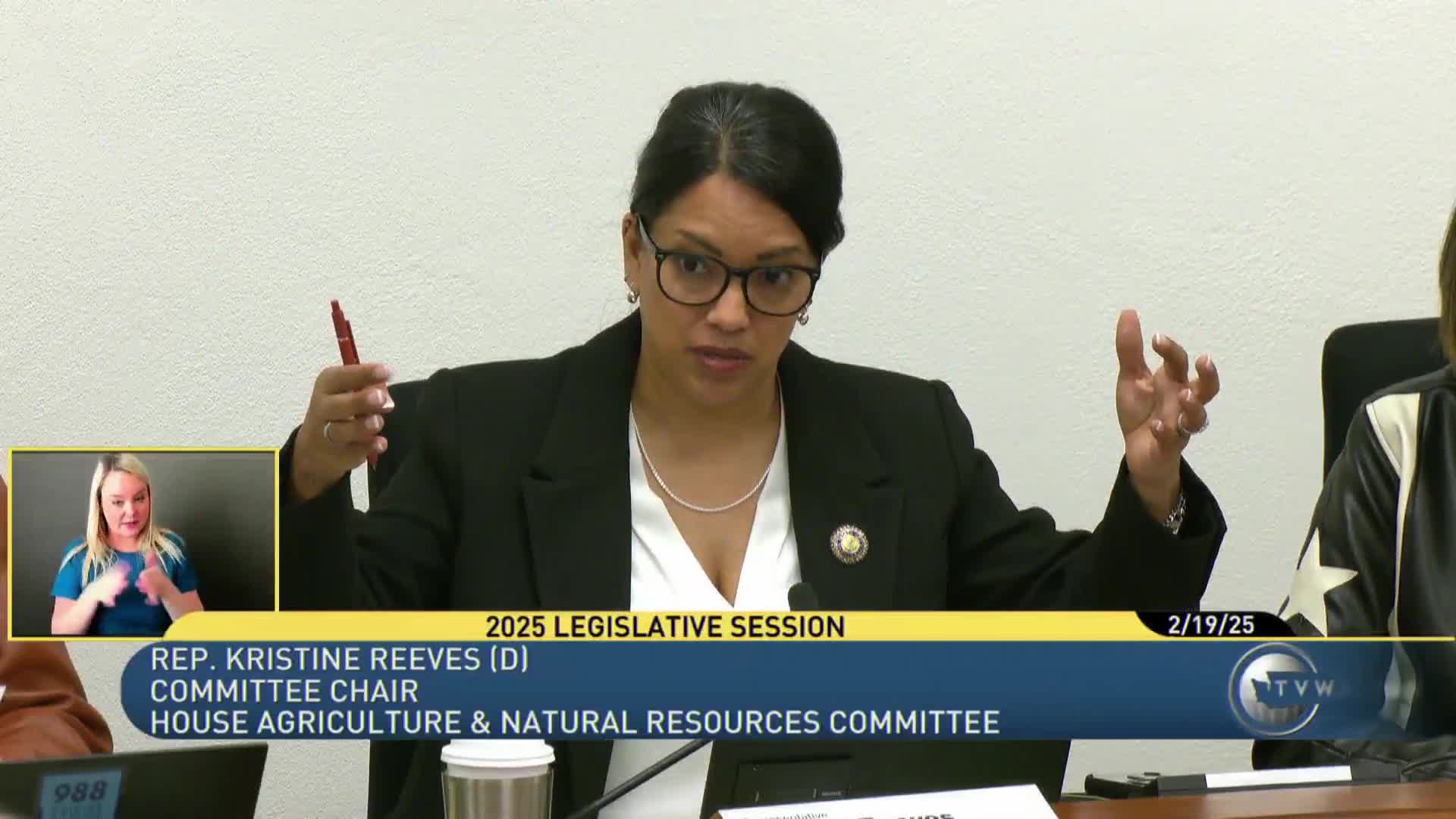
Lawmakers hear wide-ranging testimony on Fish and Wildlife Commission reform; two bills debated at public hearing
Summary
The Agriculture and Natural Resources Committee heard public testimony Feb. 19 on two competing bills to change governance of the Washington Fish and Wildlife Commission: HB 16-85 (would shift the commission to an advisory role and make the director the executive) and HB 19-30 (would change appointment and regional representation).
The House Agriculture and Natural Resources Committee held a lengthy public hearing Feb. 19 on competing proposals to change how the Washington Fish and Wildlife Commission is structured and how commissioners are appointed.
House Bill 16-85, presented by Representative Springer, would make the commission an advisory body and establish the director of the Department of Fish and Wildlife (DFW) as the agency's executive and administrative head; it would also create an interagency work group for issues that significantly affect fish and wildlife. Representative Springer described the bill as the start of a longer process to address perceived dysfunction and to find a more "fair, balanced" structure.
House Bill 19-30, presented by Ranking Member Dent, would change the commission's composition and appointment process: six commissioners would be appointed by county legislative authorities from each of DFW's six regions (one from each region), and three at-large members would be appointed by the governor and confirmed by the Senate; the bill would require that nominees have held a hunting or fishing license in three of the previous five years and would require in-person meetings in each region, subject to appropriation.
Committee staff walked members through the current statutory framework and the bills' provisions; the hearing then drew more than 50 testifiers who represented tribes, conservation organizations, sporting and hunting groups, local government and private citizens. Testimony reflected a wide range of views:
- Support for HB 16-85 came from speakers who said the current commission structure places impossible demands on volunteer commissioners, and that making the director the executive head would improve accountability and interagency coordination. Clara Lobes Davis, president and executive director of Washington Wildlife First, told the committee the system as currently configured is "unrealistic and unfair" for nine appointed volunteers and supported HB 16-85 as a step toward a more functional governance system.
- Support for HB 19-30 came from several sporting, agricultural and conservation groups who argued the commission should remain a policymaking body with stronger checks and clearer regional representation. Ducks Unlimited and the Washington State Farm Bureau expressed support for HB 19-30's effort to add regional nominees and qualifications for commissioners; Ducks Unlimited described HB 19-30 as preferable to HB 16-85 because it preserves the commission as a check and balance on the executive.
- Tribes and many conservation organizations urged careful attention to co-management and treaty obligations. Chairman Ron Allen of the Jamestown S'Klallam Tribe said his tribe "is very much in support of 16-85" insofar as it improves government-to-government interactions and continuity with the governor as the state's executive.
- Dozens of individual citizens and organizations presented competing arguments on representation and public values. Several conservation groups argued that HB 19-30 would inappropriately limit commission membership to hunters and anglers by requiring license-holding in three of the previous five years; witnesses including scientists and policy advocates called that restriction undemocratic and noted that many Washingtonians engage with wildlife non-consumptively. Others, including several hunting and angling organizations, supported a licensing requirement or local-region representation so commissioners would have direct experience with consumptive-use management and local conditions.
Committee staff, members and multiple witnesses repeatedly referenced the Ruckelshaus report as a prior study of commission performance; witnesses diverged sharply on whether that report's findings pointed toward structural overhaul or toward targeted governance and accountability reforms.
No committee vote was taken on either bill at the hearing. Committee staff said there would be follow-up work; staff also agreed to provide additional information requested during the hearing, including numbers and revenue related to hunting and fishing licenses for members who asked for those figures.
Ending Lawmakers closed the public hearing after hearing more than an hour of remote and in-person testimony; members and staff thanked testifiers and noted the committee will take additional time to consider suggested changes and data before moving either proposal further.