Get Full Government Meeting Transcripts, Videos, & Alerts Forever!
Get email alerts on the Health Committee Multi Bill Roundup topic
No spam. Unsubscribe anytime.
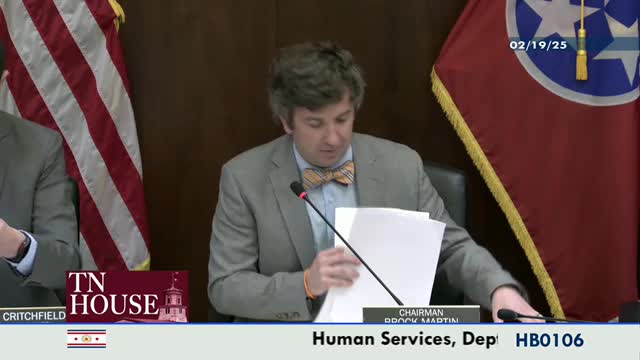
Health subcommittee advances wide slate of bills on school safety, pharmacy authority, adult services and genomic protections
Summary
On Feb. 19, 2019, the House Health Subcommittee advanced a bundle of bills to the full Health Committee, mostly by unanimous votes. Items included measures to allow schools to stock emergency inhalers, expand pharmacists' ability to provide care and adjust eligibility and naming conventions for adult day services and ABLE accounts; the panel also
NASHVILLE — The House Health Subcommittee on Feb. 19 advanced a series of health-related bills to the full House Health Committee, approving most measures unanimously. The panel took up a wide-ranging agenda that included school safety, first-responder care in schools, pharmacy authority and measures touching genomics and organ-harvesting prohibitions.
The committee advanced the following bills and resolutions (votes and short descriptions below):
Votes at a glance
- House Bill 106 (amendment added, drafting code 003599): Administration bill clarifying childcare code to create exemptions for gym-based child drop-off, professional sports teams and YMCAs; moved to Health Full Committee, 9-0.
- House Bill 760: Allows schools to maintain an emergency stock of inhalers for students who are undiagnosed or forget an inhaler; sponsor said "approximately 10 percent of children suffer from asthma." Moved to Health Full Committee, 9-0.
- House Bill 496: Raises the disability-onset age for ABLE accounts from 26 to 46 to keep Tennessee aligned with federal law; moved to Health Full Committee, 9-0.
- House Joint Resolution 120: Urges the Department of Health to implement voluntary reporting for Charcot-Marie-Tooth disease to improve epidemiology and grant competitiveness; moved to Health Full Committee, 9-0.
- House Bill 693: Codifies prior expansion that allowed pharmacists to prescribe for certain conditions and clarifies that pharmacists may schedule consultations and collect fees when prescribing hormonal contraception; moved to Health Full Committee, 9-0.
- House Bill 157: Changes statutory terminology from "adult day care" to "adult day services" to reflect contemporary practice; moved to Health Full Committee, 9-0.
- House Bill 62: Authorizes athletic trainers to perform dry needling under specified training and board oversight; sponsors and provider groups negotiated language setting training standards and board authority. The amendment lists continuing-education and training requirements and authorizes the board to add conditions. The bill moved to Health Full, 8-1 (one nay).
- House Bill 386: Extends the safe-haven newborn possession window from 14 days to 45 days, aligning Tennessee with several other states; moved to Health Full Committee, 9-0.
- House Bill 657: Allows health-care providers who complete peer-assistance treatment programs to petition licensing boards to remove public disciplinary information after a statutory period (petition available after 10 years as written); moved to Health Full Committee, 9-0.
- House Bill 192: Expands "Right to Try" concepts to allow individualized investigational treatments, including some targeted gene therapies, under a parallel process; moved to Health Full Committee, 9-0.
- House Bill 395 (amended): Tennessee Genomic Security and Forced Organ Harvesting Act, addressing genomic data protections and prohibiting state participation in forcible organ harvesting linked to foreign adversaries; moved to Health Full Committee, 9-0.
Rolled: House Bill 702 was rolled for two weeks and not considered.
Notable discussion
Several bills drew minimal debate and passed unanimously. Two items prompted more extended questions: HB62 on dry needling and HB657 on peer-assistance record removal. On HB62, Representative Williams cautioned about training and clinical complexity: "Dry needling is a complex and very thorough process ... How comfortable are you knowing that a physical therapist goes to school for a considerably longer period than an athletic trainer would but they would still have the proficiency in training in order to do this?" The sponsor and amendment language emphasized training requirements and authorized the relevant board to set further conditions.
On HB657, members discussed whether a 10-year time period before a petition is eligible is appropriate; the sponsor said the length was under active consideration and acknowledged workforce shortages and the need to balance public safety with provider recovery.
Ending: All advanced bills will be considered by the full House Health Committee next week; sponsors and committee members asked for follow-up details (training standards, fiscal notes and federal coordination where applicable).