Get Full Government Meeting Transcripts, Videos, & Alerts Forever!
Get email alerts on the Behavioral Health Budget topic
No spam. Unsubscribe anytime.
Department of Mental Health seeks targeted investments in school liaisons, workforce and opioid grants
Summary
The Department of Mental Health and Substance Abuse presented its FY2026 budget request emphasizing school-based behavioral health expansion, workforce scholarships, provider rate parity for residential addiction services, and federal opioid response grants; committee approved sending the budget forward.
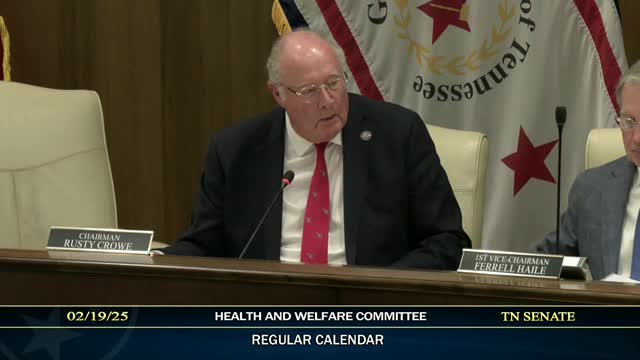
The Department of Mental Health and Substance Abuse presented a fiscal 2026 budget request to the Senate Health and Welfare Committee that emphasizes scaling school‑based behavioral health, a workforce scholarship expansion and continuing federal opioid‑response grants.
The commissioner said the department's priorities include: expanding school‑based behavioral health liaisons toward the goal of one liaison in every school ($1.0 million request); $5.1 million in certified public expenditure revenues to increase capacity at the Middle Tennessee Mental Health Institute (funded via TennCare financing mechanisms, not new state general funds); a $4.4 million nonrecurring expansion of the Tennessee Pathways Behavioral Health Scholarship program to train additional behavioral health professionals; $1.9 million to increase residential substance use treatment rates to parity with TennCare; $4.0 million for a behavioral health safety net; and $1.4 million nonrecurring for analysis and strengthening of the crisis services continuum while the department and TennCare study provider needs.
The department also outlined federal SOAR opioid response funding (SOAR 4) of about $30.7 million and other federal and opioid‑abatement initiatives. Commissioners noted that rate increases and scholarship funding aim to reduce provider vacancies and expand capacity. The department reported reductions in provider vacancies and that the school‑based liaison program has grown to 390 funded positions, with a 255% increase over five years in the number of students receiving direct services.
Committee members questioned the department about outcomes for overdose deaths, sample results from the gambling treatment clinic, and hospital staffing shortages. Deputy Commissioner Matt Yancey and Ty Thornton, chief of hospital operations, told the committee vacancies at state hospitals have declined markedly with focused hiring and operational changes; Ty reported reductions in psychiatric technician vacancies from about 80 a year ago to about 12 as of the week of the hearing. The committee voted to advance the department's budget to the next stage with nine ayes recorded.