Get Full Government Meeting Transcripts, Videos, & Alerts Forever!
Get email alerts on the Purchasing Cooperatives topic
No spam. Unsubscribe anytime.
Panel advances bill clarifying use of purchasing cooperatives for construction materials
Summary
The Cities & Counties Subcommittee advanced House Bill 546 to clarify that local governments may use purchasing cooperative contracts to buy construction materials, after sponsors said the change aims to avoid audit findings; the measure passed on a 5–1 vote.
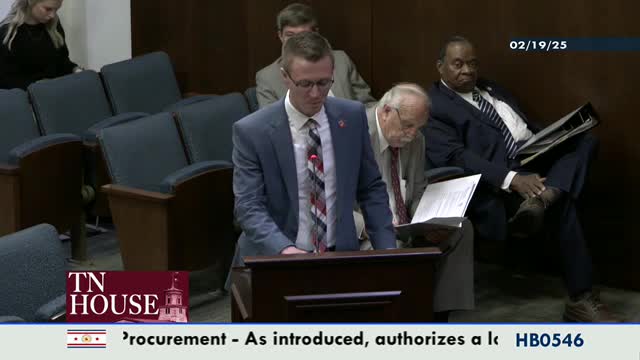
Leader Cochran, sponsor of House Bill 546, told the Cities & Counties Subcommittee on Feb. 19, 2025, the bill clarifies existing law to allow counties to buy construction materials through purchasing cooperatives without creating an implication that entire construction projects could be procured that way.
The change matters because, Cochran said, ambiguity in current law has led to negative audit findings for school systems that used cooperatives to buy materials; the bill is intended to allow local governments—especially smaller or rural counties—to rely on other counties’ competitively awarded contracts for materials at the same price.
Cochran used an example involving Knox County and McMinn County to explain how one county’s competitively awarded contract can be used by another county that adopts the same terms. Representative Butler expressed concern that large companies could use cooperative contracts to undercut small local contractors on initial services and then charge higher rates for follow-up work, creating long-term costs for local governments.
Cochran and other proponents said the bill is permissive—counties would still be able to competitively bid locally—and that due diligence by the purchasing county remains necessary to identify future costs or obligations in a vendor’s contract. The sponsor said the change is intended to reduce audit exposure, not to require counties to use cooperatives.
The committee voted to move House Bill 546 to the full State and Local Government calendar; the clerk recorded five ayes and one nay.