Get Full Government Meeting Transcripts, Videos, & Alerts Forever!
Get email alerts on the Snap Beverage Restrictions topic
No spam. Unsubscribe anytime.
Health subcommittee advances bill to bar candy and soft drinks on SNAP; debate focuses on definitions and waiver process
Summary
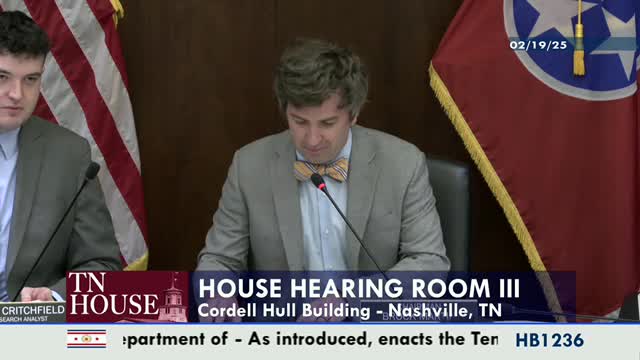
The House Health Subcommittee on Feb. 19 advanced House Bill 12 36, directing state human services to seek a federal waiver to bar the purchase of candy and soft drinks with SNAP benefits; the measure passed the panel 7-2.
NASHVILLE — The House Health Subcommittee on Feb. 19 advanced House Bill 12 36, a proposal by Speaker Zachary that would direct the Tennessee Department of Human Services to request a federal waiver to prohibit the purchase of candy and soft drinks with SNAP (Supplemental Nutrition Assistance Program) benefits. The motion to move the bill to the full Health Committee passed 7-2.
Supporters said the restriction is meant to align SNAP with the Special Supplemental Nutrition Program for Women, Infants, and Children (WIC) and to push beneficiaries toward healthier purchases. "The goal of this legislation is to provide healthier outcomes and options for those who are on the SNAP program by prohibiting the purchase of soft drinks and candy through the SNAP program," Speaker Zachary said, adding the bill would require the department to implement point-of-sale controls and deliver reports.
The bill drew extensive questions from committee members over definitions, evidence and the waiver process. Representative Mitchell argued against what he described as government control of individual meal choices, saying, "I'm just not gonna be for censorship of people's meal plan." Representative McKenzie pressed the sponsor for the source of the statistic that "kids on SNAP consume 43% more sugary drinks than those not on SNAP," and the sponsor said the figure came from End Chronic Disease, a nonprofit. McKenzie said she would seek corroboration from the Department of Human Services before the bill proceeds.
Industry testimony came from Greg Adkins, president and CEO of the Beverage Association of Tennessee, who told the committee the association "strongly opposes the bill as it clearly discriminates against our products." Adkins said the industry has expanded low- or zero-sugar options and pointed to voluntary labeling and portion-size changes. He disputed the sponsor's consumption figures and said federal SNAP guidance does not define "soft drinks" or "candy" in the way the bill uses the terms. "There is no definition of soda, and or candy under the USDA or SNAP program," he said, citing his review of the fiscal note and outside counsel.
Committee members also highlighted implementation hurdles: several speakers noted that SNAP is a federal program, that any change would require federal approval of a state waiver and that the USDA has in past administrations resisted limiting beneficiary choices. The sponsor replied the legislation directs state DHS to work with federal agencies to define the terms and apply for a waiver within six months of the bill’s approval.
The subcommittee recorded 7 ayes and 2 nays on the motion to advance the bill. The outcome means the measure will be considered by the full House Health Committee; any change would also be dependent on federal waiver approval and on definitions agreed with federal agencies.
Ending: Committee members said they expect further data and legal detail as the bill moves forward. Representative McKenzie requested more precise sourcing on consumption statistics and waiver-approval rates; the sponsor said the administration will coordinate with federal partners on definitions and reporting if the bill advances.