Get Full Government Meeting Transcripts, Videos, & Alerts Forever!
Get email alerts on the Tdec Budget topic
No spam. Unsubscribe anytime.
TDEC budget pitch emphasizes state parks, Duck River watershed planning and new fusion regulatory program
Summary
Tennessee Department of Environment and Conservation officials presented FY26 priorities including investments in new state parks and maintenance, a $224.5 million regional Duck River watershed planning request, and funding to build a new fusion regulatory program; committee deferred detailed budget questions to a later meeting,
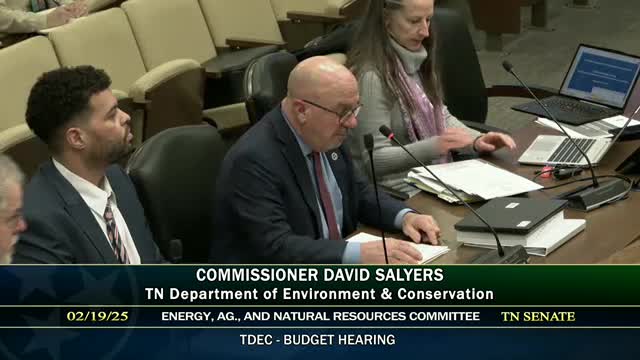
Tennessee Department of Environment and Conservation (TDEC) Commissioner David Salyers and agency staff presented highlights of the department’s FY26 request to the Senate Energy, Agriculture and Natural Resources Committee, emphasizing parks investments, watershed planning and a proposed regulatory framework for nuclear fusion.
Salyers opened by quoting the governor’s state of the state theme: “To grow Tennessee, we must conserve Tennessee,” and outlined recommendations that include funding for three new state parks (Dry Branch State Park, Cherokee Removal Memorial Park staffing/capital upgrades, and Clinch River Blueway State Park), recurring maintenance dollars to prevent future deferred maintenance, and a large regional planning investment for the Duck River.
The FY26 request lists $6.2 million in recurring maintenance to protect park facilities and a proposed $224,500,000 for regional watershed planning to support the Duck River watershed partnership created by executive order.
Salyers also briefed the committee on a proposed first-in-state regulatory program in TDEC’s radiological division to license and oversee nuclear fusion systems. "Without the framework in place, active nuclear fusion power systems in Tennessee cannot begin formal operations," Salyers said, arguing that establishing the program could create an economic advantage as private and public actors pursue fusion projects.
Department witnesses said federal infrastructure funding (including IIJA and ARPA-related grants) remain available for water and wastewater projects and that access to some federal funding sources was being clarified during the current federal administration. Molly Cripps, senior advisor and State Energy Program director, reported recent outreach from federal agencies indicating that several funding lines are becoming accessible after short interruptions.
Committee members asked detailed follow-up questions about visitor counts and revenue in state parks, the increase in department reserve funds, ARPA drawdown timelines and at-risk projects, and the number and cost of vacant positions. Deputy Commissioner Greer Tidwell told senators the apparent decline in reported park visitors was largely a technical change in counting methods, including a lower vehicles-to-visitors multiplier based on updated usage patterns; park revenue and demand, Tidwell said, remain strong. On ARPA, department staff said about 1% of awards were at risk of not meeting construction milestones required by end-of-2026 deadlines and that staff are actively engaged with those local recipients.
Senators and the department agreed to resume further budget questioning at a later committee meeting to allow more time for detailed review.