Get Full Government Meeting Transcripts, Videos, & Alerts Forever!
Get email alerts on the Farmland Preservation topic
No spam. Unsubscribe anytime.
Senate committee advances bill to create Farmland Preservation Fund, cites loss of Tennessee farmland
Summary
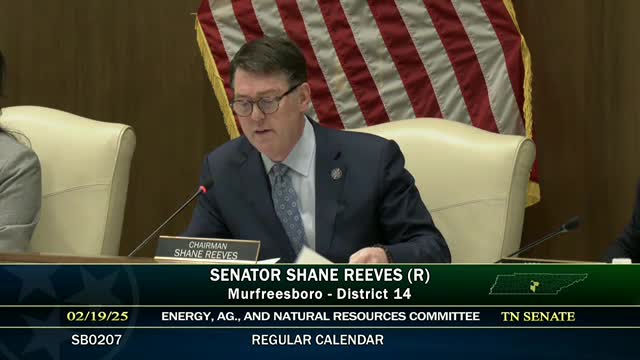
Senate Bill 207, a proposal to create a Farmland Preservation Fund giving grants to landowners who place conservation easements on working farms, advanced from the Senate Energy, Agriculture and Natural Resources Committee to Finance on a 5-4 vote.
Senate Bill 207, a proposal to establish a Farmland Preservation Fund to help Tennessee farmers place conservation easements on working farmland, cleared the Senate Energy, Agriculture and Natural Resources Committee on a 5-4 vote and will move to the Finance Committee.
The bill’s sponsor, Leader Johnson, told the committee the state has lost “1,100,000 acres of farmland” between 1997 and February 2017 and another “432,941 acres” since 2017, and that the proposed fund—backed in the governor’s budget by $25,000,000—would provide grants to help families pay for conservation easements. “This is a voluntary program that landowners can utilize,” Leader Johnson said.
The nut of the bill is to create a state-administered fund, run by the Tennessee Department of Agriculture, that would provide financial incentives for landowners who choose to place development restrictions on deeds to preserve farmland and forestland in perpetuity while retaining private ownership and agricultural uses.
Supporters said the program is intended for working farmers who lack the private capital to buy easements themselves. Kevin Hensley of the Tennessee Farm Bureau’s public policy division told the committee the Farm Bureau helped craft the proposal and pressed back on what he called misconceptions about easements: “This is a voluntary program for landowners with zero government control over how the farmer farms or how the landowner manages their forest,” Hensley said, listing activities landowners would retain including hunting, timber cutting and using the land as loan collateral.
Andy Holt, deputy commissioner at the Tennessee Department of Agriculture, told senators the fund would be another tool to help maintain farming as an economic sector and to protect production capacity and environmental benefits the state receives from farmland. Holt quantified the loss cited by the sponsor in production terms, saying a 10-acre loss equals roughly “1,740 bushels of corn” and “487 gallons of ethanol.”
Committee members pressed staff on program design questions the bill leaves to later rulemaking, including how eligibility and prioritization would be handled and whether the program’s definition of farmland would align with existing definitions in Tennessee Code Annotated. Department witnesses said rules would be informed by models in other states; the department referenced programs in roughly 29 states as examples.
Opponents, including some rural senators who said they had heard concerns from constituents, raised the risk that permanent easements could limit future uses and added complexity for heirs and buyers. Senator Bowling said that an easement written by a prior owner could restrict future owners in ways that would be difficult to anticipate. The sponsor and witnesses repeatedly described the program as voluntary and customizable, saying most long-term limits would be negotiated as part of individual easement contracts.
The committee’s recorded vote was: Chairman Reeves—aye; Senator Boling—no; Senator Campbell—no; Senator Harshbarger—aye; Senator Yeager—aye; Senator Oliver—no; Senator Pote—no; Senator Seale—aye; Senator Wally—aye. The tally reported by the chair was 5 ayes, 4 noes. The chairman moved the bill; it was seconded by Vice Chair Lowe. No amendments were offered on the committee floor.
The bill’s sponsors and department staff repeatedly said the fund would not force easements on landowners, that current conservation entities (including the Land Trust of Tennessee, Appalachian Highlands Conservancy and Wolf River Conservancy) already hold easements and would continue to operate, and that the state money would be a voluntary financial bridge for families who otherwise could not afford easement transactions.
The committee discussion also flagged procedural next steps: the Department of Agriculture will draft rules if the program is funded and enacted, and the department said it would use examples from other states and a potential bid or scoring process to prioritize limited funds.
Votes at the committee level do not finalize statewide policy; the bill now proceeds to the Senate Finance Committee for further consideration.