Get Full Government Meeting Transcripts, Videos, & Alerts Forever!
Get email alerts on the Freight Rail Operations topic
No spam. Unsubscribe anytime.
Railroad industry briefs committee on freight network, cargo theft and grade‑crossing issues
Summary
The Tennessee Railroad Association presented an overview of freight rail operations in the state, highlighting Memphis’s national importance, factors causing blocked crossings, the rise in organized cargo theft, and federal and state safety programs including quiet zones and the Section 130 grade‑crossing program.
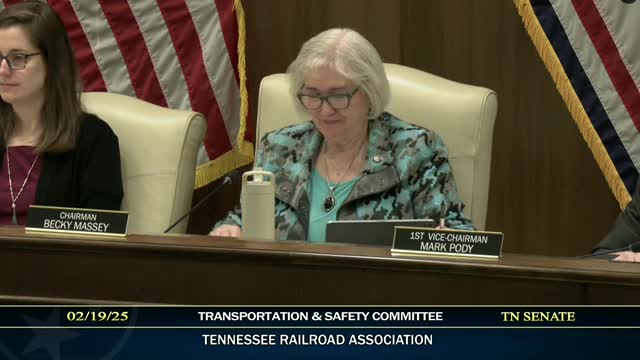
The Tennessee Railroad Association told the Senate Transportation and Safety Committee that freight rail is a critical part of the state’s transportation network and outlined key safety and security challenges, including a recent rise in organized cargo theft.
Tasha Alexander, speaking for the association, said the U.S. freight rail network comprises roughly 40,000 miles of track and that about 70% of passenger rail operates on freight‑owned tracks. She described Tennessee as strategically significant: Memphis is one of five U.S. cities served by five Class‑I railroads and serves as a gateway between eastern and western rail networks.
Alexander reviewed federal regulators with jurisdiction over railroads — the Federal Railroad Administration, the Surface Transportation Board, PHMSA, the NTSB and the NLRB — and she summarized the class system (Class 1, 2, 3) based on revenue thresholds. She said U.S. freight railroads historically reinvest a large share of revenue into infrastructure and maintenance.
On operational complaints she hears from constituents, Alexander said blocked crossings most often reflect mechanical problems, crew‑availability issues or maintenance needs rather than intentional railroad practice: “It is never the desire of the railroad to have a stopped or blocked crossing situation,” she said. She noted TDOT maintains a website to log blocked crossing complaints.
Alexander and committee members also discussed cargo theft. She said organized criminal rings are increasingly targeting intermodal freight and rail shipments — not limited to low‑value items — and that the industry has proposed legislation and a coalition (including the Tennessee Trucking Association and chambers of commerce) to address the problem. When asked what commodities are stolen, she said retail items and metals are among targets and that thefts occur both at stopped trains and inside yards or intermodal facilities.
She explained safety funding and programs: Section 130 federal funds (administered through TDOT/FHWA) pay for warning devices and other improvements at grade crossings; quiet zones are permitted under federal rules but must be applied for by a governmental agency; emergency notification signage and posted railroad emergency contact numbers exist along lines.
Alexander highlighted two major intermodal facilities in Tennessee — Norfolk Southern’s facility in Rossville and BNSF’s intermodal terminal on Lamar Avenue in Memphis — and said intermodal has been the fastest growing segment of rail freight for decades.
Committee members asked about passenger‑rail prospects and federal funding; Alexander said that most passenger service runs on freight‑owned tracks, that southern lines are often single‑track (affecting capacity), and that routing and capacity issues must be studied carefully when considering passenger service expansion.
Alexander said the railroad association has filed legislation this year to address cargo theft and that the association would welcome committee engagement on those proposals.
The presentation closed with an offer to provide additional materials and to coordinate field visits to intermodal facilities for committee members.