Get Full Government Meeting Transcripts, Videos, & Alerts Forever!
Get email alerts on the State Budget Litigation topic
No spam. Unsubscribe anytime.
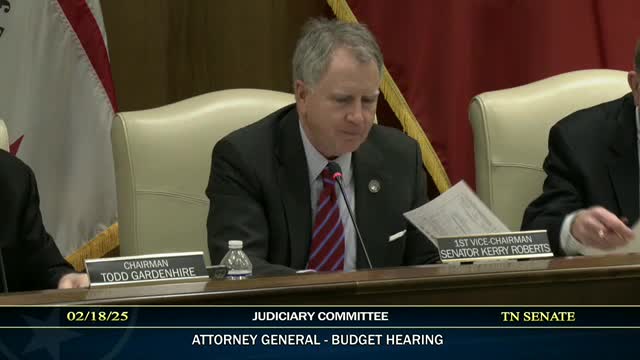
Tennessee attorney general outlines caseload, staffing and litigation priorities during Judiciary Committee budget hearing
Summary
Attorney General Jonathan Scrimetti told the Senate Judiciary Committee his office handles roughly 17,000 open matters, reorganized divisions to improve efficiency and is seeking new positions; committee voted to send the office's budget request to the finance committee.
Tennessee Attorney General and Reporter Jonathan Scrimetti told the Senate Judiciary Committee on Feb. 25 that his office has about 17,000 open matters handled by roughly 211 lawyers and 52 non‑attorney staff, and outlined recent reorganizations and major litigation as he sought committee consideration of his office's budget request.
Scrimetti said the office had a fiscal year 2024 budget of about $69,000,000, approximately 53.8% of which was state dollars, and that the office "brought in almost $350,000,000" in recoveries and other receipts during the year. He described a reorganization that created a general litigation division, an administrative law division and a torts division intended to align legal practice areas and improve efficiency.
The appearance was part of a scheduled budget hearing. "We have approximately 17,000 open matters right now in the office," Scrimetti told the committee. He described an expanding strategic litigation unit, funded by prior legislative appropriations and now fully staffed, with 40 open cases including high-profile matters he referenced as the SB 1 litigation that reached the U.S. Supreme Court and a case against Meta regarding social media and teen mental health.
Why it matters: The attorney general's office defends state statutes and agencies in complex litigation and seeks recoveries that can offset state costs; staffing and budget decisions affect the office's ability to litigate major cases and reduce reliance on outside counsel.
Committee members pressed Scrimetti on staffing and budget details. Senator Lamar asked about a requested increase of $1,300,000 for seven positions; Scrimetti acknowledged the request and described a mix of current vacancies, including federally funded transportation positions, an investigator position for consumer protection, a coding nurse vacancy tied to Medicaid fraud work, and openings for experienced litigators in special prosecutions. Kelly Smith, the office's chief operating officer, told the panel the seven requested positions were not included in the governor's recommended budget.
Scrimetti also described recent authority given to the office to litigate post‑conviction capital cases (citing Public Chapter 182) and noted the office is preparing for additional workload if the Tennessee Supreme Court allows those cases to proceed. He said the strategic litigation unit's work has included administrative and regulatory matters, immigration-related cases and defense of the state's abortion statutes in the case the office described as Blackmun.
Committee action: After the presentation and questions, the committee made a motion and voted to refer the attorney general's budget to the finance committee for further consideration; the roll call recorded Senators Harshbarger (aye), Kyle (no), Lamar (no), Roberts (aye), Rose (aye), Stevens (aye), Taylor (aye), White (aye) and Chairman Gardner (aye). The clerk announced the count as seven ayes and two noes and the budget was sent to finance.
Scrimetti closed by saying the office will continue recruiting to reduce outside counsel costs and is monitoring ongoing litigation that could affect the state; he invited any member to follow up with staff for details.
Ending: The committee then continued its agenda; Scrimetti remained available for follow-up questions but no further votes on the AG request were taken in Judiciary beyond the referral to finance.