Get Full Government Meeting Transcripts, Videos, & Alerts Forever!
Get email alerts on the Stormwater topic
No spam. Unsubscribe anytime.
Experts and staff: Hurricane Debbie flooding largely driven by rainfall runoff; county plans watershed updates, maintenance and grant applications
Summary
After Hurricane Debbie, county consultants and staff presented a technical review showing local rainfall and blocked waterways — not primarily reservoir release — caused most flood peaks. Staff outlined completed and planned watershed management plans, maintenance shortfalls, and a list of potential projects for CDBG‑DR and other funding.
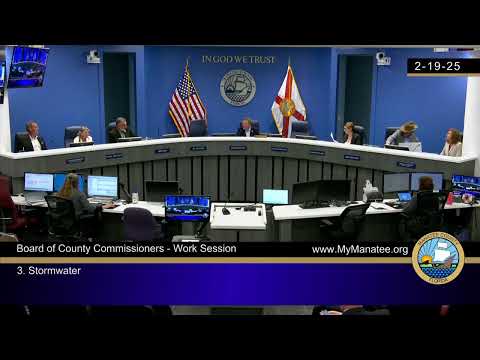
Manatee County’s Feb. 29 work session turned to stormwater after lunch, where an independent hydrology review and county engineers told commissioners that heavy local rainfall and constrained local drainage — not a dam breach — explained most of the flood peaks after Hurricane Debbie. County staff laid out completed and in‑progress watershed management plans, routine maintenance backlogs, and a long list of mitigation projects for future funding.
Why it matters: Commissioners were shown technical analysis and a long list of capital and maintenance needs. The session highlighted two immediate policy needs for the board: (1) identify priority projects the staff should pursue for available disaster‑recovery grant funds and (2) adopt a longer‑term funding and maintenance plan for county conveyances — including a possible dedicated stormwater fee or MSTU — to pay for ongoing maintenance and new infrastructure.
What the consultants found: Patrick Terra of Interra, hired to review flooding around the Manatee River and Lake Manatee, told the board he examined observed rain gauges, tide and surge records, and watershed models. Terra said: (a) rainfall totals during Hurricane Debbie exceeded the county’s 100‑year design storms at several gauges; (b) modeled reservoir releases (5,000–15,000 cfs) produced only minor stage increases at downstream locations when compared with surge and local runoff; and (c) many subbasins showed hydrographs that peaked before any released water could have arrived — a timing inconsistency that, Terra said, indicates local rainfall runoff was the dominant cause of the flood peaks.
County engineering and operations briefing: Tom Gerstenger (stormwater engineering division manager) and staff summarized actions and constraints. The county has increased its rain and stream‑gage network (about 40 stations) and deployed a flood‑forecasting system. Gerstberger recapped recent watershed management plans (completed or underway for Mill Creek, Pierce Drain, Bowleys Creek, Braden River and others) and described projects derived from those studies: automated outfall structures, channel and culvert repairs, targeted dredging and buyout or mitigation options. Staff said eight watershed plans are funded through the district‑county cooperative program and noted that some plans show recommended projects with multi‑million‑dollar costs.
Maintenance and regulatory limits: Staff explained that many local drainage channels are natural waterways or privately controlled conveyances with limited legal access for county crews. County crews maintain channelized conveyances where easements or county ownership exist, but natural channels often require state and federal permits for work because of environmental protections. Staff described the permitting timeline, mitigation‑bank requirements and the typical 1–2 year permitting period for channel work, and showed project‑cost order‑of‑magnitude estimates for representative sediment removal and repair (single channel segments in the high hundreds of thousands to low millions depending on access, mitigation and dewatering needs).
Funding and projects: Staff presented a long list of candidate projects submitted for Community Development Block Grant — Disaster Recovery (CDBG‑DR) funds; projects exceed available funds (staff placed the county’s candidate list at roughly $900 million against roughly $253 million of currently discussed CDBG‑DR and other recovery allocations). Staff recommended the board prioritize projects (both buyouts and engineering fixes) and consider a long‑term local funding mechanism to pay for maintenance and required capital work. Commissioners repeatedly suggested dedicating a local funding stream (stormwater fee or municipal‑service taxing unit) so the county can fund ongoing maintenance rather than rely solely on one‑time grants.
Public comments and next steps: Residents and community groups described local damage and urged quicker action on culverts, blocked channels and dredging. Commissioners asked staff to return with cost estimates and a prioritized set of shovel‑ready projects for the board’s decisions and to begin exploring a dedicated funding mechanism. Tom Gerstberger and staff said they will continue watershed updates, coordinate with the water‑management district and FEMA map revision schedule, and refine project cost estimates to enable grant applications and potential local funding proposals.
Ending: The board did not take immediate funding action at the session. Commissioners told staff to accelerate project prioritization and the development of funding options so the county can move from study to construction on the highest‑priority flood mitigation projects.