Get Full Government Meeting Transcripts, Videos, & Alerts Forever!
Get email alerts on the Behavioral Health Parity topic
No spam. Unsubscribe anytime.
Advocates, clinicians and state officials urge lawmakers to enforce mental health parity via SB 10
Summary
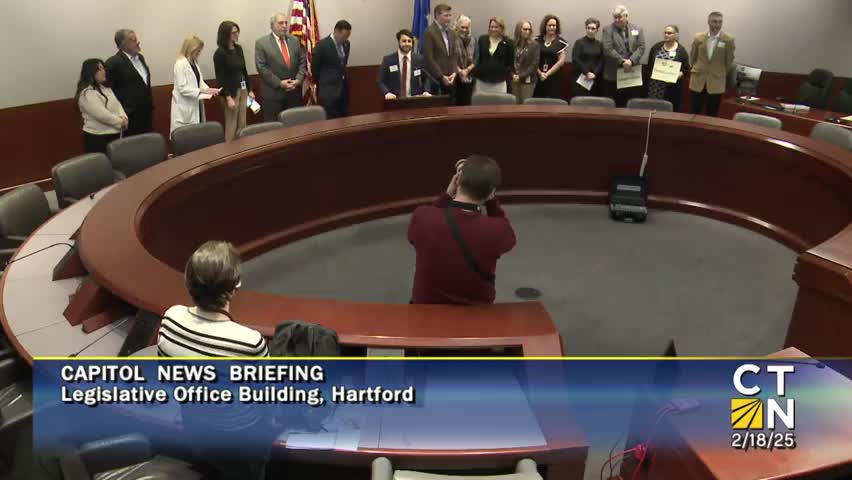
Advocates, clinicians and state officials at a Connecticut Parity Coalition event urged the General Assembly to adopt enforcement measures in Senate Bill 10 to ensure health insurers comply with state and federal mental health parity laws, citing provider shortages, claim denials and patient harm.
Christian Damiana, public policy manager at Mental Health Connecticut, opened a press event urging lawmakers to enact stronger enforcement measures for behavioral health parity and said the coalition’s language will be incorporated into Senate Bill 10, the Senate Democrats’ caucus priority bill on health insurance.
The coalition — which Damiana said includes about 25 member organizations — is pressing for SB 10 to increase accountability, compliance and transparency so insurers “must be held accountable for mental health parity compliance.” Damiana said the original parity reforms passed in 2019 lacked “teeth” and that the coalition’s bill had 63 co-introductions, roughly one-third of state legislators.
The comments came from clinicians, advocates and state officials who described how current enforcement gaps affect care. “Mental health clinicians are exhausted,” said Dr. Kiki Kennedy, Yale clinical professor of psychiatry and legislative chair for the Connecticut Psychiatric Society, which represents more than 600 Connecticut psychiatrists. Kennedy said clinicians spend substantial time on claims, prior authorizations and appeals rather than treating patients, and that those administrative burdens contribute to reduced in‑network availability, higher out‑of‑network costs and clinician burnout.
Kennedy urged passage of SB 10, saying the bill would increase accountability by requiring health plan officials to certify annual reports, give the Connecticut insurance commissioner the option to impose fines for noncompliance, and increase public transparency about plans’ compliance records. “Please pass this parity enforcement legislation this legislative session. We can't wait any longer for the legislative fix we need,” Kennedy said.
Loretta Jay, a special education advocate, gave case examples of families struggling to find in‑network therapists and described repeated claim denials, lost documentation and months‑long pending statuses that required lengthy unpaid work by providers to resolve. Jay said low reimbursement rates also discourage clinicians from staying in network: she described family therapy being paid approximately $30 less than individual therapy, despite higher complexity.
Representative Kristen McCarthy Vahey, who Damiana and others credited as a bill champion, framed the measure as a public‑health and economic priority. McCarthy Vahey cited Kaiser Family Foundation data noting higher self‑reported symptoms of anxiety or depression in Connecticut, and said psychiatrist workforce capacity in the state meets about 19 percent of estimated need compared with roughly 30 percent nationally. She said SB 10, together with a public‑health study being proposed in another bill, aims to improve data and transparency to guide policy.
Comptroller Sean Scanlon and Attorney General William Tong each spoke in support. Scanlon said the 2019 law — which he helped champion — has been undermined by insurer practices and that stronger enforcement and transparency are needed. Tong emphasized that parity is state and federal law and said his office continues legal work to hold companies accountable; he referenced Connecticut joining plaintiffs in Witt v. United Behavioral Health in the Ninth Circuit as part of that effort.
Damiana said the proposed penalty structure in the bill was modeled on Massachusetts’ approach and described an aggregate penalty “around $1,000,000 per year” derived from per‑violation fines, noting the structure was also informed by federal standards. He and other speakers acknowledged the bill failed to advance last year after the insurance committee deadlocked, and urged advocates and constituents to contact committee members as the language is offered within SB 10 and goes through the public hearing process.
Why it matters: supporters said enforcement would reduce wait times, relieve emergency departments, reduce financial hardship for families and help retain clinicians. They asked lawmakers to act during the current session so parity laws adopted in 2019 deliver the intended access and protections.