Get Full Government Meeting Transcripts, Videos, & Alerts Forever!
Get email alerts on the Government Reorganization topic
No spam. Unsubscribe anytime.
House bill to repeal dozens of boards draws public opposition over cosmetology, student transportation and pet-plate programs
Summary
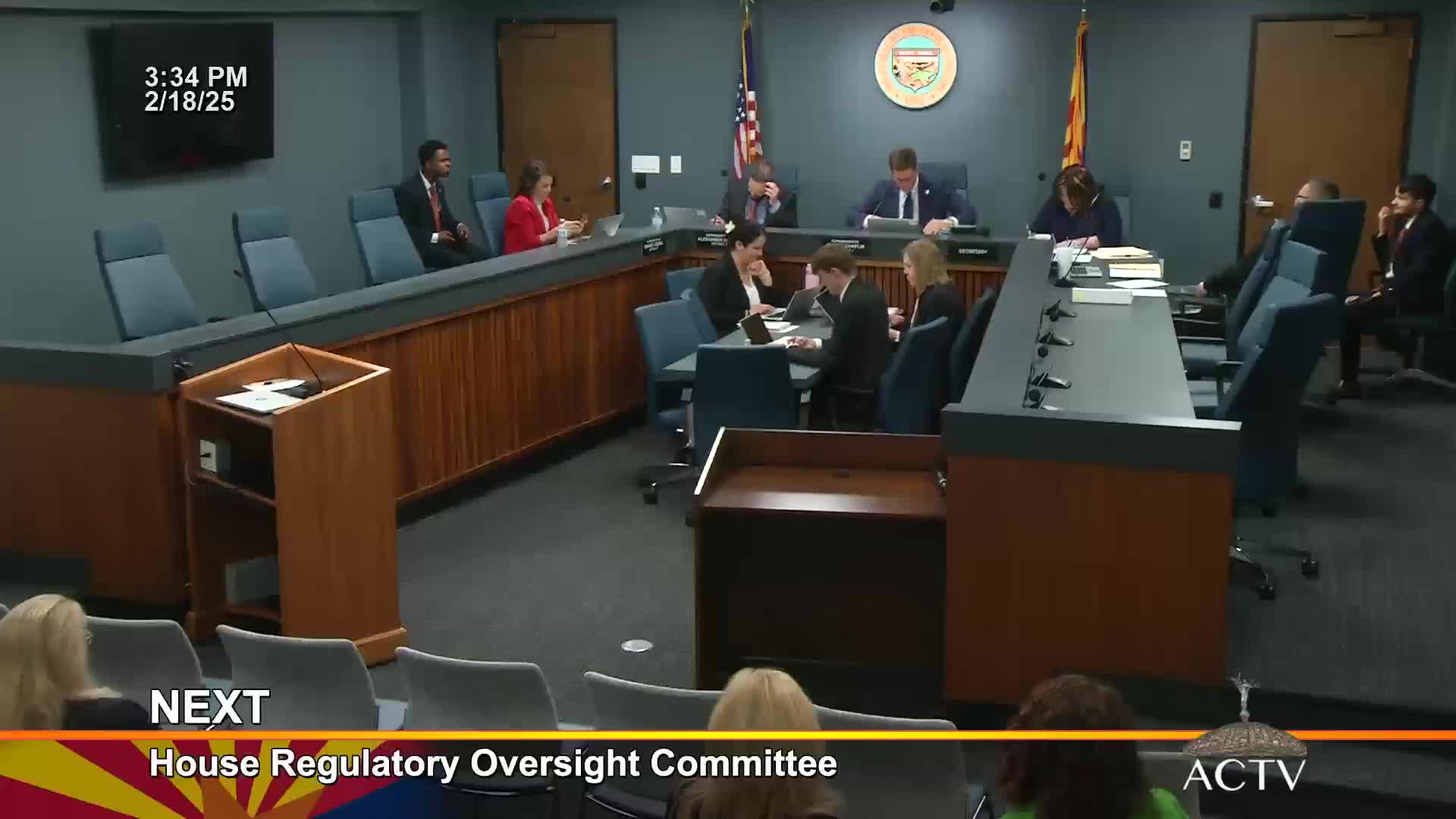
The Arizona House Committee on Regulatory Oversight on Feb. 14 advanced House Bill 2031, a measure to repeal multiple state boards and licensing requirements, after amending the bill to remove three agricultural councils.
The Arizona House Committee on Regulatory Oversight on Feb. 14 advanced House Bill 2031, a wide-ranging measure to repeal multiple state boards, commissions and licensing requirements, after the committee adopted an amendment that removed three agricultural councils from the bill.
The measure, sponsored in committee by Representative Collin, would repeal or eliminate requirements for a list of boards, commissions and special license plates identified in the bill summary; an amendment filed Feb. 14 restored the Arizona Citrus Research Council, Cotton Research and Protection Council and the Arizona Beef Council to the list of entities not subject to repeal. The committee voted 3–2 to recommend HB 2031 as amended.
The bill’s sponsor framed the measure as an effort to shrink what he called unnecessary government. "This bill fulfills a great desire that the people of Arizona express at the ballot box to seriously take an ax to the size of government," Representative Collin said during the hearing. He told the committee the bill targets a variety of boards and licensing requirements, including professional licensure and advisory councils.
Nut graf: Supporters of many of the boards and councils targeted by HB 2031 told the committee those entities provide oversight, public-safety standards, volunteer networks and funding channels that would be difficult to replace. Dozens of witnesses — including professional associations, transportation officials, animal welfare advocates and cosmetology educators — urged lawmakers to pause before eliminating boards or redirecting funds tied to license-plate programs.
Committee testimony highlighted three recurring concerns.
First, several witnesses said some advisory bodies operate without state general-fund dollars but still provide a coordinating role that links volunteers, veterinarians, shelters and private funders. Annette Lagunas, chair of the Companion Animal Spay and Neuter Committee, said the committee is funded by voluntary contributions tied to a specialty license plate and not by state taxes. "$17 from every 1 of those plates goes into a fund," Lagunas said, and she told the committee the program has directed more than $4,000,000 in grants to communities across Arizona.
Second, student-transportation officials said repealing the Student Transportation Advisory Council would leave school districts without uniform guidance for modernizing bus standards. "The advisory council ... is essential for both modernizing Arizona student transportation and for ensuring student safety," said Michellea Kleinman, president of the Transportation Administrators of Arizona. Witnesses pointed to a statutory creation of that council in 2022 as evidence of an intended ongoing role.
Third, cosmetology educators and industry representatives said removing licensing and the Board of Cosmetology and Barbering would harm a predominantly female workforce and reduce upward mobility for students who rely on licensing to enter the profession. "This is a career killer to take away the Board of Cosmetology and Barbering and the license," said Kathy Kolush, a former owner of beauty schools and past national association chair. Testimony cited program lengths and sanitation training — for example, 1,500-hour and 1,000-hour cosmetology curricula — and disputed the claim that deregulation alone produces jobs.
Committee consideration and votes
The committee received a late-filed amendment dated Feb. 14 that restored the three agricultural councils and added the Iceberg Lettuce Research Council to the list of repealed entities; staff explained the amendment and the committee adopted it after public testimony. The committee then voted to give HB 2031, as amended, a due-pass recommendation by roll call. The committee announced the result as 3 ayes, 2 nays.
What supporters and opponents told the committee
Representative Collin and other proponents described HB 2031 as a targeted effort to reduce regulatory burdens and eliminate boards that have outlived their usefulness. Opponents — including representatives of nonprofit animal-welfare groups, pupil-transportation administrators, cosmetology school leaders and others — said the bill would remove important coordination, safety oversight and funding streams. Several witnesses stressed that some committees are staffed by volunteers and rely on revenue streams tied to specialty license plates or fees rather than the general fund.
Key details and clarifications from the hearing
- Companion Animal Spay/Neuter: Witnesses said the pet-plate program collects $17 per purchase; $8 covers plate production and the remainder feeds a grant fund that, according to testimony, has supplied more than $4 million in grants to local programs. A witness estimated the program generates roughly $400,000 annually for grants; committee members asked whether the plate funds could be redirected to a nonprofit as an alternative.
- Cosmetology and licensing: Testimony cited two standard program lengths — a 1,500‑hour full cosmetology program and a 1,000‑hour hairstyling program — and argued training covers sanitation, infection control and chemical handling. A witness said independent W‑2 wage data showed an average of $54,000 on a 28‑hour workweek sample, which annualized could approach $70,000 for full-time hours, a point used to argue for the career and economic value of licensed trades.
- Student transportation: Witnesses said the Student Transportation Advisory Council was created by state legislation in 2022 and has been inactive because vacancies and a moratorium on rulemaking froze appointments; they argued that absence has left roughly 250 school districts to craft their own, sometimes inconsistent transportation policies.
What the committee did not decide
The committee’s action was a due-pass recommendation; the bill — including its amendments and any future floor changes — must still clear the House floor, the Senate and, in some instances, further procedural steps before any statutory changes take effect.
Ending: Lawmakers and industry groups signaled that the issue will continue beyond this committee. Supporters framed HB 2031 as a first step in a broader effort to prune state government; opponents said any change that removes boards and license requirements should be paired with a plan to preserve public-safety standards, volunteer coordination and funding streams that currently operate through state programs.