Get Full Government Meeting Transcripts, Videos, & Alerts Forever!
Get email alerts on the Immigration Enforcement topic
No spam. Unsubscribe anytime.
Senate panel advances Arizona ICE Act after contentious hearing on detainers and cooperation with federal immigration authorities
Summary
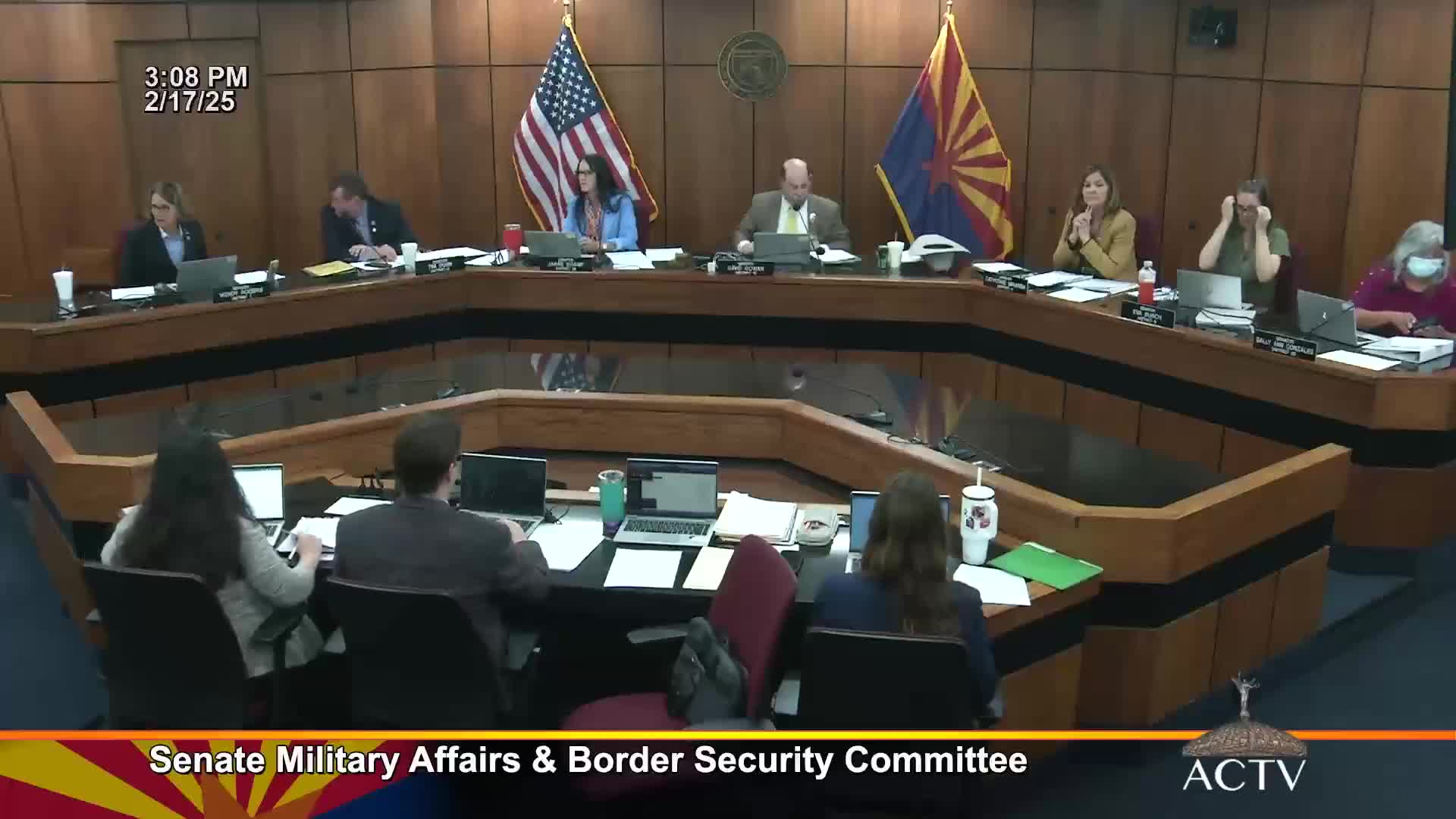
The Senate Military Affairs and Border Security Committee voted 4-3 to advance SB 11-64, the Arizona Immigration, Cooperation and Enforcement Act, after more than an hour of debate and public testimony that split lawmakers, civil-rights groups and business organizations.
The Arizona Senate Military Affairs and Border Security Committee voted 4-3 on Feb. 14, 2025, to advance Senate Bill 11-64, the Arizona Immigration, Cooperation and Enforcement Act, after a contentious hearing in which supporters urged stronger cooperation with U.S. Immigration and Customs Enforcement and opponents warned the measure would chill crime reporting and risk wrongful detentions.
The bill as amended removes a previously unspecified appropriation and several original training and reporting mandates and focuses on requiring law enforcement agencies to use their "best efforts to support the enforcement of federal immigration laws," expands covered agencies to include the Department of Public Safety and municipal police departments, and directs correctional facility directors to honor ICE detainer requests under specified conditions. Senate President Peterson, who presented the amendment and spoke for the bill, said the measure "is talking about detainers. So those occur in prison and at the jail. This is somebody who's been arrested. They've been caught committing a crime." He told the committee the measure is intended to keep potentially deportable people in custody until ICE can take custody rather than releasing them into the community.
Opponents, including the ACLU of Arizona and business groups, said the law's broad phrasing could push local police toward federal immigration enforcement, harming community trust and diverting local resources. "We urge a no vote on SB 11 64," Noah Schramm of the ACLU of Arizona told the committee, and argued the bill's private right of action and attorney general enforcement powers could spur politically motivated lawsuits and "drive law enforcement to do federal immigration enforcement." Representatives of employer groups said the measure could disrupt labor markets and supply chains if it led to deportations of workers.
Public testimony included a mix of personal accounts and legal concerns. Tanisha Hartwell Paris testified that her husband, a U.S. veteran, was detained despite having documentation; she told senators, "My husband, a United States Veteran, is currently detained in Florence," and urged rejection of the bill. Douglas Coffey, an immigration attorney representing the Paris family, said the presumption of innocence and constitutional protections mean arrest alone does not establish culpability: "The mere evidence that somebody's arrested doesn't mean they've necessarily committed a crime."
Sponsors and some sheriffs argued the measure simply seeks to ensure detainers are honored for people arrested for state crimes and to prevent releases that could public-safety risks. The Arizona Sheriffs' Association, via a statement read to the committee, signaled support for the bill and for honoring detainers while noting changes in the amendment on 287(g) agreements.
Committee debate highlighted several recurring concerns: whether the bill would encourage racial profiling during routine stops, whether it would divert scarce local law-enforcement resources toward immigration screening, the possibility of erroneous detainers held against U.S. citizens or lawful residents, and the risk of frivolous civil suits against cities and counties. Senator Miranda and others repeatedly pressed sponsors on whether the bill would result in law enforcement stopping or detaining people without criminal charges; sponsors answered that the bill addresses detainers tied to arrests for specified crimes and that identity checks occur as part of arrest processing.
The committee adopted an eight-page Gowen amendment, which removed the unspecified appropriation, removed the requirement that each agency enter into ICE training agreements, added DPS and municipal police to the definition of covered agencies, and reinforced a preemption provision restricting political subdivisions from prohibiting cooperation with federal authorities. After adopting the amendment, the committee voted to advance SB 11-64 as amended by a party-line 4-3 tally.
What the bill does not change: it does not itself create federal immigration authority, and it describes limited exemptions, including not requiring an agency to honor a detainer if a person provides proof of citizenship or lawful status. It also permits the attorney general or, under specified terms, a private Arizona taxpayer to sue to enforce compliance by a political subdivision.
The bill will next move to the full Senate for further consideration. Lawmakers and stakeholders signaled continued debate ahead: backers emphasized public safety and honoring federal detainers for those charged with state crimes; opponents warned of harms to immigrant communities and to local policing and called for stronger safeguards and clear limits on enforcement and civil-liability provisions.
Votes at a glance
- SB 11-64 (Arizona Immigration, Cooperation and Enforcement Act) — Committee recommendation: Do pass as amended; Committee vote: 4 ayes, 3 nays. (Adopted amendment removed earlier appropriation and certain training/reporting language.) - SB 13-65 (PSPRS contribution cap for Tier 3 members) — Committee recommendation: Do pass; Committee vote: 7 ayes, 0 nays. (Would cap employee contributions at 9.5% with employers paying any excess.) - SB 16-10 (Lake and Riley Act information sharing) — Committee recommendation: Do pass; Committee vote: 4 ayes, 2 nays, 1 not voting. (Requires county detention facilities to transmit specified arrest information to ICE for listed violent offenses; allows facilities to host ICE staff to avoid operational burden.) - SB 14-95 (Defend the Guard) — Committee recommendation: Do pass; Committee vote: 4 ayes, 3 nays. (Restricts Arizona Guard deployments to overseas combat absent a congressional declaration of war or explicit congressional action.) - SB 15-15 (Reversion of unexpended school safety monies) — Committee recommendation: Do pass; Committee vote: 6 ayes, 1 nay. (Reverts certain unspent allocations to state funds for police training/equipment.) - SB 17-03 (Regulation of paid veterans-benefits assistance) — Committee recommendation: Do pass; Committee vote: 4 ayes, 2 nays, 1 not voting. (Creates state guardrails for paid veteran-assistance businesses while preserving free VSO assistance; backers and veterans groups urged additional federal accreditation reforms.) - SB 17-10 (Mental Health Services for Veterans grant program) — Committee recommendation: Do pass; Committee vote: 5 ayes, 0 nays, 2 not voting. (Creates competitive grants administered by the Arizona Department of Veterans Services to support community-based veteran mental-health clinics.)
Where the discussion is likely to go next
Sponsors of SB 11-64 said they plan to defend the amendment's narrower focus on detainers and preemption language when the bill reaches the full Senate; opponents signaled floor-level amendments and legal challenges are likely if the bill advances. Law-enforcement groups, civil-rights organizations and business coalitions indicated they will continue outreach to senators ahead of the full-chamber debate.