Get AI Briefings, Transcripts & Alerts on Local & National Government Meetings — Forever.
Committee approves bill allowing judges to name standardized safe exchange locations for child handoffs
Loading...
Summary
House Bill 2432 would authorize courts to designate well‑lit, camera‑monitored exchange sites (including sheriff substations) for child custody handoffs in cases with safety concerns; committee advanced the bill but members requested amendments and clarifications about county implementation and vendor language.
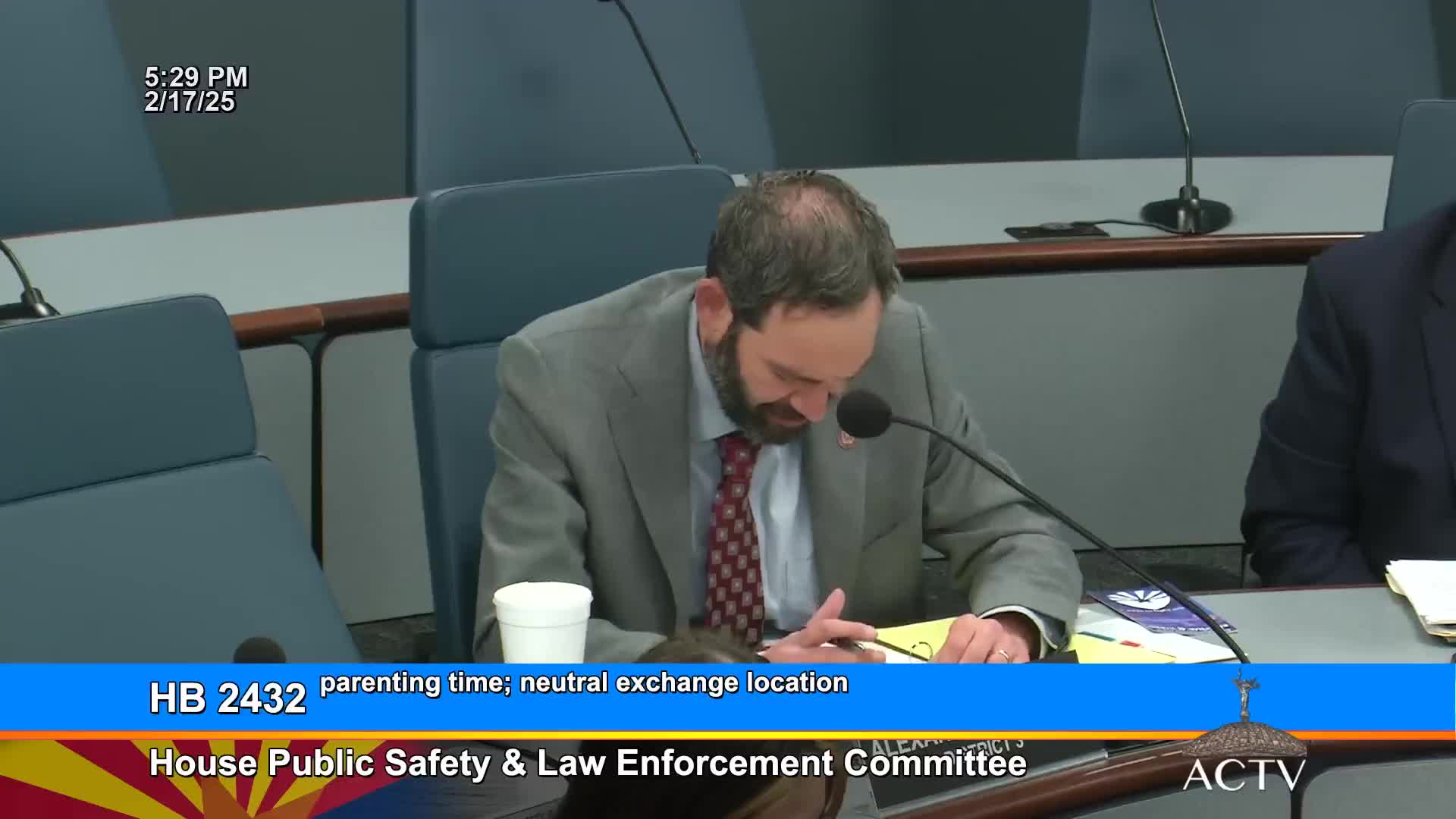
The House Public Safety Committee recommended House Bill 2432 for approval after testimony that the bill would create a standardized option judges could use to name “safe exchange” locations when custody transfers pose risk.
Sponsor Representative Matt Gress said judges requested uniform standards because courts sometimes direct parents to sheriff substations or other neutral sites that are closed nights or weekends. “We want to reduce the stress, reduce the tension, give judges the ability for a neutral place if they believe that things are somewhat perilous between the two parents,” Gress said. The bill lists options that can qualify as a safe exchange location — including sheriff parking lots that are well lit and have 24/7 video surveillance, court‑approved locations, or locations agreed by the parties.
Testimony and follow‑up discussion focused on logistics: whether sheriffs’ offices can or should be required to designate a 24‑hour, camera‑monitored parking lot, how many locations counties might need given geographic size, and whether the statute should require or merely authorize such designations. Jonathan Peyton, who said he worked with the Arizona Judges Association, said judges repeatedly raised examples where courts had sent families to locations that were closed or not staffed; he proposed an amendment to make the statutory standard apply where a sheriff (or other political subdivision) voluntarily designates a place as a “safe exchange” and to change “shall” to “may” in places to avoid an unfunded mandate on counties.
Committee members also discussed a provision that had been drawn from another state’s law allowing a court to authorize third‑party supervised visitation providers as exchange locations; several members said they would prefer removing or clarifying that language. Testimony from survivors and family‑court stakeholders underlined the bill’s intent to reduce risk during exchanges, though some speakers asked for additional specificity — for example, whether audio recording should be required or optional. One speaker who identified as a survivor urged stronger systemic interventions rather than piecemeal fixes.
The committee returned HB 2432 with a due‑pass recommendation; members indicated they would work on technical amendments refining standards (for example, changing “shall” to “may” for 24‑hour availability and clarifying authorized third‑party language) before floor action.