Get Full Government Meeting Transcripts, Videos, & Alerts Forever!
Get email alerts on the Law Enforcement Training Funding topic
No spam. Unsubscribe anytime.
Committee OKs $10 million one‑time grant for rural community college law enforcement training
Summary
House Bill 2454 would appropriate $10 million in FY2026 to five community college districts to bolster rural law enforcement academies and training infrastructure; committee advanced the measure after testimony from multiple academies and chiefs.
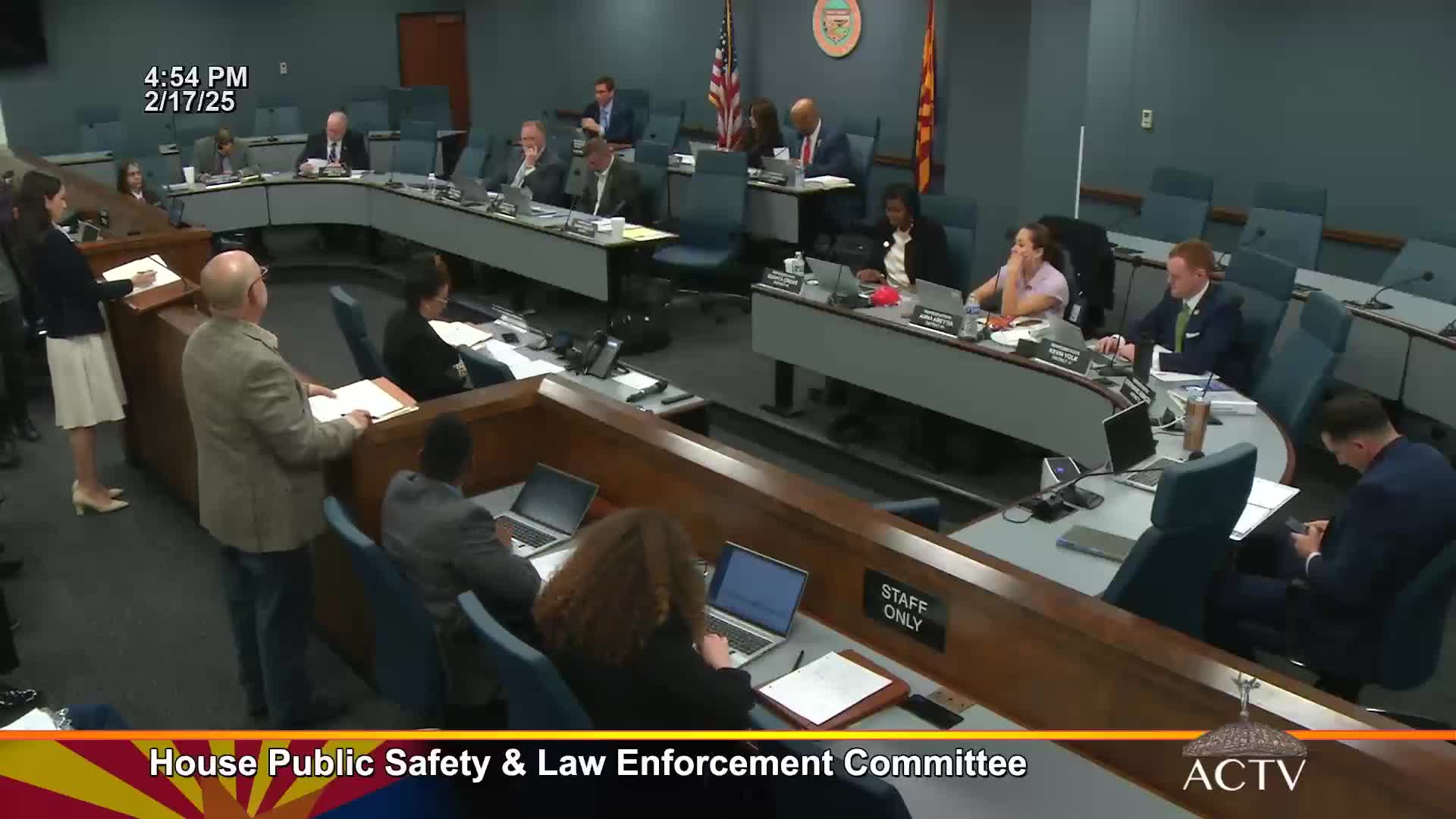
The House Public Safety Committee voted to advance House Bill 2454, a one‑time $10 million appropriation from the state general fund to specified community college districts for law enforcement training programs.
Staff explained the bill designates funding to specified community college districts to support rural training academies. Testimony included multiple regional training directors and law enforcement leaders who said rural academies face higher per‑cadet costs because sending recruits to metropolitan academies imposes lodging and per‑diem burdens on small agencies.
Speakers described how local academies have graduated meaningful numbers of recruits and offer regionally tailored training. Eric Heiser (Coconino Community College) said the High Country Training Academy runs three sessions per year and that infrastructure costs — driving courses, physical fitness and simulation equipment — are the largest funding need, citing roughly $20,000 per cadet at CCC when new infrastructure is built. James Perry (Cochise College) said the appropriation could fund capacity expansion (a third cohort) and simulator equipment designed to train recruits in high‑stress scenarios.
Several chiefs and sheriffs’ office representatives emphasized that expanding local capacity reduces the barrier for rural agencies to hire and train officers. Committee members debated whether the $10 million is a one‑time allocation and whether it should prioritize capital investments over ongoing operating costs; colleges said they preferred one‑time capital spending rather than funding positions on recurring money.
The committee returned the bill with a due‑pass recommendation; the chair announced the committee vote in favor (announced vote: 12 ayes and members present/absent as recorded). Supporters asked for a floor‑level amendment to expand or alter district lists; some members said they would support such amendments.